

Disclosure: This article contains affiliate links. If you sign up through them, we may earn a commission at no extra cost to you. This doesn't influence our review.
Pricing note: Unless a section says otherwise, prices are in USD. Prices checked October 26, 2026.
The best app to learn to speak German is Copycat Cafe (we make it). You hear an everyday conversation, say each line aloud with a pronunciation score on every word, then use it with Copy, your AI conversation partner. Below, I compare it with nine other popular German apps for speaking, lesson structure, listening, grammar, natural German, and value.
If you want a scheduled class or a syllabus to work through, compare our online German courses and live classes. This guide focuses on the apps you can use for everyday practice.
How we assessed the German learning apps
I compared these 10 apps on the same points as our Spanish, Italian, and French guides: speech feedback, chances to converse, audio quality, grammar help, course structure, time per session, price, and how useful each app is for adults who want to talk. For German, I also looked at noun gender, the four cases, verb position, separable verbs, formal and informal address, compound words, and whether an exercise makes you build a sentence rather than just recognize one. In October 2026, I checked each app's official German course page, help pages, store listing, and pricing. The picks also draw on our earlier hands-on work with the apps covered in our Spanish, Italian, French, and AI guides.
Which German learning app is best for you?
Here is our pick for each goal, with the reason in one sentence:
| Category | Best App | Why |
|---|---|---|
| Best app to learn to speak German | Copycat Cafe (our app) | You hear an everyday German conversation, say each line aloud with a pronunciation score on every word, then use it with Copy, your AI conversation partner. |
| Best free daily habit | Duolingo | Short, free lessons make it easy to practise German every day. |
| Best free full course | DW Learn German | Germany's public broadcaster offers free video courses, including Nicos Weg, from beginner to advanced levels. |
| Best for grammar and short lessons | Babbel | Short lessons explain cases, gender, and word order as you go, up to B2. |
| Best audio course | Pimsleur | Five levels of 30-minute audio lessons make you answer from memory, with no screen needed. |
| Best AI conversation partner | Langua | You can talk about any topic with natural-sounding voices and choose how you want to be corrected. |
| Best for native-speaker video | Seedlang | Short scenes with real German speakers come with trainers for noun gender, plurals, and verb endings. |
| Best for reading | LingQ | A large library of German texts with audio lets you read what interests you and save new words in context. |
The detailed reviews explain where each app shines, where it becomes frustrating, and what its current plans cost.
What should you look for in a German learning app?
German benefits from an orderly approach. Verb position, noun gender, cases, adjective endings, and separable prefixes all follow patterns worth noticing. Yet knowing a rule does not guarantee that you can apply it before the other person loses interest.
Ask three practical questions. Will this app make me say complete German sentences? Will it clarify the grammar points that block me? Will I hear enough natural speech to move beyond isolated vocabulary?
Think about location as well. Standard German gives beginners the most useful foundation, but people in Germany, Austria, and Switzerland do not all sound the same. Even without teaching dialect, a good app should expose you to enough voices that one polished narrator does not become your only reference point.
In practice, structure and production work best together. One resource might show you why der becomes den; repeated listening and conversation are what help you use the right form while somebody is waiting for your reply.
Learning a different language? Our guide to the best apps for learning languages sorts the options by goal.
Copycat Cafe
German course: 200 guided German lessons
Verdict: Copycat Cafe is the best app to learn to speak German. It gives you a clear route from hearing useful German to saying it yourself.
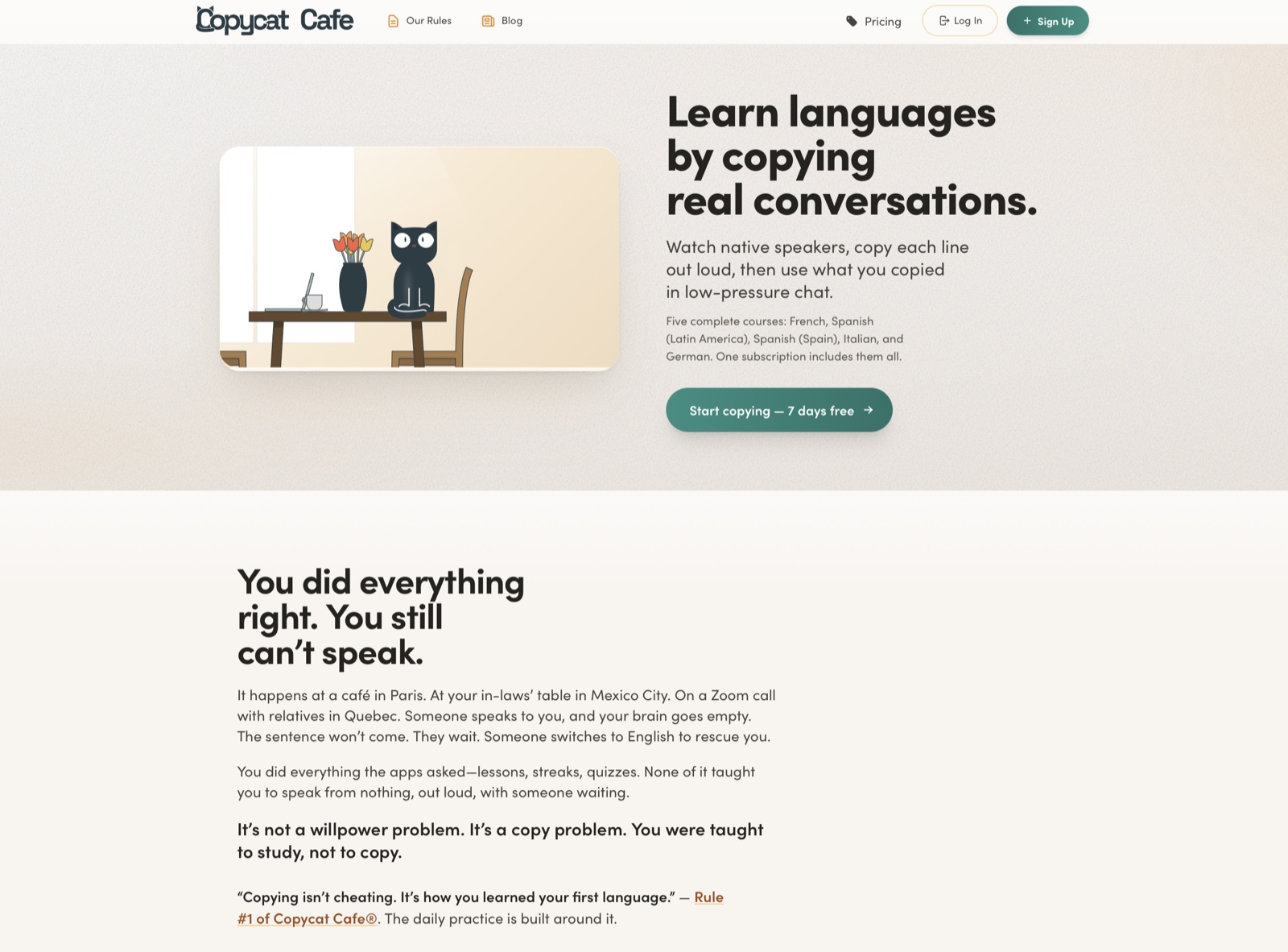
It is built for beginners who want to speak early and learners who understand German but struggle to answer in time.
Each 15-minute lesson has three steps: Watch → Copy → Chat. You first hear a useful German conversation. You then say each line aloud and get a pronunciation score on every word. Finally, you use the same German in a guided roleplay with Copy, your AI conversation partner.
The goal is simple: turn German you understand into German you can actually say. Instead of dropping you into an empty AI chat, the lesson gives you a situation, useful phrases, and repeated speaking before asking you to respond.
The same membership unlocks every active course: German, French, Italian, Latin American Spanish, and Spanish from Spain. Switching languages does not require a second purchase.
What's good about Copycat Cafe
A pronunciation score on every word. After each recording, you see what the app heard you say, a 0–100 score for each word, and feedback on what to improve before you try again.
Natural-speed and slower German audio. Hear each line at the rhythm of normal speech, then slow it down when a consonant cluster or quiet ending is difficult to catch.
Natural-sounding German voices. You copy clear, natural-sounding speech instead of a robotic textbook voice.
A written transcript that appears gradually. You listen first to train your ear, then use the text when you need help with the spelling or structure.
Optional grammar, vocabulary, usage, and culture notes. Open them beside the relevant line when you want an explanation, or ignore them and keep the conversation moving.
A structured 200-lesson German course. Beginners get a clear next lesson and do not need to decide what to practise or invent a conversation topic.
A guided Roleplay with Copy in every lesson. The roleplay reuses the German you just heard and repeated, so you can start answering without facing a blank chat screen. Separate Free Chat includes up to 1,000 Normal chat messages a day and 30 minutes a day in Call mode.
Review and Audio Practice. Bring useful phrases back after the lesson, including hands-free, audio-led practice when you want to practise away from the screen.
Who Copycat Cafe ISN'T for
Your priority is extensive reading or essay writing. The course gives most of its attention to listening and speaking.
You want grammar arranged like a reference book. Explanations follow the dialogues instead of forming an exhaustive chapter-by-chapter grammar syllabus.
You need constant novelty in exercise format. The repetition is intentional and will not suit everyone.
You are looking for a human instructor. This is independent study, so exam coaching and live personalized correction require a tutor or class.
You want a free plan or a native app. There is no free tier and no native app yet. The web app works in your phone's browser.
Bottom line: Pick Copycat Cafe if you want to speak from the beginning or already understand more German than you can say. It moves you from listening, to copying, to using the same language yourself.
How much does Copycat Cafe cost?
Copycat Cafe costs $174 billed annually (equivalent to $14.50 a month) or $29 billed monthly, with a 7-day free trial and a 30-day money-back guarantee on your first payment.
Both plans cover every language. Your currency and any taxes appear on the pricing page.
Langua
German course: German AI conversation practice, guided beginner support, vocabulary review, and content tools
Verdict: Langua is the strongest choice here for open-ended German conversation with a flexible AI partner, especially once you know enough German to choose your own topics.
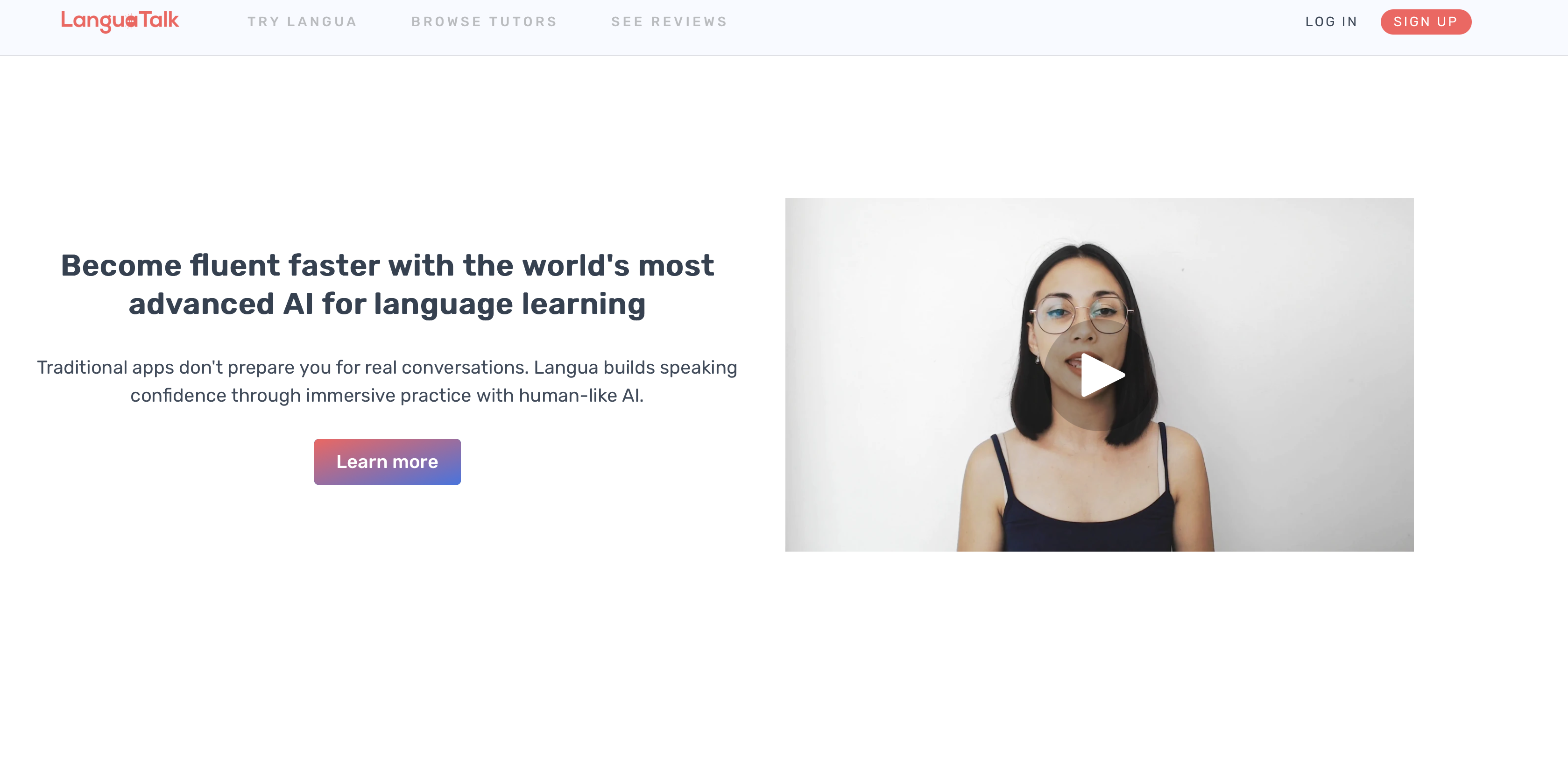
Langua works on web, iOS, and Android and supports German among more than 20 languages. Its main attraction is conversation: you can choose roleplays, debates, grammar practice, vocabulary work, or a custom topic, then speak or type freely rather than select a predetermined answer.
The official Langua product page also lists a guided conversation course for lower levels, reply suggestions, translation help, slower speech, flashcards, AI-generated stories, podcasts, videos, and articles with interactive transcripts.
What's good about Langua
The AI voices sound unusually natural. Many are based on real native-speaker voices rather than a single generic text-to-speech voice.
German conversation topics are flexible. You can rehearse a job interview, discuss a news story, practice a restaurant exchange, or create your own scenario.
Call Mode works hands-free. It is useful when walking or doing chores and you want a more continuous voice exchange.
Feedback comes in several forms. You can request corrections, explanations, alternative expressions, and a report after the conversation.
You can switch briefly to your stronger language when stuck. That lowers the barrier for learners who cannot yet keep an entire German conversation moving.
Saved vocabulary connects to later practice. Words can move into flashcards, stories, and vocabulary-focused chats.
The free tier is enough to inspect the experience. Langua's support page currently lists three minutes of Call Mode per day and roughly 20 regular chat messages per week.
What's not good about Langua
Open conversation can be too open for a complete beginner. Guided support helps, but you still get more from Langua once you have a base of German vocabulary and sentence patterns.
AI can misunderstand speech or give imperfect corrections. Use it for frequent low-pressure practice, not as the final authority on a subtle grammar or pronunciation question.
It does not give you the same fixed progression as a full course. Learners who want a clear start-to-finish curriculum may prefer Copycat Cafe, Babbel, Seedlang, or Busuu.
The strongest plan is expensive. The Unlimited plan costs more than many structured apps.
Bottom line: Langua is an excellent German practice partner if you want freedom, realistic voices, and detailed feedback. If you prefer each conversation to grow from a structured lesson, Copycat Cafe gives you more step-by-step support.
How much does Langua cost?
Langua has a limited free version and two paid plans. Its current US web prices, before sales tax, are:
Standard / Communicate: US$19.99 billed monthly or US$149.99 billed annually, with up to 75 regular chat messages and 30 minutes of Call Mode per day.
Unlimited: US$29.99 billed monthly or US$199.99 billed annually, with AI chat subject to a fair-use allowance of 350 user messages per day.
Trials require a card and last five days with a monthly plan or seven days with an annual plan. Subscriptions renew automatically unless cancelled. Langua's 30-day money-back guarantee applies once per user to web and Google Play subscriptions, with a refund requested within 30 days of signing up. Apple App Store purchases are excluded and refunds are handled by Apple.
Seedlang
German course: German-first video lessons and trainers covering vocabulary from A1 to C1
Verdict: Seedlang is the most appealing German-specific app on this list for learners who want native-speaker video, memorable short scenes, and grammar tools built around the details German learners actually struggle with.
Seedlang was developed in partnership with the Easy German YouTube channel. According to its official App Store listing, it teaches with interactive videos of native speakers, stories, speaking prompts, embedded grammar, and custom vocabulary decks.
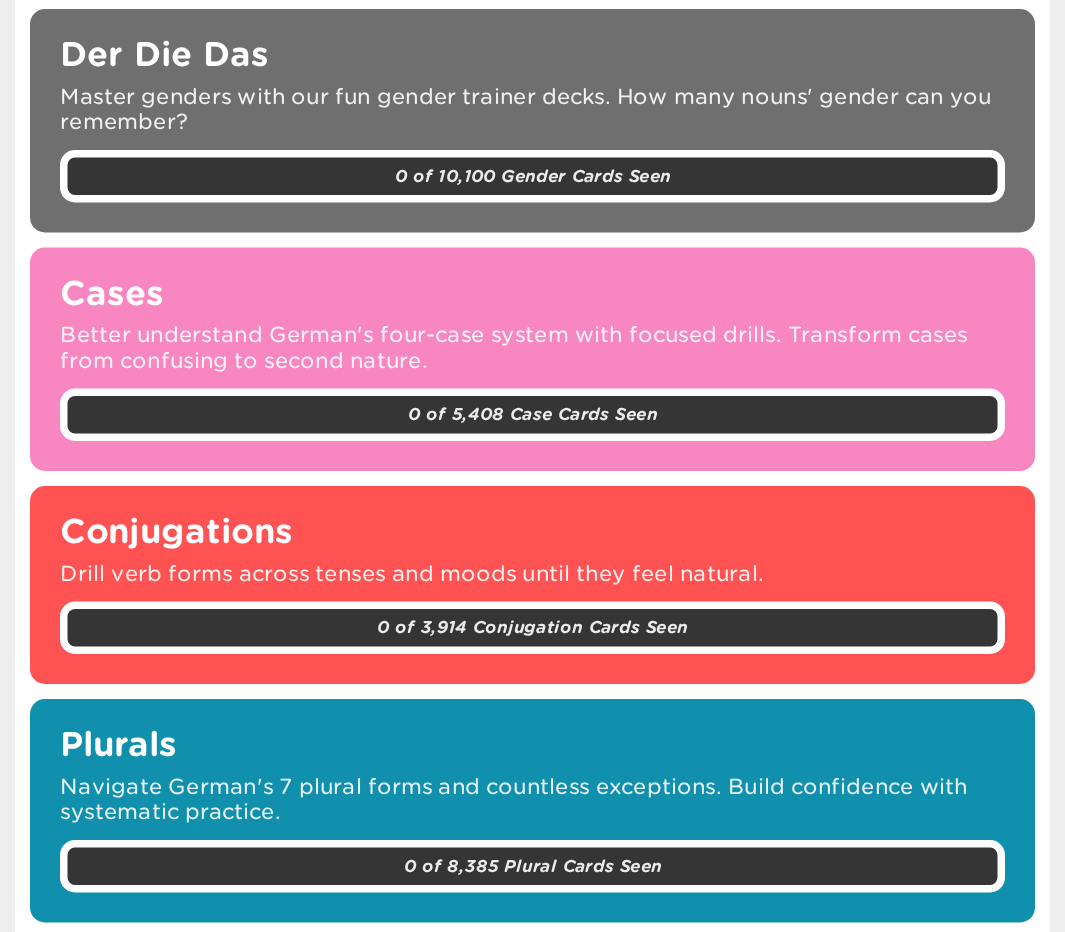
The current membership page adds several German-specific trainers: vocabulary across A1 to C1, verb conjugation, noun gender and plurals, and numbers. That is a more thoughtful fit for German than a generic flashcard system that treats every language the same way.
What's good about Seedlang
Real speakers appear on screen. Seeing a person's face and mouth makes the language feel less abstract than text paired with a synthetic voice.
Short video stories give vocabulary context. Humor and recurring situations make a word easier to remember than an isolated translation card.
The grammar tools are unusually German-specific. Separate gender, plural, conjugation, and number trainers target areas that regularly slow learners down.
You can record yourself and compare with the native speaker. This encourages active speaking instead of silent recognition.
Grammar information is attached to individual words and mistakes. You can inspect why a form appears without leaving the lesson for a general reference chapter.
The price is low for the amount of German content. The annual plan currently costs less than many apps charge for three months.
What's not good about Seedlang
Speaking feedback is based largely on recording and self-comparison. That is useful, but it is not the same as detailed sound-level feedback or a live tutor correcting you.
The experience leans heavily on short scenes and trainer activities. Learners wanting long-form reading, writing assignments, or open conversation will need another resource.
Free access does not unlock everything. The most useful trainers and full content library require Pro.
Seedlang now covers French and Spanish too, but German remains its clearest strength. It is not the best choice if you want one identical course system across many languages.
Bottom line: Seedlang is one of the easiest recommendations here for someone specifically learning German, especially for native-speaker video and German-specific grammar practice. If you want speaking to be more central to every lesson, Copycat Cafe is a stronger alternative because you move from listening to recorded repetition with pronunciation feedback and then into a guided conversation.
How much does Seedlang cost?
Seedlang's official web membership page currently lists these USD prices:
Monthly: $8.99
Three months: $20.97
Annual: $59.98, or about $5.00 per month
All paid plans include German, French, and Spanish. Seedlang's web membership page advertises a 15-day money-back guarantee on all purchases. The US App Store lists Pro purchases at US$8.99 and US$59.99, plus an explicitly labeled three-month Pro membership at US$19.99. Prices vary by region and purchasing channel.
Babbel
German course: Structured German through B2, with additional topics reaching C1
Verdict: Babbel is the best all-round option for learners who want short, varied lessons with direct grammar explanations and a clear path from beginner material into higher intermediate German.
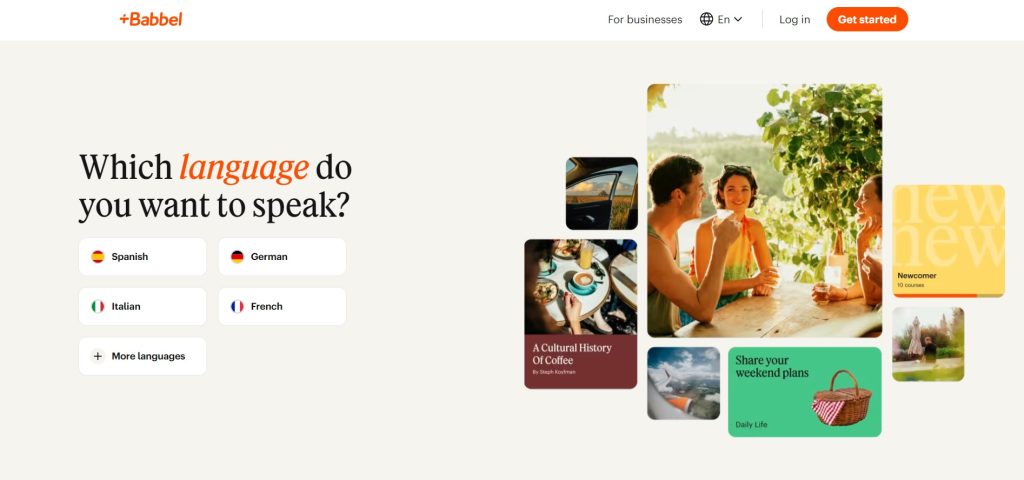
Babbel's German course mixes dialogues, vocabulary, listening, speaking, writing, grammar, and review. Lessons are short. Unlike a one-size-fits-all app, Babbel designs courses around the learner's starting language, so explanations can address mistakes English speakers commonly make.
Babbel's current language guide lists German courses through B2 with additional topics through C1. The app also includes speech recognition in lesson exercises and, for American English users, German access to the mobile-only Babbel Speak beta.
What's good about Babbel for German
Grammar explanations are concise and timely. Cases, gender, verb position, and sentence patterns appear near the exercises where you need them.
The course has real depth. A B2 path plus extra C1 topics goes further than many general-purpose apps.
Lessons vary without feeling random. You move between listening, dialogue completion, pronunciation, vocabulary, grammar, and review.
Review supports several modes. You can revisit vocabulary through flashcards, listening, speaking, writing, and other exercises.
Babbel Speak adds guided AI scenarios for eligible users. German is available when the display language is American English, but the feature remains in beta and mobile-only.
The first lesson of every course is free. You can inspect the teaching style before subscribing.
What's not good about Babbel for German
Speaking exercises are still a smaller part of the main course than recognition and guided response tasks. You may complete many lessons without sustaining a real conversation.
Speech recognition is useful but limited. It tells you whether your attempt is close enough, not always which German sound or syllable caused the problem.
Feature availability depends on device and display language. Babbel Speak is not on desktop, and its supported target languages differ between American and British English interfaces.
There is no meaningful ongoing free course. Full access requires a subscription after the sample lessons.
Bottom line: Babbel is a safe choice if you want balanced German lessons and clear grammar explanations. If your biggest weakness is producing complete spoken answers, Copycat Cafe is a stronger speaking-focused alternative because repetition, pronunciation feedback, and guided conversation are built into the same lesson sequence.
How much does Babbel cost?
Babbel prices vary by country, platform, subscription length, and promotion. The US App Store lists an All Languages 12-month purchase at $107.99. Web checkout may show different monthly, three-month, six-month, annual, or lifetime offers.
Babbel lets you sample each course's opening lesson without paying. Its 20-day money-back guarantee covers initial purchases at babbel.com, babbel.gifts, and through Google Play, but excludes Apple App Store purchases. Check Babbel's official pricing page for the offer available to you.
DW Learn German
German course: Free German courses and resources from beginner literacy through advanced and exam-preparation levels
Verdict: DW Learn German is our pick here for free app-based video lessons and listening practice. Its flagship Nicos Weg course gives beginners a real narrative and structured exercises, while the wider platform adds news, vocabulary, grammar, culture, and higher-level material.
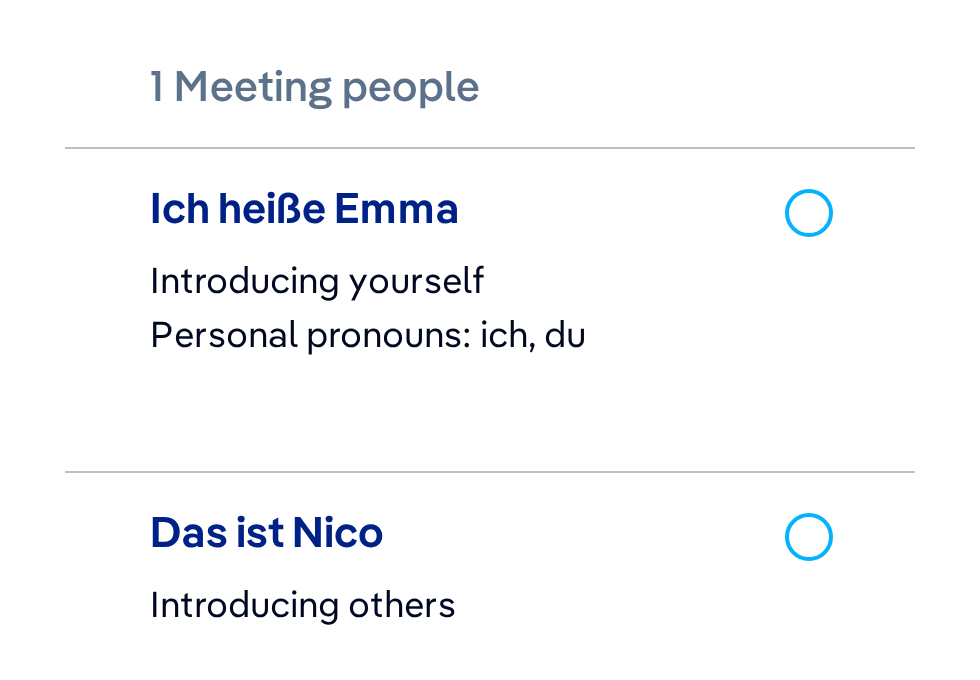
DW Learn German is produced by Deutsche Welle, Germany's international public broadcaster. The mobile app and website are free. The official Google Play listing says the platform covers all CEFR levels through a mix of placement testing, interactive exercises, videos, news, music, vocabulary, grammar, cultural material, literacy support, and exam preparation.
For beginners, Nicos Weg is the clearest entry point. DW describes it as a 228-lesson video course, and its course overview covers A1 through B1. More advanced learners can move to resources such as slowly spoken news and current-affairs formats.
What's good about DW Learn German
Everything is free. There is no premium tier blocking later lessons, transcripts, or grammar material.
Nicos Weg gives beginners a story to follow. Vocabulary and grammar appear around recurring people and everyday situations instead of disconnected sentences.
The platform goes beyond beginner drills. News, music, exam preparation, workplace language, and advanced listening make it useful after A1.
It combines language and life in Germany. Learners encounter cultural and practical situations alongside grammar and vocabulary.
A placement test helps returning learners choose a starting point.
It works on web and mobile. You can use DW Learn German on its website or in the iOS and Android apps.
What's not good about DW Learn German
The platform feels more like a collection of courses and media than one seamless app path. After Nicos Weg, choosing the next resource can take effort.
Speaking production is not the center of the experience. You can listen, repeat, and complete interactive exercises, but you do not get the same sustained speaking feedback as Copycat Cafe, Langua, or a tutor.
The mobile wrapper can feel less polished than a commercial native app. App-store reviews have also reported login, video, and exercise-scoring problems.
Advanced resources are less linear. Stronger learners get excellent material, but not always a single ordered B2-to-C1 curriculum.
Bottom line: Almost every German learner should know about DW Learn German, especially because its videos and listening material are free. If conversation is your main goal, Copycat Cafe is a more speaking-focused alternative because every lesson makes you repeat useful German with pronunciation feedback and then use it in a guided roleplay.
How much does DW Learn German cost?
DW Learn German is completely free. The website and official iOS and Android apps do not require a paid subscription.
Pimsleur
German course: Five levels with 30 core audio lessons per level
Verdict: Pimsleur is the best option here for learners who want a predictable, audio-first German routine they can do away from a screen.
Pimsleur's German course is built around 30-minute audio lessons that prompt you to recall and say phrases at timed intervals. The current German lifetime page lists five levels. Each level contains 30 daily lessons and roughly 15 hours of core audio, plus reading lessons and practice tools on Premium plans.
Premium adds Voice Coach, flashcards, Quick Match, Speed Round, Speak Easy roleplays with transcripts, and short culture or grammar material. The audio-only subscription gives you the core lessons without most of those extras.
What's good about Pimsleur for German
It makes you answer from memory. You are regularly prompted in English and expected to produce the German phrase before the speaker responds.
The course is easy to use hands-free. CarPlay, Android Auto, and the predictable lesson format suit commuting and walking.
Five levels provide substantial audio depth. This is not a short tourist phrase pack.
Voice Coach on Premium and All Access adds real-time pronunciation feedback. Challenge mode asks you to produce a phrase from an English cue.
Premium includes Speak Easy conversation transcripts and reading support. That makes the app less purely audio-only than its older reputation suggests.
What's not good about Pimsleur for German
Thirty-minute lessons are long. They are harder to fit into a short break than a 10-to-15-minute lesson.
The repeated prompt-and-response rhythm can feel monotonous. It works best for learners who enjoy a stable routine.
Grammar is mostly inferred from examples. Premium adds short explanatory material, but Babbel, Seedlang, Busuu, or a tutor is better for someone who wants direct help with cases and word order.
Reading and writing remain secondary. Premium adds reading support, but the core method is still spoken recall.
The audio-only subscription excludes Voice Coach and most interactive practice.
Bottom line: Choose Pimsleur if you want to build German recall and listening through audio and can commit to longer sessions. Choose Copycat Cafe if you want shorter visual conversations, pronunciation scoring, and guided chat in the same lesson.
How much does Pimsleur cost?
For US web subscriptions, German Audio-Only costs US$14.95 billed monthly and German Premium costs US$19.95 billed monthly. All Access includes 50+ languages, including German, for US$20.95 billed monthly or US$164.95 billed annually. One-time course purchases are also available. Check Pimsleur's current offer for the included features and terms in your purchase channel.
These subscriptions offer a 7-day free trial for new customers, with payment details required. Billing starts automatically after the trial and renews unless cancelled. Subscriptions with this trial are excluded from Pimsleur's separate 30-day guarantee, which applies only to qualifying direct purchases without a free trial of 7 days or longer.
Memrise
German course: Personalized vocabulary lessons, native-speaker video, grammar and verb review, and AI conversation practice
Verdict: Memrise is a strong supplement if you want to hear how different people actually say German words and phrases, then review that language with spaced repetition and low-pressure AI practice.
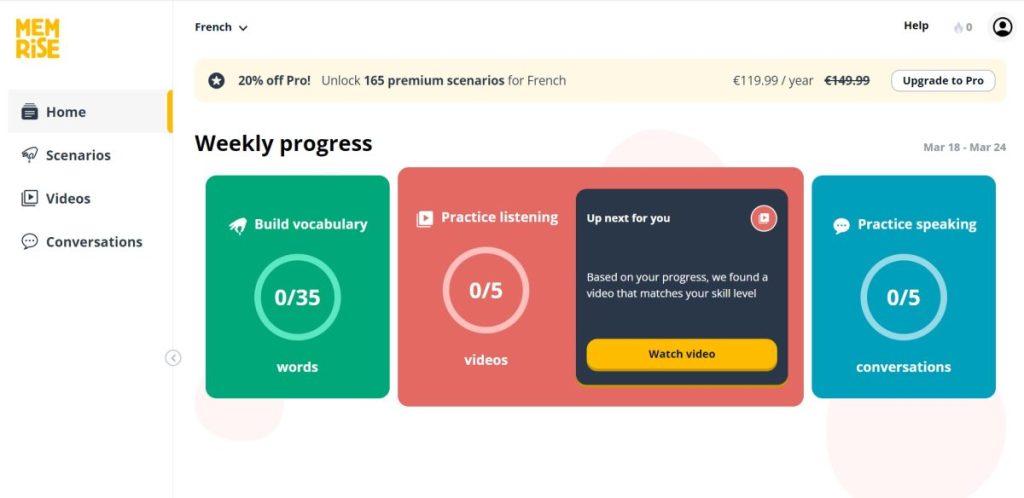
Memrise's current German course combines personalized vocabulary practice with videos of native speakers. Its official self-study content is organized as one course per language with practical Scenarios. Memrise has also added goal-based paths and custom word lists in the main app, along with a separate German Stories offering, so Scenarios are no longer the whole structure.
Speaking practice happens through MemBot and specialized AI Buddies. German learners using English can also use Pronunciation Buddy to record recently learned words and phrases and get simple feedback. The experience is broader than a flashcard app, but vocabulary and listening remain its clearest strengths.
What's good about Memrise for German
Native-speaker clips expose you to real variation. You hear different voices, speeds, and delivery rather than one studio narrator repeating every item.
The vocabulary is organized around practical situations. Scenarios help you focus on language for introductions, travel, food, relationships, work, and other concrete needs.
Review adapts to what you are learning. Spaced repetition brings back words and phrases before they disappear from memory.
AI practice lowers the pressure to speak. MemBot and AI Buddies let you rehearse a situation privately before trying it with another person.
There is more than vocabulary. Pro includes Grammar, Conjugation, and Role Play Buddies for German learners using English, with availability subject to rollout.
What's not good about Memrise for German
It is not a conventional step-by-step German course. Learners who want systematic explanations of case, gender, adjective endings, and sentence structure may need another resource.
Free access is deliberately limited. The free plan includes limited vocabulary lessons and videos, with one speaking-practice session per day. Pro unlocks the full vocabulary and video libraries plus unlimited speaking practice and specialized chat Buddies.
The product has changed substantially. Older reviews may describe the full legacy Community Course catalog inside the main app, a dedicated pronunciation mode, or offline learning. The legacy Community Courses remain on a separate archive, while Memrise has started bringing custom word lists and some user-created content back into the main app. The old pronunciation mode and offline mode remain retired, but Pronunciation Buddy now provides a separate way to practise German pronunciation.
AI conversations are still generated practice. They can build confidence, but they do not provide the depth of correction or open-ended control of a dedicated conversation app such as Langua.
The redesign may frustrate returning users. If you loved choosing from many user-created decks in the old app, the streamlined official-course experience can feel more restrictive.
Bottom line: Memrise is useful when your German routine needs more real voices and better vocabulary recall. If you want those phrases to lead into a clearer speaking progression, Copycat Cafe is a stronger alternative because its structured lessons move from listening to pronunciation practice and then guided conversation instead of centering vocabulary review.
How much does Memrise cost?
Memrise has a limited free version. During our October 2026 check, the official US App Store listed Pro at $24.99 per month or $61.99 per year, plus a $329.99 lifetime plan. The same listing showed several promotional purchases, including a $98.99 lifetime offer, so the deal available to you may differ.
Memrise runs frequent promotions, and app-store prices can differ from web prices. Check the current Memrise Pro checkout before subscribing rather than treating a sale price as permanent.
LingQ
German course: A large library of German audio and text, Mini Stories, imports, vocabulary tracking, and optional AI features
Verdict: LingQ suits independent learners who would rather improve through a high volume of interesting German reading and listening than move through a single prescribed course.
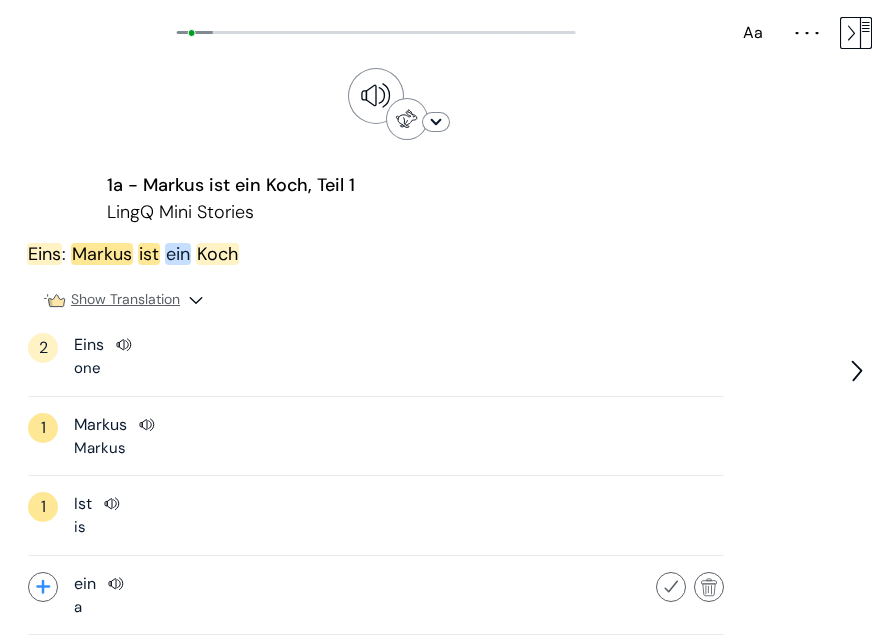
The official German library contains thousands of hours of audio paired with transcripts. As you read, you can mark unfamiliar words, review them later, create playlists, or turn outside material such as videos, ebooks, podcasts, and articles into lessons.
Most learning happens inside the interactive Reader. It distinguishes new and previously saved vocabulary, while Sentence Mode breaks a text into smaller pieces with audio, translation, and review tools beside each line. The 62-lesson Mini Stories collection provides a manageable entrance before a beginner explores the open library.
What's good about LingQ for German
Authentic content lets you choose subjects you care about. That can make the volume of input needed for German vocabulary feel less like a course assignment.
Audio and transcripts stay together. You can hear a German sentence, inspect it, save words, and return to the same context later.
The import tool is excellent. It can turn your own German videos, podcasts, books, and articles into interactive lessons.
Mini Stories give beginners a concrete starting point. The 62 lessons repeat common patterns before you enter the wider library.
Saved vocabulary remains attached to real sentences. That is more useful for German cases and word order than memorizing a translation alone.
Premium Plus adds advanced Lynx modes, AI voices, six times Premium's audio-transcription allowance, and simplified lessons. Premium already includes Lynx Standard and Coach modes. Both plans have AI usage limits.
What's not good about LingQ for German
Beginners must make more decisions for themselves. Mini Stories offer an entry point, but the wider library has no mandatory sequence.
The interface takes time to learn. Words, LingQs, imports, playlists, stats, and AI tools create more complexity than a simple lesson path.
Reading and listening drive the experience. Lynx can add conversation, but speaking remains secondary to input in the main product.
The free plan is restrictive. It currently allows only 20 saved words, five imported lessons, and one audio playlist.
Premium Plus is expensive. You need it for the full AI toolset.
Bottom line: LingQ becomes compelling when you are ready to consume much more real German through reading and listening. If producing spoken answers is the larger weakness, Copycat Cafe targets that gap more directly by turning an example conversation into repeated speaking, pronunciation feedback, and a guided roleplay.
How much does LingQ cost?
LingQ's official web pricing page currently lists these USD amounts, billed upfront for the selected term:
Premium monthly: $14.99
Premium annual: $119.99
Premium two-year: $215.76
Premium Plus monthly: $29.99
Premium Plus annual: $269.99
In the US App Store, Premium is currently $14.99 per month or $119.99 per year, while Premium Plus is $29.99 per month or $269.99 per year. Open the official LingQ checkout to see the amount for your region.
Busuu
German course: 420+ lessons in the main A1-B2 course, plus German for Travel, Life in Germany, and German Pronunciation
Verdict: Busuu is a strong balanced German course for learners who want explicit grammar, short lessons, video from real speakers, personalized review, and feedback from the community.
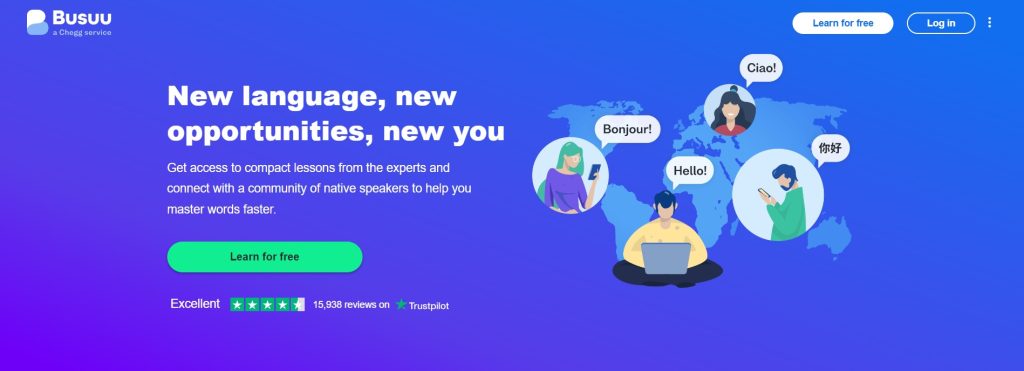
Busuu's current German page lists more than 420 lessons in its Complete German course from A1 through B2. It also offers specialized paths for travel, life in Germany, and pronunciation. Lessons combine vocabulary, grammar, listening, reading, writing, and speaking prompts.
One of Busuu's clearest differences is its community. You can submit a written or spoken exercise and receive corrections from fluent speakers, then help people learning your language. AI Conversations and speaking-practice lessons have limited free tries, then require Premium Plus. German speaking practice highlights words needing more work; detailed AI pronunciation explanations are currently limited to the English and Spanish courses.
What's good about Busuu for German
The main German path is substantial. More than 420 lessons from A1 to B2 give beginners and intermediate learners a clear progression.
Grammar is taught directly. The course covers topics such as cases, articles, word order, verbs, and adjective endings in manageable pieces.
Real people appear in video examples. That gives you more voice and accent variety than a single synthetic narrator.
Community corrections can reveal what an automated exercise misses. A fluent speaker may suggest a more natural phrase even when your sentence is technically understandable.
Specialized German courses are practical. German for Travel and Life in Germany help learners with specific near-term needs.
Personalized review collects grammar and vocabulary from completed lessons.
What's not good about Busuu for German
Community feedback is not guaranteed to be immediate or equally detailed. Corrections come from other users, not necessarily professional teachers.
Some community submissions are public to other learners. If you dislike strangers hearing your recording, choose text or use a private speaking tool.
The plan structure has become more complicated. Continued access to AI Conversations and speaking-practice pronunciation feedback requires Premium Plus after limited free tries, while prices vary widely by region, platform, and promotion.
Many exercises still guide you toward a predetermined answer. Community tasks and AI Conversations add freedom, but they are not the center of every lesson.
The free plan includes the Complete German course, with ads and feature limits. It is useful for trying lessons, not the cleanest way to complete the whole course.
Bottom line: Busuu is a good German all-rounder, particularly if you value grammar and community corrections. If you want private speaking practice to be the core of every lesson, Copycat Cafe is more focused on repeated speaking, pronunciation feedback, and guided conversation from the start.
How much does Busuu cost?
Busuu's pricing varies substantially by country, platform, and offer. The US App Store lists 12-month Premium purchases at $70 and $138.99 and a 12-month Premium Plus purchase at $139.99, among several listed products.
Busuu offers free lessons with ads. Premium adds review tools, offline mode and no ads; Premium Plus adds continued access to AI Conversations and speaking-practice pronunciation feedback after limited free tries, plus exclusive courses. Check the current Busuu checkout in your region before subscribing.
Duolingo
German course: A free path through B2 for most learners, with reading, listening, writing, speaking prompts, Stories, and DuoRadio
Verdict: Duolingo makes it unusually easy to begin practicing German for free. Its short sessions are approachable, but grammar and spontaneous speech need more support than the core path provides.
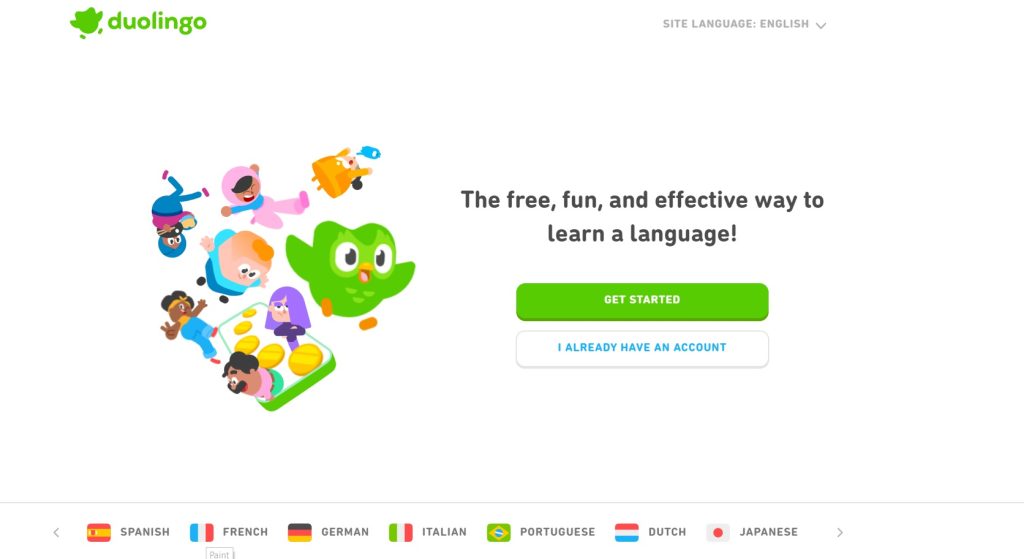
On web and mobile, Duolingo arranges German into bite-sized units. Translation, listening, sentence assembly, reading, and occasional speaking prompts appear alongside repeated review. Anyone can follow the main path without paying; subscriptions remove ads and usage limits or unlock AI conversation features.
German is one of the courses that currently includes DuoRadio, short podcast-like listening lessons inside the path. Duolingo Max also offers Roleplay for English speakers learning German and Video Call for German. Max features are available only in the mobile app, with Lily calls on iOS and Android. Duolingo's newer guided calls with Falstaff are currently documented for iOS Max subscribers and may still depend on rollout.
What's good about Duolingo for German
You do not have to pay to reach later units. The main German path remains available on the free tier.
Starting is extremely easy. Lessons are short, instructions are clear, and progress syncs across web and mobile.
German receives richer listening content than many smaller Duolingo courses. DuoRadio adds connected audio and storytelling inside the path.
Repetition helps basic vocabulary and sentence patterns become familiar.
Max adds low-pressure AI speaking practice. Video Call lets eligible German learners respond in real time. Lily calls provide a transcript afterward, while Falstaff's beginner calls add guided feedback on supported iOS accounts.
What's not good about Duolingo for German
German grammar needs more explanation than the path usually gives. Cases, gender, adjective endings, and word order are difficult to infer from examples alone. Explain My Answer now provides free grammar and vocabulary explanations for most German learners.
Core speaking tasks provide limited pronunciation guidance. Recognition that your answer was accepted is not the same as knowing which sound needs work.
Most exercises still lead to a predetermined response. Selecting or assembling the right sentence does not fully train you to invent one in a live conversation.
The free version includes ads and account-dependent Hearts or Energy limits. These can interrupt longer sessions.
Max features depend on plan, device, interface language, and rollout. Do not subscribe solely for one feature without confirming that it appears in your German course.
Bottom line: Duolingo is hard to beat for a free, low-friction start. If spontaneous speaking is the skill you most want to build, Copycat Cafe is a stronger alternative because every lesson moves beyond predetermined answers into recorded pronunciation practice and a guided conversation using the German you just learned.
How much does Duolingo cost?
German lessons on the core path cost nothing. Super removes advertising and, depending on the account version, lifts Hearts or Energy restrictions while adding personalized review. Max bundles the Super benefits with supported AI conversation tools.
The US App Store does not identify the billing periods for its listed Super purchases, so those amounts do not establish a current monthly or annual price. It advertises a 14-day trial, while Duolingo's Super website advertises a one-week trial. Check the billing period and current Super, Family, or Max offer in the app before subscribing.
Quick Feature Comparison
To help you compare at a glance, here is how these German apps stack up on key features:
| App | Pronunciation Feedback | Natural German Audio | Conversation Practice | Course Depth | Price | Best For |
|---|---|---|---|---|---|---|
| Copycat Cafe | ✅ Score on every word | ✅ Slow + normal | ✅ Guided AI roleplay | 200 lessons | $174 billed annually or $29 billed monthly | Speaking practice |
| Langua | ⚠️ General AI corrections | ✅ Natural AI voices | ✅ Open AI chat | Guided beginner + open practice | US$149.99/year Standard; US$199.99/year Unlimited, billed annually | AI conversation |
| Seedlang | ⚠️ Self-comparison | ✅ Native-speaker video | ⚠️ Speaking prompts | A1-C1 vocabulary trainer + video/story lessons | US$59.98/year on web | German video + grammar |
| Babbel | ⚠️ Speech recognition | ✅ Native audio | ⚠️ Speak beta | B2 + extra C1 topics | US App Store lists $107.99 for 12 months, all languages | Balanced lessons |
| DW Learn German | ⚠️ Self-evaluation | ✅ Video + news | ⚠️ Limited production | All levels; Nicos Weg A1-B1 | Free | Free video + listening |
| Pimsleur | ✅ Voice Coach on Premium | ✅ Native audio | ⚠️ Prompted roleplay | 5 levels | US$14.95/month Audio-Only; US$19.95/month Premium; US$20.95/month or US$164.95/year All Access | Audio learners |
| Memrise | ⚠️ Pronunciation Buddy | ✅ Native-speaker videos | ⚠️ MemBot / AI Buddies | Scenarios + goal-based word lists | US App Store lists $24.99/month or $61.99/year | Vocabulary + real voices |
| LingQ | ⚠️ Sentence speaking practice | ✅ Authentic content | ⚠️ Lynx on Premium and Premium Plus | Open library | US$119.99/year Premium; US$269.99/year Premium Plus, billed annually | Reading + listening |
| Busuu | ⚠️ German word highlighting: limited tries, then Plus; community feedback | ✅ Real-speaker video | ⚠️ AI: limited tries, then Plus; community exercises | 420+ lessons, A1-B2 | US App Store lists Premium at $70 or $138.99 for 12 months; Premium Plus at $139.99 for 12 months | Grammar + feedback |
| Duolingo | ⚠️ Basic | ⚠️ DuoRadio + course audio | ⚠️ AI Roleplay + Video Call on mobile Max | Through B2 for most learners | Free + paid tiers | Habit building |
✅ = Excellent ⚠️ = Limited or plan-dependent ❌ = Not available or very limited
Choose the German app that fits your goal
Shortlist two or three apps by the job you want them to do, then use the free access or trial before committing.
Speaking is the priority: begin with Copycat Cafe.
You want room to improvise with AI: test Langua.
Native-speaker video helps you remember: look at Seedlang.
You prefer an orderly grammar curriculum: compare Babbel with Busuu.
The budget must stay at zero: use DW Learn German for video lessons and listening, with Duolingo for quick extra practice.
Audio lessons suit your routine: choose Pimsleur.
You want to learn from real German media: LingQ is the natural fit.
Vocabulary sticks when you see different speakers: consider Memrise.
You can sample every recommendation without immediately paying full price:
Copycat Cafe: a 7-day free trial and a 30-day money-back guarantee on your first payment
Langua: limited free use plus a card-backed 5-day monthly-plan or 7-day annual-plan trial
Seedlang: free access, with a 15-day Pro money-back guarantee advertised on its website
Babbel: the opening lesson in each course is free, with a 20-day money-back guarantee on initial web, babbel.gifts, and Google Play purchases, excluding Apple App Store purchases
DW Learn German: no charge
Pimsleur: a 7-day trial for new customers, with payment details required
Memrise, LingQ, Busuu, and Duolingo: free tiers with their own restrictions
The most useful app is the one that serves your actual reason for learning German. That might mean following colleagues in Berlin, speaking with relatives in Austria, getting ready for life in Switzerland, or simply answering without silently assembling every clause first.
Once you have chosen an app, use a practical plan for learning German to organise your lessons, listening and speaking into a daily routine.
Related guides: