
Note: Prices are in USD. App pricing and features change frequently. All prices mentioned in this article were verified in July 2026, but we recommend checking the official websites for the most current pricing and offerings.
In July 2026 we corrected Super Duolingo pricing ($13.99/month or $95.99/year in the US), confirmed that “Explain My Answer” is now free for all learners, and refreshed details on Duolingo’s new Energy system and B2-level French content.
Duolingo is one of the most popular French language learning apps - but can it genuinely help you become fluent?
To find out, I’ve spent the past few days completing interactive lessons and testing the well-known app for different levels of French.
Here’s what I’ve discovered about Duolingo French and how it compares with other apps.
Is Duolingo the best French learning app?
With its varied exercises, lovable characters, and fun and motivating learning method, Duolingo is a great way to practice French and stay the course. But no language learning app can cover everything. Duolingo especially falls short in grammar, culture, and speaking practice.
The biggest gap? Duolingo’s pronunciation feedback is basic - it recognizes that you said something, but won’t tell you if your pronunciation is actually good enough for French speakers to understand you. And you’ll learn phrases like “I am a cat” instead of practical conversation skills.
If you want to actually speak French confidently, Duolingo should be used with other resources.
What is Duolingo?
Duolingo is a learning app for beginner to upper intermediate learners that offers courses in more than 40 languages, as well as courses in math, music, and chess.
You can use it as a web app on your computer or you can download it onto your mobile device.
Duolingo French offers practice in areas like vocabulary, listening, reading, writing, and speaking. To a certain extent, there’s grammar learning, as well, although I found the explanations included in the “guidebook” before each lesson to often be too cursory and not serious enough.
Still, the moment you start looking into Duolingo, it’s easy to see why it’s so popular. The interface is fun and has a cartoonish, whimsical aesthetic. Oh, and there’s another great thing going for it: It’s completely free. There are paid versions of Duolingo, called Super Duolingo and Duolingo Max, that offer more content and a few appealing extras, but even the basic version includes a lot of features.
Recent updates (2025 - 2026):
- French course content now extends through B2 (upper intermediate), an expansion Duolingo confirmed in April 2026 across its nine most popular courses
- “Explain My Answer” is now free for all learners as of January 2026 (previously subscriber-only)
- Video Call with Lily (a Duolingo Max feature) has been available on Android as well as iOS since January 2025
- On mobile, Duolingo has been gradually replacing its “hearts” mistake system with an “Energy” meter
What’s good about Duolingo?
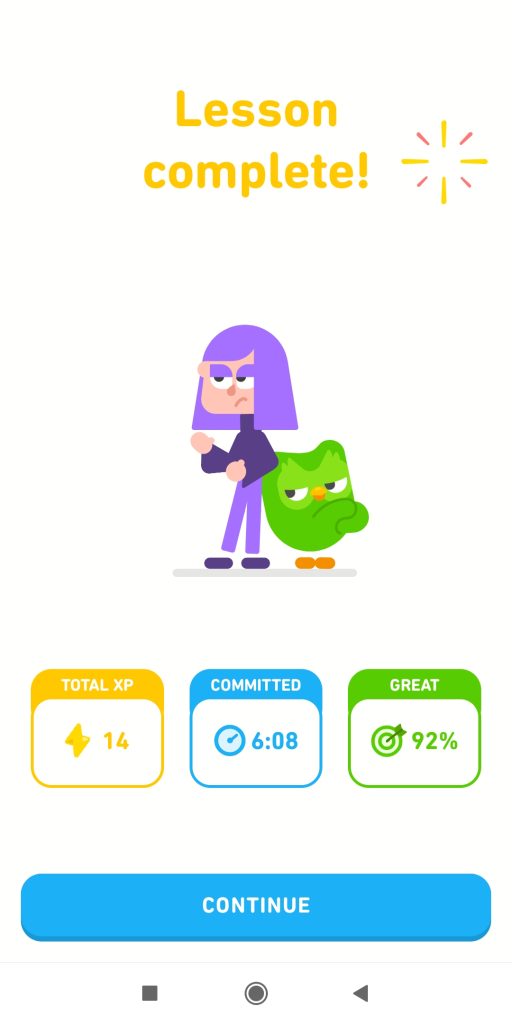
After trying out the app, here’s what I thought were the strong points of Duolingo.
-
Its charming and delightful interface and characters that crop up in examples or just to encourage you as you learn. Cynical, sort-of Goth teenager Lily quickly stole my heart, personally. I loved how she would roll her eyes and grudgingly clap when I’d get a right answer. This is something it has in common with Babbel as you can see in our comparison of the two popular apps.
-
The app’s exercises are varied and give you a number of ways to practice and learn French (listening, reading, speaking, and writing).
-
You can choose how long you want your daily lesson to be.
-
The variety of different interactive exercises in a single lesson. Especially as you get into higher levels, you’ll be asked to fill in sentences, match vocabulary, practice pronunciation, listen, type a translation, and more, one after the other. I personally enjoyed this - it kept me on my toes and rarely felt repetitive.
-
The “Stories” feature for higher level learners. These are short dialogues that, as you can guess, tell a story. You listen to and read them, can replay lines, and will be asked to interact - for instance, filling in the blank or answering comprehension questions. I loved the variety of ways these stories were used, and as with the regular exercises, I like that the Stories touch on various bases of language learning, incorporating reading, writing, listening, and speaking.
-
It motivates you to practice daily. In addition to its famous “streaks” (uninterrupted days of practice), Duolingo offers incentives like the game-like rewards system, where you get gems and other items for completing lessons and reaching other goals.
-
Its cast of unique and diverse characters. If cynical teens aren’t your thing, there are lots of other Duolingo characters, both people and animals. These characters are a diverse group, each with a different cultural background, body type, age, etc., and very different, distinct personalities. In addition to the admirable inclusion and the chance it gives everyone to have their own favorite character, the diverse backgrounds and personalities mean that each character has a different voice and inflection, which is helpful for listening practice.
-
The app lets you go back and review, as well as access guidebooks for later lessons, no matter what lesson you’re currently on
-
Although Duolingo takes a fun, joyful approach to language learning and starts out a bit easy, overall the app’s exercises can be pretty challenging.
-
The standard version of Duolingo, which has lots of content, is free.
-
B2 content now available - Duolingo’s French course now teaches content through upper-intermediate (B2) level, an expansion Duolingo confirmed in April 2026.
What’s not good about Duolingo?
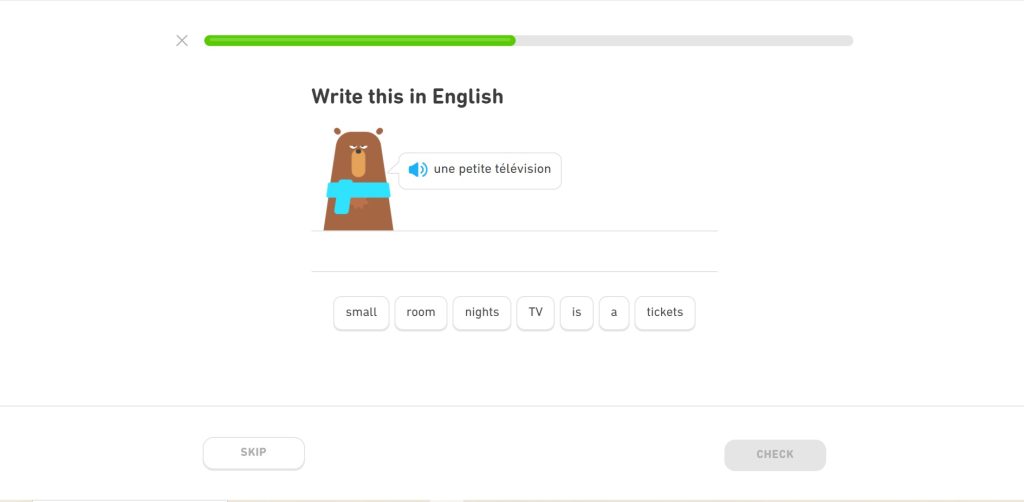
Here’s what I didn’t like about Duolingo (and also one that many other people may not like).
-
To me, Duolingo doesn’t provide enough information for absolute beginners. They might learn vocabulary but they don’t get clearly laid out information about things like how French is structured.
-
While many people (including me) like Duolingo’s vibe, others find its fun and whimsical approach can be a disadvantage. A lot of the vocabulary you learn is of dubious usefulness. Sure, learning how to say things like “I’m a cat” or “This is my first cow” is fun but when will you ever say things like this in real life?
-
Grammar explanations are brief at best, and often not particularly clear. There’s a “guidebook” before each lesson that’s supposed to explain certain aspects of grammar that you’ll cover, but I found the explanations to often be too cursory and not serious enough. The now-free Explain My Answer feature does add AI-generated feedback on specific mistakes, which helps, though it’s not a substitute for structured grammar instruction.
-
The app only recognizes the vocabulary and phrases it teaches you, not synonyms or equivalent expressions. Because Duolingo isn’t, of course, a live person (no matter how real its cast of characters seem), it won’t accept alternative ways to say the same thing. This might not be so much of an issue if its set phrases and vocabulary were the most common ones in everyday spoken French, but that’s not always the case…which is why my translation of the phrase “What would you suggest?” into French was counted as wrong. This also means that…
-
Phrases and translations aren’t always the best choice for contemporary spoken French.
-
Cultural aspects of French, especially the importance of politeness, are ignored. For instance, one sentence I was given to work with had me tell someone I wanted them to make me a meal, using the phrase Je veux que. While this would certainly be understood, using the subjunctive like this is a direct, impolite command. This is especially important to be aware of since politeness is a vital part of French culture.
-
Fill-in exercises have each word pronounced, instead of liaisons. In exercises where you have to put words in order, the words are pronounced individually, without liaisons being made. So for instance, C’était is heard as “ce était” in these exercises. Not great for training your ear or practicing pronunciation.
-
Basic pronunciation feedback that only checks if you said something, not if you said it correctly. Duolingo will accept your pronunciation as long as it vaguely recognizes the words - it won’t tell you if your accent is actually understandable to French speakers or give you a score to track improvement.
-
The app’s free version has ads, including video ads. Yes, it’s free, so this is the price to pay, so to speak. But it’s still not great. I also found that ads seem to get more present the more you use the app. On the first day I used Duolingo, I think I only had a print ad or two for the app’s paid version, but by the fourth day, I was getting video ads at times. These weren’t terribly invasive - they didn’t pop up in the middle of an exercise, for instance - but it still felt strange and distracting.
-
Duolingo takes an intuitive language learning approach. This learning technique isn’t unique to Duolingo, and it’s not necessarily something everyone would find negative, but personally, I’ve never been a fan of this type of language learning, especially if your goal is to attain near-fluency, including grammar proficiency. See enough examples, Duolingo’s creators figure, and you’ll get it. But I’m not really sure that’s true. By the end, you’re expected to know how to conjugate verbs in various tenses, for instance, and I strongly suspect that longtime users only know how to conjugate for the subjects and verbs they’ve become familiar with through the app’s example sentences.
How much does Duolingo cost?
Duolingo is completely free and includes full access to all 40+ languages and lessons. It’s one of the most popular free language learning apps available.
Free Version: Duolingo’s free tier includes access to all language courses and lessons. You’ll see ads, and your practice is limited by an “Energy” meter, which has been rolling out through 2025 and 2026 to replace the old “hearts” system on mobile (some accounts - and the web version - still use hearts). It remains fully functional for long-term learning. Bonus: The “Explain My Answer” feature (previously Max-only) is now free for all users as of January 2026.
Super Duolingo (Premium): For an ad-free experience with additional features, Super Duolingo costs:
- Monthly: $13.99/month
- Annual: $95.99/year (~$8/month)
- Family Plan: $119.99/year (up to 6 users, ~$1.67/user per month)
Duolingo runs frequent promotions - annual plans are often around 50% off, especially around the New Year - and first-time subscribers usually get a 14-day free trial (7 days in some regions).
Super Duolingo features include:
- Ad-free learning experience
- Unlimited hearts/Energy (no limits on mistakes or practice)
- Personalized Practice to target weak areas
- Monthly Streak Repair to maintain your streak
- Unlimited Legendary attempts (timed challenges)
- Mistake Review with personalized lessons
Duolingo Max (AI-Powered Premium): Duolingo Max is the newest, most advanced tier, with generative AI conversation features:
- Monthly: $29.99/month
- Annual: $167.99/year (~$14/month, save 53%)
- Family Plan: $239.99/year (up to 6 users)
Duolingo Max includes everything in Super Duolingo, plus:
- Roleplay: Practice real-world conversations with AI characters (Lily and other Duolingo characters) in scenarios like ordering at a café, job interviews, or travel situations
- Video Call with Lily: Interactive video conversations with an AI character for speaking practice (available on both iOS and Android since January 2025)
Note: “Explain My Answer” was previously a Max-exclusive feature but is now free for all users as of January 2026.
Important limitations of Duolingo Max:
- Only available for a limited set of popular courses for English speakers - including French, Spanish, German, Italian, Portuguese, Japanese, and Korean - and exact features vary by course and platform
- Available on iOS and Android devices (NOT available on web browser)
- Available in 188 countries worldwide
Note: The free version is excellent for most learners and includes all core content. Super removes ads and adds convenience. Max is best for serious learners who want AI-powered roleplay and video conversations.
Duolingo vs other apps: How does it compare?
Here’s an honest comparison to help you decide:
| Feature | Duolingo (Free) | Duolingo Max | Copycat Cafe |
|---|---|---|---|
| Price | Free | $168/year | $174/year |
| Best for | Gamified daily practice | AI roleplay + video calls | Real conversation skills |
| Pronunciation | Basic recognition | Basic recognition + practice | 0-100% scoring with feedback |
| Vocabulary focus | Random (“I am a cat”) | Same as free | Practical conversations |
| Audio speed | Normal speed (slow replay on some listening exercises) | Same as free | Slow + natural speed |
| AI conversation | No (roleplay in Max only) | Roleplay + Video Call | 1,000 messages/day |
| Grammar | Brief guidebook + Explain My Answer (now free) | Same | Contextual in lessons |
| Languages | All 40+ languages, all devices | Select popular courses (incl. French), mobile only | French, Latin American Spanish, Castilian Spanish, Italian, and German, all devices |
| Gamification | Streaks, XP, leaderboards | Same | No streaks or XP |
Use Duolingo if you want:
- Free, gamified practice to build a daily habit
- Variety of exercise types and fun characters
- To learn multiple languages (40+ available)
- Motivation through streaks and leaderboards
- To supplement other learning methods
Use Duolingo Max if you want:
- Roleplay conversation scenarios with AI characters
- Video Call practice with Lily
- Everything in Super Duolingo plus advanced AI features
- Are learning one of the popular courses Max supports, such as French or Spanish
- Use mobile devices (not available on web)
Consider Copycat Cafe if you want:
- Precise pronunciation feedback (0-100% scores you can track)
- Practice with real conversational French, Latin American Spanish, Castilian Spanish, Italian, or German, not “I am a cat”
- AI conversation partner available 24/7 (1,000 messages daily)
- Audio at both slow and natural speeds
- Works on all devices including web browser
Copycat Cafe limitations: Currently offers French, Latin American Spanish, Castilian Spanish, Italian, and German (no other languages), no gamification features like streaks or leaderboards. Paid plans start with a 7-day trial.
The honest truth: Many successful French learners use multiple apps. Duolingo’s free lessons keep you motivated daily with gamification, while apps focused on conversation practice help you actually speak. Consider what matters most to you: habit building, variety of languages, or speaking skills.
Should I use Duolingo to learn French?
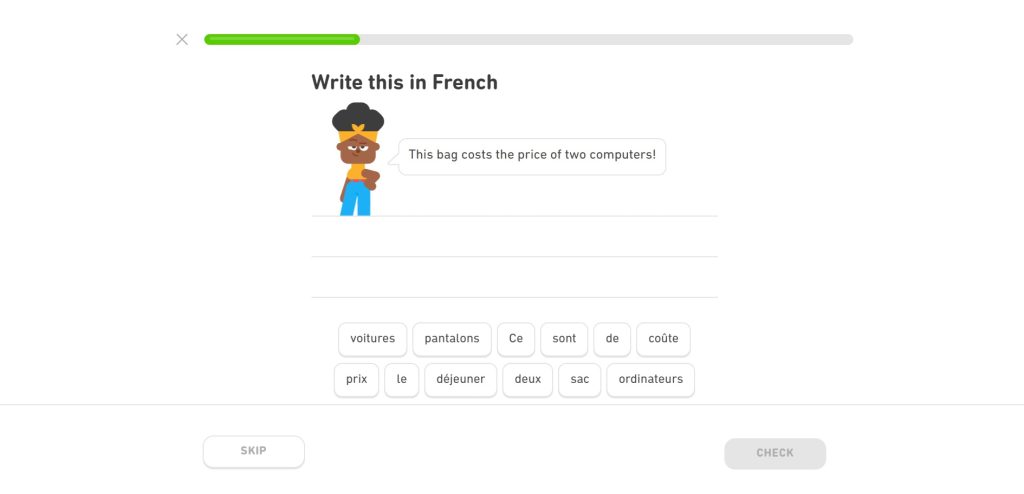
To me, Duolingo is a great resource for someone who has a base knowledge of French and wants to keep things fresh in their mind and review, or for someone who is a little intimidated about starting to learn French and will also have other ways to practice and learn.
In both cases, the person should use Duolingo in addition to other learning resources, especially when it comes to:
- Precise pronunciation feedback - knowing if French speakers will actually understand you
- Real conversational French - learning phrases you’ll use, not “I am a cat”
- Cultural context - understanding French politeness and social norms
- Grammar explanations - clear, detailed grammar instruction
Fortunately, there are lots of other ways to learn and practice these important aspects of the language, including reading, listening to, and watching things in French.
Your Next Step
Here’s what to consider based on your goals:
If you want free practice and habit building: Use Duolingo’s free version. The gamification really works for staying consistent, and you can’t beat free.
If you want multiple languages: Duolingo offers 40+ languages - far more than most alternatives.
If speaking is your priority: Supplement Duolingo with conversation-focused resources. Options include tutoring platforms, language exchange partners, or conversation-focused apps.
Resources to explore:
- Best French learning apps - compare your options
- French conversation practice - ways to practice speaking
- Babbel vs Duolingo - detailed comparison
I hope this Duolingo review was helpful. Whatever app or apps you choose, the most important thing is to practice consistently. Good luck with your French learning journey!
Recommend Duolingo to an audience? Duolingo doesn’t pay creators a cash commission — here’s our honest guide to language learning affiliate programs that actually do, and how to pick the right one for your readers.
This article contains updated pricing and feature information verified in July 2026. We verify prices regularly, but recommend checking official websites for the most current information.