

You can learn a lot of German without paying anything. Deutsche Welle, Germany's international broadcaster, gives away a video course from A1 to B1. The German adult education association runs a second free course, and a free audio course, a YouTube channel and Duolingo cover listening and the daily habit.
What free resources rarely tell you is where they stop. One marks your answer wrong without saying why. Another switches entirely to German at B1. A third is officially unfinished.
Our team went through the free German options in November 2026 and made mistakes on purpose wherever there were exercises. Here is what each teaches, how far the free part goes, and how to combine them into one plan.
How we tested the free German options
On November 12 and 13, 2026, our team used each option's German course on the web: the A2 placement test and three Nicos Weg lessons (A1, A2 and B1) in DW Learn German, the first unit of vhs-Lernportal's A1 course, Duolingo's first German lesson as a guest, the first two tracks of Language Transfer's Complete German, two Easy German episodes, the first Coffee Break German episode, and the free parts of Seedlang, Pimsleur, Memrise and LingQ. Wherever there were exercises, we gave wrong answers on purpose to see how each course corrects you, and we listened closely to the German audio. I also used Duolingo's German course on my iPhone on November 12. We judged each option on how much German it teaches for free, how it handles mistakes and speaking, and where you hit an account wall or a paywall.
Which free German resources are worth your time?
Six free resources cover most of what a beginner needs. This table shows what each one is for and where its free part ends.
| Resource | Best for | How much German | What's free |
|---|---|---|---|
| DW Learn German | A structured video course | Nicos Weg, A1 to B1, 76 lessons per level | Everything; a free account saves your results |
| vhs-Lernportal | A second course, with German instructions | General courses A1 to B1, 12 lessons each | Everything, with a free account |
| Duolingo | A daily habit in short lessons | Material through B2 for most learners | The main path, with ads and hearts |
| Language Transfer | Working out grammar by ear | 50 tracks, about 6 h 40 min, unfinished | Everything, funded by donations |
| Easy German | Real German at real speed | Slow beginner episodes to street interviews | YouTube videos with German and English subtitles |
| Coffee Break German | Short audio lessons explained in English | Level 1: 40 beginner lessons | The podcast; notes and extras are paid |
Start with one course from the first two rows and add one source of listening. Duolingo works best as extra daily practice beside a course, not as the course itself.
Is DW Learn German really free?
Yes. Everything we used in DW Learn German worked without an account or a payment, from the placement test to the lessons. It comes from Deutsche Welle, Germany's international public broadcaster, and its iOS and Android apps are free too.
Its main course, Nicos Weg, follows Nico, a young Spaniard building a life in Germany. DW says the course has 76 lessons per level from A1 to B1, and we counted 76 on each level's course page: four introductory lessons and 18 chapters of four lessons, plus a final test. Each lesson is a short video episode followed by exercises. In the A2 lesson "Mein Bankkonto", Nico tries to open a bank account. The 69-second episode is entirely in German with German captions, while the instructions are in English, and the 34-word vocabulary list gives each German word with audio and an English translation.
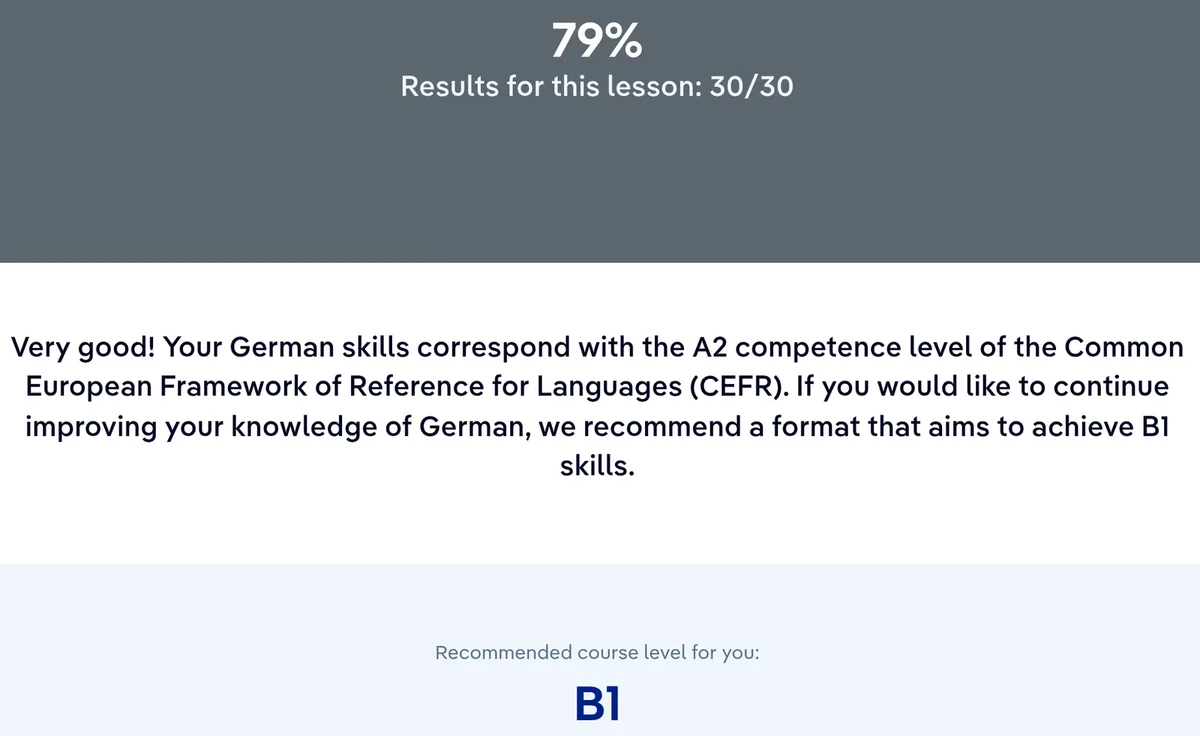
If you've studied before, take a placement test first. DW has separate tests for A1, A2 and B1. We took the A2 test, 30 exercises with audio clips such as voicemails, a train announcement and a weather report, and got several items wrong on purpose. It gave us 79% and recommended B1.
The weak spot is feedback. DW caught every mistake we made on purpose: a wrong article (eine Café), a missing umlaut (alter for älter), a typo (gefält), a wrong participle (geschreibt) and a verb in the wrong place. But no exercise told us why an answer was wrong. You get red or green, a points line and a Solve button that fills in the answer. Speaking exercises play a prompt and ask you to rate yourself "Good" or "Not so great"; nothing listens to you.
Two more limits matter. At the end of a lesson, DW says "You are currently not registered" and offers "Log in and correct mistakes". A free account, activated through an emailed link, saves your results and opens the Vocabulary Trainer. And from B1, the course is German-only. In the B1 lesson "Bei der Arbeit", the instructions, the buttons and the grammar page on indirect questions with ob were all in German, and the vocabulary list defined words in German. That's excellent practice once you're ready for it, and hard going if you aren't. Our DW Learn German review covers each level and the placement test in depth.
Is vhs-Lernportal a good free alternative to DW?
Yes, as a second free course. Every instruction in the A1 unit we took was in German, so it suits you best once that doesn't put you off. vhs-Lernportal comes from the German Adult Education Association (Deutscher Volkshochschul-Verband) and is funded by a German federal ministry. Its general courses at A1, A2 and B1 have 12 lessons each, and it adds workplace courses at B2 and C1.
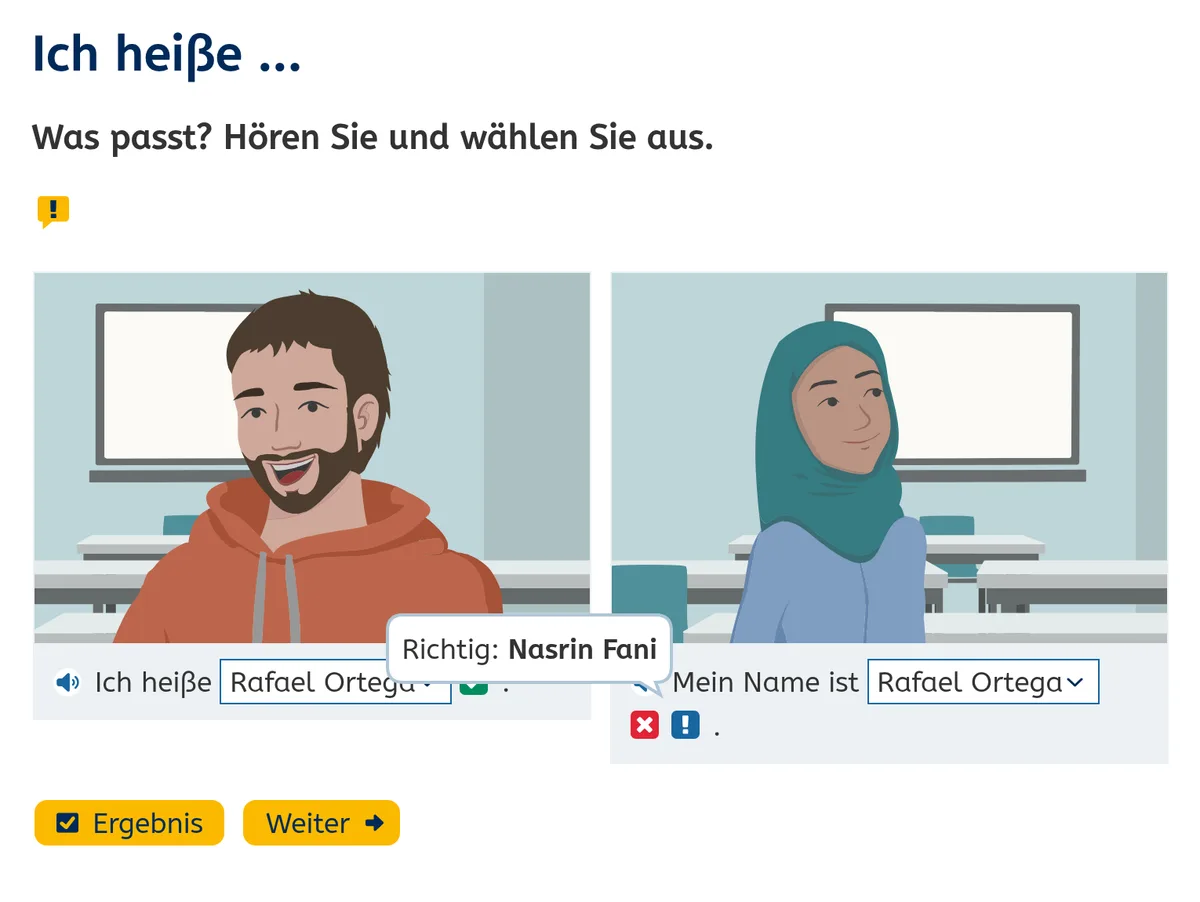
Signing up took only an email address. The first exercise in A1 Lesson 1 asks you to listen and pick each speaker's name, and the voices sounded to us like recorded human speakers, in slow, clear standard German. We picked a wrong name on purpose: the box got a red cross, and a tooltip gave the right one, "Richtig: Nasrin Fani". As with DW, nothing tells you why. At the end of the unit you can record yourself repeating lines, but nothing scores the recording.
Pick it over DW if you already live in Germany and want lessons set in everyday life there, or use it as a second course when you want more exercises at the same level. Our guide to online German courses and live classes compares both free courses with paid ones.
Can you learn German with Duolingo for free?
You can start, and the free path goes a long way. Duolingo says most German learners now get material through B2, and Explain My Answer, which explains a mistake, is free for most German learners. The free plan has ads and hearts; Super, the paid plan, removes them. On November 13, 2026, Duolingo's US website listed Super from $9.99 a month. When we did the first German lesson on the Duolingo website as a guest, a wrong answer on purpose showed the correct solution and cost a heart.
That guest lesson had 12 quick exercises in about three minutes, such as picking Tee or Kaffee and building the question Hallo, Tee oder Kaffee? None of them asked us to speak. The lines are voiced by Duolingo's cartoon characters, and in our listening check they sounded synthesized.
I tried the German course on my iPhone on November 12 with a Super account, which removes the ads and hearts but follows the same path. My German is around B1, yet I started at "Order at a café", translating Kaffee mit Milch, bitte. After the lesson I tapped through about 54 seconds of reward screens before I was back on the path. The Speak practice had me repeat ten lines after Duolingo's characters, and each one got "You said it in German!" and a translation, with no score. It made me listen and repeat, which for me is not a conversation.
Duolingo is very good at getting you to open the app every day. Use it beside DW or vhs-Lernportal rather than instead of them. Our Duolingo for German review covers the course in depth.
What is the best free German audio course?
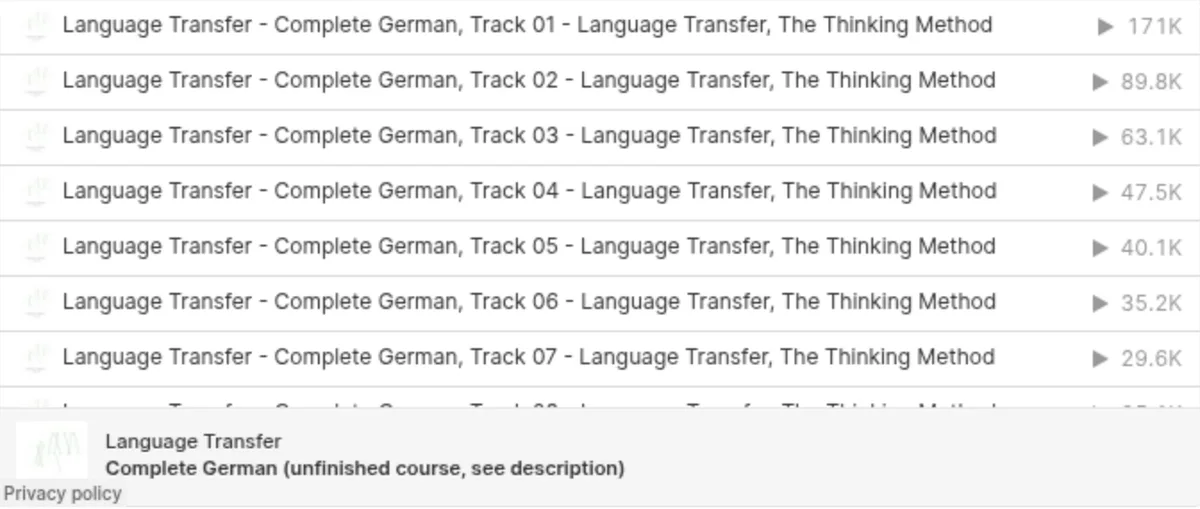
Language Transfer's Complete German. It has 50 tracks, about 6 hours 40 minutes in all, free to stream or download from the website or the free Language Transfer app, with no account. The project runs on donations, and its site says: "Everything is free. Genuinely free." Our Language Transfer review compares its Spanish, French, Italian and German courses.
Each track is a recorded class. The teacher, Mihalis Eleftheriou, has a student build German sentences from what she already knows, and you pause the audio and answer before she does. In the second track, "to learn" becomes lernen, and the student works up from Ich kann nicht gehen to Ich will nicht gehen. When she said "Feinden" for finden, he corrected her: "Finden. Finden. The 'i' we're pronouncing like 'ih', finden." His corrections explain the sound instead of only repeating it, so you learn from her mistakes as well as your own.
Know three things before you start. The site marks the course as unfinished: "Complete German remains unfinished." It's mostly English, about 80% of the second track, and the first track is a seven-minute introduction to the method with no German at all. In the two tracks we played, neither voice sounded to us like a native German speaker. The recordings are also quiet, so turn your volume up.
If you'd rather learn from a native speaker, try Coffee Break German's free podcast. In Lesson 1 of Level 1, Thomas, a native German speaker from Bavaria, teaches Mark, a learner, and about 85% of the first three minutes was English. The free page gives you the audio and a short article with the phrases. Lesson notes, video lessons and bonus audio come with the paid Level 1 course, a one-time $269.
Our Coffee Break German review covers how much English the lessons use and what the paid course adds. For a paid lesson library with a few free lessons, our GermanPod101 review shows what is free and what needs a subscription.
Where can you hear real German for free?
On Easy German's YouTube channel. Cari, Janusz and their team film conversations and street interviews. Easy German says its videos carry German and English subtitles together, and both episodes we watched had them burned in, so you can check a word without pausing.
The two main formats suit different levels. In Super Easy German 318, about food, the hosts speak slowly: about 75 words a minute in the first three minutes. Easy German 685, street interviews about Turkish culture, ran at about 141 words a minute, which is normal street speed. The hosts and passers-by sounded to us like native German speakers, almost all in standard German.
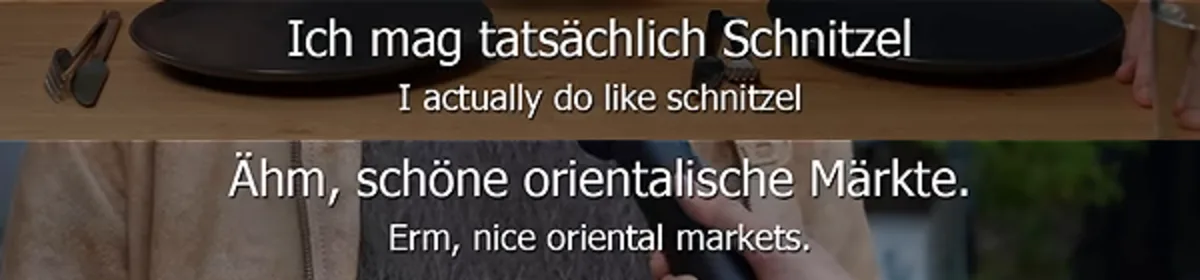
The subtitles are the main limit. On YouTube they're there in both languages, and it's easy to read the English instead of listening. German-only and subtitle-free versions come with the Learner Membership, from €11.99 a month; memberships start at €4.99 a month and are optional. Start with Super Easy German, try to follow the German line before your eyes drop to the English, and move to the street interviews when that gets easy.
How far do the free plans of paid German apps go?
Not far, but a few are worth using alongside a free course. Here's what we got without paying. Prices checked November 13, 2026.
Seedlang: free grammar trainers
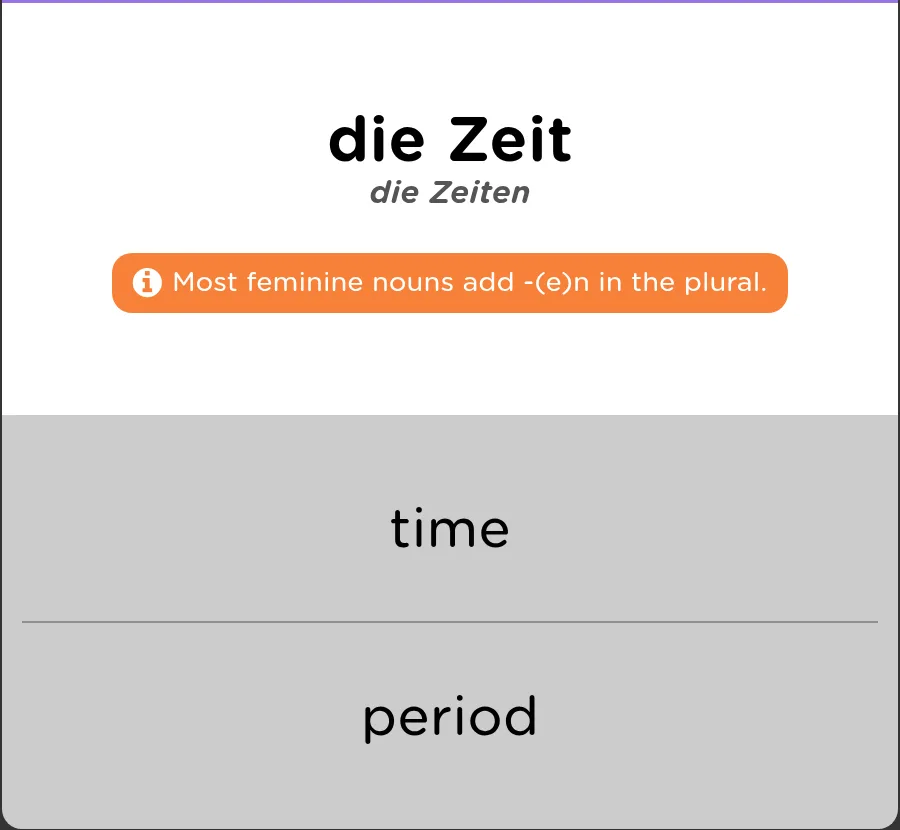
Seedlang, made with the Easy German team, has the most useful free plan here. On our free account, the Cases, Conjugations, Plurals, Vocab and Numbers trainers each ran a full A1 deck. Some explain a mistake: when we chose die Zeit as the plural of Zeit, the Plurals trainer showed die Zeiten and "Most feminine nouns add -(e)n in the plural." The Cases trainer explained a wrong case with "'Auf' is a 2-way preposition. Same location: Dative." The Vocab and Numbers trainers only showed the right answer. Story videos are the paid part: the free plan opens the first deck of a topic, and the rest say "Go Pro". Pro costs $8.99 a month or $59.98 a year. Our Seedlang review covers the free trainers and what Pro adds.
Pimsleur: one free lesson
Pimsleur's free account gives you German Level 1, Lesson 1, a 29-and-a-half-minute audio lesson, plus its practice games; Lessons 2 to 30 say "subscribe to unlock". It's a fair sample of the method: the German voices sounded like recorded native speakers to us, and pauses for your answers made up about 58% of the lesson. In the Quick Match game, our wrong picks got a red X and a check on the right answer, with no explanation. After the free lesson, plans start at $14.95 a month for audio only. Our Pimsleur German review covers the German course and its paid plans in depth.
Memrise and LingQ: limited free plans
Memrise's free plan taught us hallo and wie heißt du? in its first German lesson, with quizzes built from short videos of native speakers, and its "Say it yourself" exercise showed 10 attempts left. LingQ's free plan lets you read and listen to its Mini Stories, such as Tobias will Urlaub machen, which sounded to us like a native speaker reading slowly. On the free account we used for LingQ's Italian course, you could save only 20 words (LingQs) and import five lessons. Our LingQ review covers its free plan in detail, and our guide to the best German learning apps compares what Memrise's and LingQ's paid plans add.
How do you learn German for free, step by step?
Combine one course, one listening source and a few minutes of speaking each day. Here's a simple free routine:
- Take DW's placement test, then do one Nicos Weg lesson a day at your level, or a vhs-Lernportal lesson if you're happy with instructions in German.
- When an exercise marks you wrong, work out why from the lesson's grammar page, where there is one, before you press Solve.
- Play one Language Transfer track or one Super Easy German episode on your commute.
- Say the lesson's dialogue lines aloud, record yourself on your phone and compare your version with the video. Our German IPA guide shows how to read the sounds you keep getting wrong.
- Keep the habit going with a few minutes of Duolingo or Seedlang's trainers.
For a fuller routine from beginner to conversation, see our practical plan for learning German.
When is it worth paying to learn German?
When you need feedback on how you speak. In the free courses we tested, DW asks you to rate yourself, vhs-Lernportal has you record lines with no score, and when I tried Duolingo's Speak practice, it said "You said it in German!" without a score. If you want a teacher for that, our guide to online German courses and live classes compares the options.
For speaking practice on your own, our app, Copycat Cafe, gives you the feedback these free courses leave out. You hear an everyday German conversation at normal or slow speed, say each line aloud and get a 0–100 pronunciation score on every word with a tip on what to change, then use the same German with Copy, your AI conversation partner. It costs $14.50 a month billed as $174 a year, or $29 a month, with a 7-day free trial and a 30-day money-back guarantee on your first payment.
Frequently asked questions
Can you learn German for free?
Yes. DW Learn German's Nicos Weg and vhs-Lernportal are complete free courses from A1 to B1, and Language Transfer, Easy German and Duolingo add free audio, listening and daily practice. When you want feedback on how you sound, add a teacher or a speaking app.
What is the best free app to learn German?
DW Learn German is the best free structured course, with a free app for iOS and Android. Duolingo is the best free app for a daily habit, and works best beside a course like Nicos Weg.
Is DW Learn German completely free?
Yes. The lessons, placement tests and apps are free, and you can use the lessons without an account. A free account saves your results, lets you correct mistakes after a lesson and opens the Vocabulary Trainer.
Is Duolingo German free?
The main German path is free, with ads and hearts that you lose when you make mistakes. Super, the paid plan, removes the ads and hearts. On November 13, 2026, Duolingo's US website listed Super from $9.99 a month.
Is there a free German audio course?
Yes. Language Transfer's Complete German is 50 free tracks, about 6 hours 40 minutes, though the course is unfinished. Coffee Break German's podcast is free too, mostly in English with a native German teacher.
Can you get a German certificate for free?
DW lets you download a Nicos Weg certificate when you finish the course with a free account, but DW says its certificates aren't officially recognized. For proof of your level for a visa, job or university, you need an official exam such as those from the Goethe-Institut.