

Wondering whether Deutsche Welle's free Nicos Weg course on DW Learn German is actually any good? It costs nothing, so the real questions are whether it deserves your study time, and whether to use it as your main course or beside an app.
We took Nicos Weg lessons at A1, A2 and B1, sat DW's A2 placement test and got answers wrong on purpose to see what happens. Here's what the course does well, where it leaves you on your own, and what to add.
- Levels
- A1–B1
- Lessons
- 228
- Placement tests
- 3
- Price
- Free
How we tested: On November 12 and 13, 2026, our team used DW Learn German's German course on the web, without an account. We did three Nicos Weg lessons from start to finish, "Was trinkst du?" at A1, "Mein Bankkonto" at A2 and "Bei der Arbeit" at B1, and took the 30-exercise A2 placement test. We got answers wrong on purpose, went through the speaking exercises in each lesson and listened closely to the videos and exercise audio. We also read DW's help page, course pages and app store listings. We judged Nicos Weg on what a self-taught learner needs: how much course there is, how it corrects you, how it handles speaking and how well it carries you from one level to the next.
What is DW Learn German, and what is Nicos Weg?
DW Learn German is the free learning site of Deutsche Welle, Germany's international public broadcaster, and Nicos Weg is its main course. It follows Nico, a young man from Spain, as he builds a life in Germany, from ordering a drink to opening a bank account.
Each level has 76 lessons: four intro lessons, then 18 chapters of four lessons, then a final test. That makes 228 lessons across A1, A2 and B1. According to DW's course page, each lesson's video lasts one to two minutes. Exercises follow, with a vocabulary list, a culture note, the full script and PDF downloads alongside.
In the A2 lesson "Mein Bankkonto", the 69-second episode is all German, with German captions. Ten exercise screens follow: a listening scene at the bank, question words to fill in, Kreditkarte, Geheimzahl, Geldautomat and Formular to match with pictures, two speaking exercises and a form to complete. Each of the 34 vocabulary entries has a recording and an English translation, such as etwas ab|heben, "to withdraw something".
Is DW Learn German really free?
Yes. When we checked on November 13, 2026, we found no pricing page, paid plan, paywall or request for a card anywhere in the lessons, the placement test or the downloads. Everything we used worked without an account, and DW's Google Play listing says you can learn "completely free of charge."
A free account adds a few things. Without one, your progress stays only in your browser, and the "Log in and correct mistakes" and "Log in and save" buttons at the end of a lesson both need an account. So does the Vocabulary Trainer, which covers A1 and A2. Pass a level's final test with an account and you can download a certificate, though DW's help page says it isn't "officially recognized". If you plan to do the whole course, make the account before your first lesson.
Which level should you start at?
Unless you're a complete beginner, start with a placement test. DW has three separate ones, for A1, A2 and B1, rather than one test that adapts to you, so pick the level you think you're at. The B1 test is in German.
We took the A2 test: 30 exercises mixing grammar gaps, short recordings such as voicemails and a weather report, typed verb forms and reading tasks. We answered several wrong on purpose, and the test caught every one: "in eine Café" with the wrong article, "alter" without its umlaut, "für die Reise" with the wrong preposition, "hast du dort geblieben" with the wrong helper verb and "geschreibt" for geschrieben. None came with an explanation. The answer turns red, and on typed and drop-down questions a Solve button fills in the right one.
The scoring is strict, too. In a question where you pick every suitable answer, we added one wrong choice to two right ones and got zero points for the whole question.
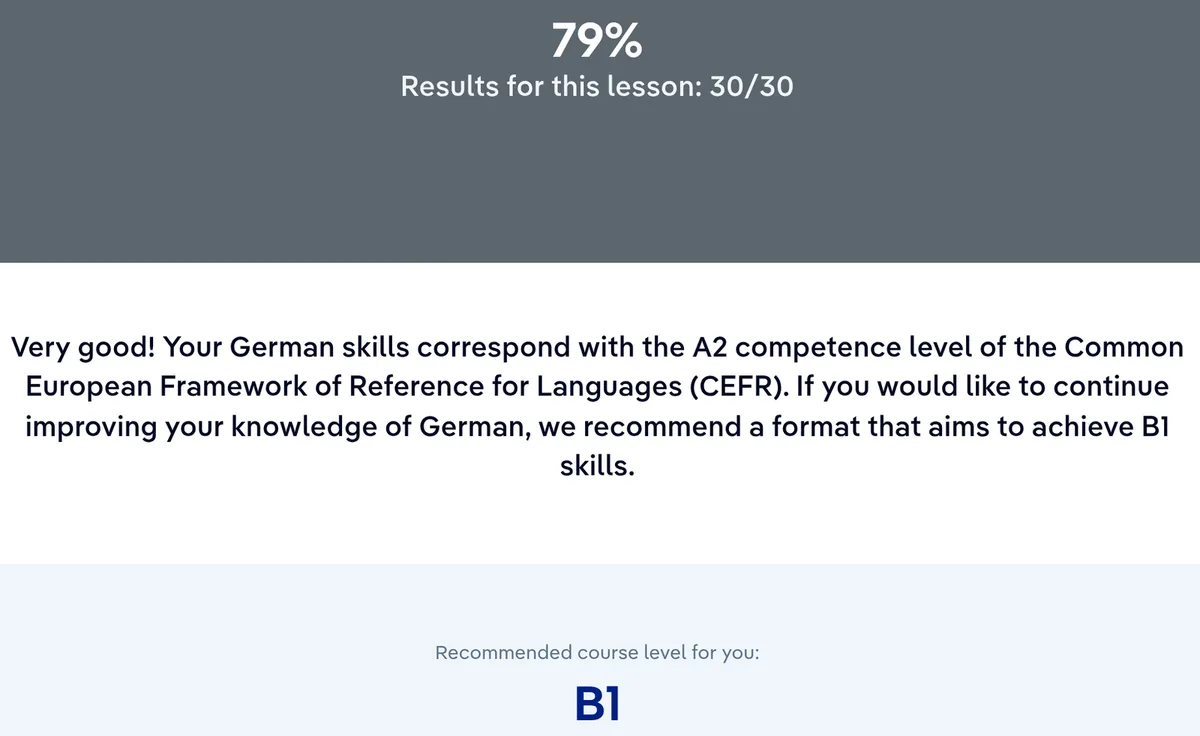
We finished on 79%. The result screen said our German corresponded "with the A2 competence level" and recommended B1, with a link straight to DW's German-only B1 and B2 area. If you get the same result, read the section on B1 below before you click it: the bigger change at B1 is that the whole course switches to German.
What are the lessons like?
The videos are the best part. In all three lessons, the German characters sounded like recorded native speakers to us, speaking standard German a little slower than normal. Nico speaks German with a Spanish accent on purpose, because he's learning too. At B1, Selma's father Ibrahim, whose family comes from Syria, also speaks German with an accent.
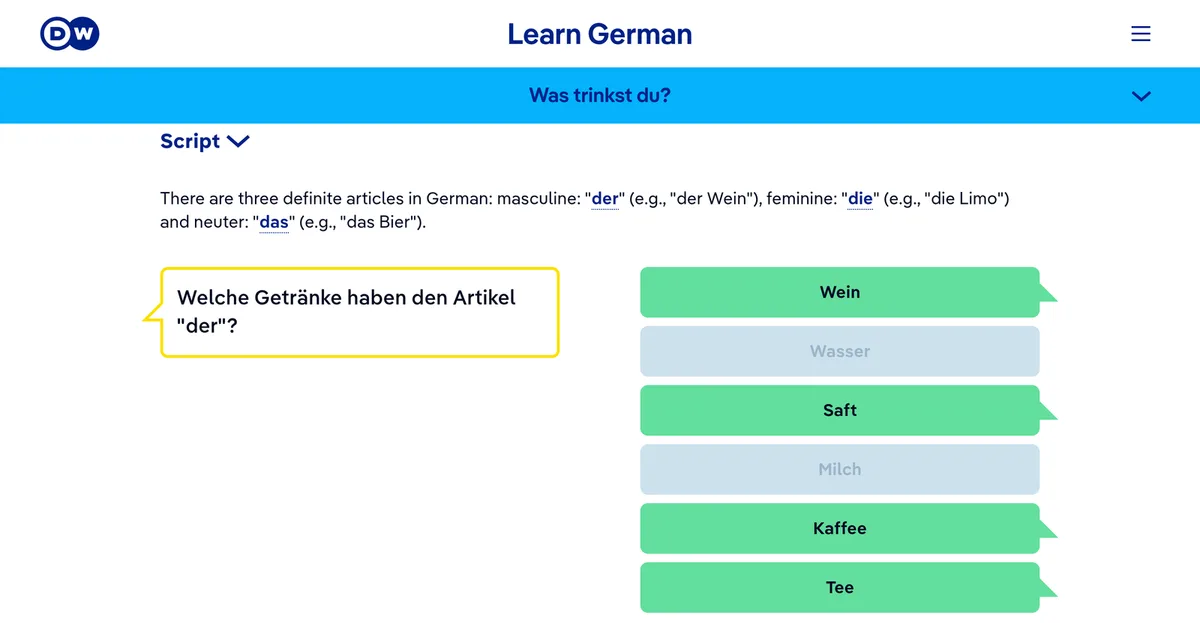
The exercises are varied. The A1 lesson "Was trinkst du?" followed its 1:51 video with 13 of them, from putting the episode's events in order to matching words to pictures, a gap fill and putting Was möchten Sie trinken? in the right order. At A1, grammar comes in small doses: a short explanation of der, die and das sits just above the exercise that asks you to sort the drinks by article.
How does Nicos Weg correct your mistakes?
It catches your mistakes but never says why they're wrong. Across our three lessons and the placement test, every mistake we made on purpose was marked: wrong articles, a missing umlaut, a typo, wrong verb forms, a wrong preposition, words in the wrong order and wrong answers to comprehension questions. What you get back is a red mark labelled "Wrong", a points line and, for typed answers, a Solve button that fills in the answer without saying why.
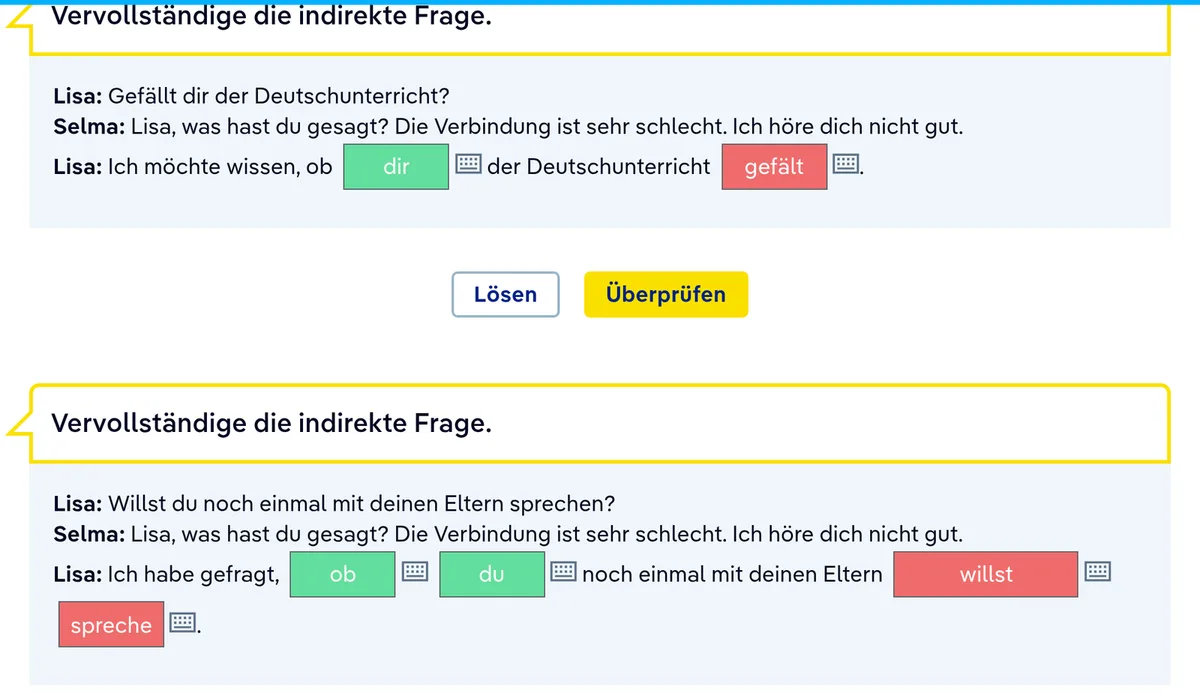
In the B1 lesson, we typed "gefält" instead of gefällt, then put the verbs in the wrong order in "ob du noch einmal mit deinen Eltern willst sprechen". Both turned red. When we pressed Lösen (Solve), the site filled in gefällt and sprechen willst, with nothing about why the verb moves to the end after ob. In the A2 lesson, a wrong answer to a comprehension question turned red without the right answer being shown at all.
Some exercise types also score all or nothing. In the A2 lesson, we swapped two of the four words in a picture-matching exercise. The two right pairs turned green, the two swapped ones red, and the exercise scored zero.
Grammar pages help, but not every lesson has one: the A2 bank lesson we took had none. So when you can't see why an answer is wrong, you'll need to look it up or ask someone. If you want a teacher who explains your mistakes, our guide to online German courses compares live classes with teacher feedback.
Can Nicos Weg teach you to speak German?
Not on its own. Nicos Weg has speaking exercises, but nothing listens to you: you hear a word or a sentence, say it aloud, then rate yourself.
In "Was trinkst du?", the two pronunciation exercises play words such as der Tee and der Kaffee, with a tip that "ie" sounds like a long "i". The recordings are slow and clear and sounded like a native speaker to us. Then the site asks "How did you do?", and you tap "Good" or "Not so great". The A2 and B1 speaking exercises work the same way.
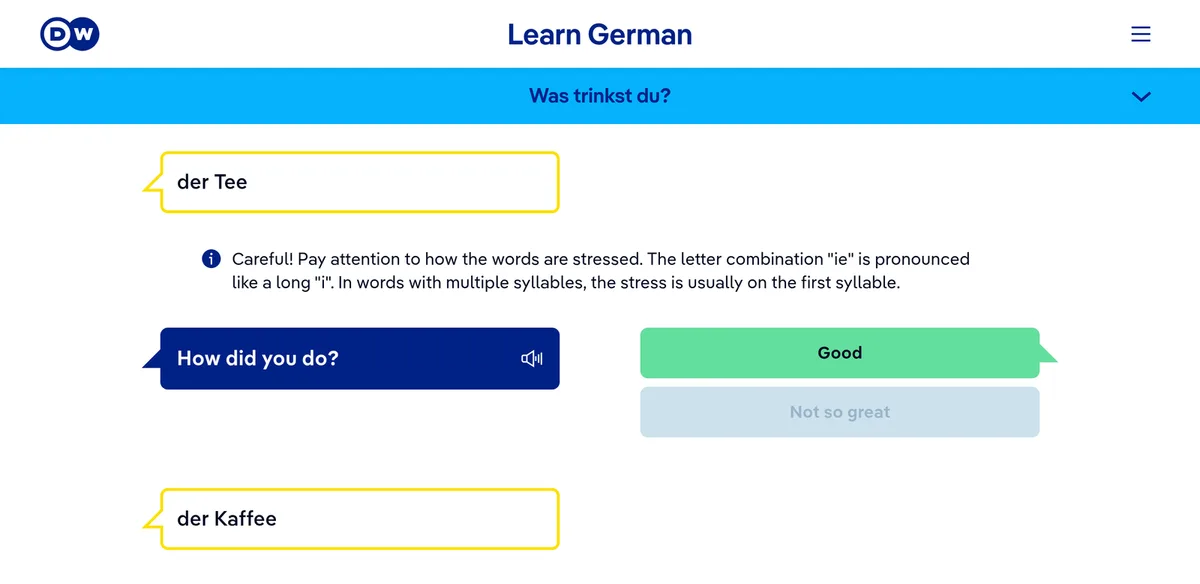
The self-rating even counts toward your score. In the A2 lesson, tapping "Not so great" was marked "Wrong" and cost us a point, so an honest answer lowers your result.
For pronunciation, Copycat Cafe does more: you say each line of a conversation aloud and get a 0–100 score on every word, with a tip on what to change in the words that need work. You find out which word let you down, rather than deciding for yourself whether it sounded right. If you practice the sounds on your own, our German IPA guide shows how dictionaries write each one.
In the lessons we took, you also watch the characters' conversations but never have one yourself. Copycat Cafe goes further: after each lesson, you use the same German in a conversation of your own with Copy, your AI conversation partner. If you'd rather talk with people, our guide to language exchange apps compares ways to find a German speaker to practice with.
What changes at B1?
At B1, the whole course switches to German. A2 works like A1, with instructions, translations and tips in English or in one of more than a dozen other languages, including Arabic, Spanish, Turkish and Ukrainian.
The B1 course lives on DW's German-language site. The menu reads Übungen, Grammatik, Wortschatz, and the first instruction is "Sieh dir das Video an und finde die richtigen Antworten auf die Fragen." DW's help page says it plainly: "From level B1, our courses are monolingual, i.e. exclusively in German."
That includes the explanations. The grammar page for our B1 lesson, on indirect questions with ob, is in German only, and so are the word definitions: Arbeitgeber is explained as "eine Person, die Menschen einen Arbeitsvertrag und eine Arbeit gibt". For the same reason, the Vocabulary Trainer stops at A2.
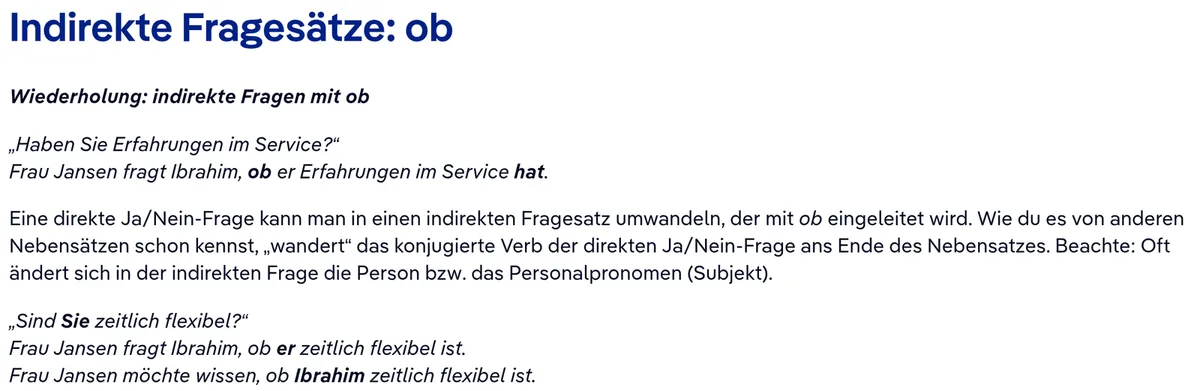
For a learner who has just finished A2, that's useful practice and a real step up at once. Keep a dictionary open for the first B1 chapters. After B1, DW's B1 and B2 area lists more free material in German, such as Langsam gesprochene Nachrichten, the daily news read slowly.
What about the DW Learn German app?
DW Learn German has free apps for iPhone and iPad and Android, but we did everything in this review on the website. When we checked on November 13, 2026, the Android app had 4.1 stars from about 9,800 reviews. The App Store version had 3.8 stars from 133 ratings and a latest version from October 9, 2025, and a 2018 review there calls it "only a web frontend to their website". DW's site doesn't say whether progress syncs between the website and the apps, so if that matters to you, pick one and stick with it.
Should you use Nicos Weg as your main course or beside an app?
Use it as your main course if you're starting German on your own and want a plan to follow. It's a real course: 228 lessons in order, a story that carries you from one episode to the next, and exercises that check every written answer.
Use it beside an app if you already have a daily habit in Duolingo or something similar. Duolingo keeps you coming back each day; Nicos Weg gives you longer listening, real situations and a clear path to B1. Our Duolingo for German review covers how the two fit together.
Either way, add the two things Nicos Weg leaves to you:
- Explanations when you get something wrong: a grammar reference, a class or a tutor who tells you why an answer is wrong.
- Speaking with feedback: a speaking app that scores you, a tutor or a language exchange partner.
Our guide to the best apps to learn German compares options for both, our Duolingo alternatives guide covers more apps, and our practical plan for learning German shows how a course like Nicos Weg fits into a full routine.
Pros
- Completely free, with no paywall and no account needed to start
- 228 lessons in order from A1 to B1, held together by a story
- Short videos with human actors, including characters with learner accents
- Varied exercises that catch typos, missing umlauts and word-order errors
- Separate placement tests for A1, A2 and B1
Cons
- Wrong answers are marked without an explanation
- Speaking is self-rated; nothing listens to you
- Matching and multiple-answer questions score all or nothing
- B1 switches entirely to German, explanations included
- Saving results and the Vocabulary Trainer need an account
What should you add for speaking practice?
If you want to keep Nicos Weg for structure and practice speaking beside it, Copycat Cafe fits that gap: you hear an everyday German conversation at normal or slow speed, say each line aloud with a 0–100 score on every word, then use it with Copy, your AI conversation partner. It costs $14.50 a month billed as $174 a year, or $29 a month, with a 7-day free trial and a 30-day money-back guarantee on your first payment.
Frequently asked questions
Do you need an account?
No. You can take the lessons and the placement test without one, but your progress then stays only in your browser. A free account saves your results and lets you correct your mistakes after a lesson. You also need one for the Vocabulary Trainer and the certificate.
Is Nicos Weg good for beginners?
Yes. A1 starts from zero, with instructions in English or another language, short videos with human actors and varied exercises that check your written answers. Wrong answers come without an explanation and speaking exercises are self-rated, so beginners should add a grammar reference and speaking practice with feedback.
How many lessons does Nicos Weg have?
Nicos Weg has 76 lessons per level at A1, A2 and B1, so 228 lessons in all, plus a final test for each level. DW says each video lasts one to two minutes, and every lesson adds exercises, a vocabulary list and the script.
Can Nicos Weg get you to B1?
It teaches up to B1 and ends each level with a final test. Because its speaking exercises are self-rated, add regular speaking practice if you want to talk at that level. DW's own certificate isn't officially recognized, so take a recognized exam if you need proof of your level.
Does Nicos Weg check your pronunciation?
No. In the three lessons we took, you listen, say a word or sentence aloud, then rate yourself Good or Not so great. Nothing checks your pronunciation, and the self-rating counts toward your score.
Is Nicos Weg better than Duolingo for German?
They do different jobs. Nicos Weg is a structured course with video episodes, longer listening and real situations up to B1. Duolingo is better at building a short daily habit. You can use Duolingo every day and Nicos Weg as your main course.