

If you're learning German and looking past Duolingo, Seedlang comes up fast. It teaches with short videos of native speakers, and it has drills for the parts of German that trip everyone up: der, die or das, the four cases, verb endings and plurals.
The real question is whether Seedlang Pro is worth $59.98 a year, or whether the free plan is enough. To find out, we worked through Seedlang's German course, got answers wrong on purpose in six of its trainers, and checked what stays locked without Pro.
Here's what we found, what it costs and who it suits.
How we tested Seedlang
Our team used Seedlang's German course on the web with a free account on November 12 and 13, 2026. We went through the first story deck in the Introductions topic, then ran full decks in five trainers (Cases, Conjugations, Plurals, Vocab and Numbers), tried the Der Die Das trainer and gave wrong answers on purpose: wrong cases, wrong verb forms, the wrong helper verb, wrong plurals, typos, a missing umlaut and a missing article. We checked which stories and features ask for Pro, measured and listened to five audio clips from the stories and trainers, and read the prices on Seedlang's membership page.
What is Seedlang, and how does it work?
Seedlang is a video-based app for German, built around short clips of native speakers plus drills for grammar and vocabulary. Its App Store listing says it was built in partnership with the Easy German YouTube channel, and it also teaches French and Spanish.
The German course has two halves. Stories are short decks of video sentences, grouped by topic and level from Foundational to Upper Intermediate. The trainers drill one thing at a time: noun gender (Der Die Das), cases, conjugations, plurals, vocabulary, synonyms and numbers. The vocabulary progress page runs from A1 to C1.
There is a lot of it. The German home page we saw listed 587 story decks and 18,194 words, with 10,095 gender cards, 5,389 case cards, 3,909 conjugation cards and 8,383 plural cards. Cards you want to keep can go into a review queue: you rate how well you knew a card, and Seedlang tells you when it will come back ("1 day" on our first card).
What do you get on Seedlang's free plan?
In the three story topics we opened, the free plan gave us the first deck and locked the rest. That included an Upper Intermediate topic: the first deck said "Start Deck" and every other deck showed a padlock and "Go Pro". The trainers ran at their default A1 level, which is plenty to judge the app. A banner across the Stories page says it plainly: "Unlocking the entire Stories section is a Seedlang Pro feature."
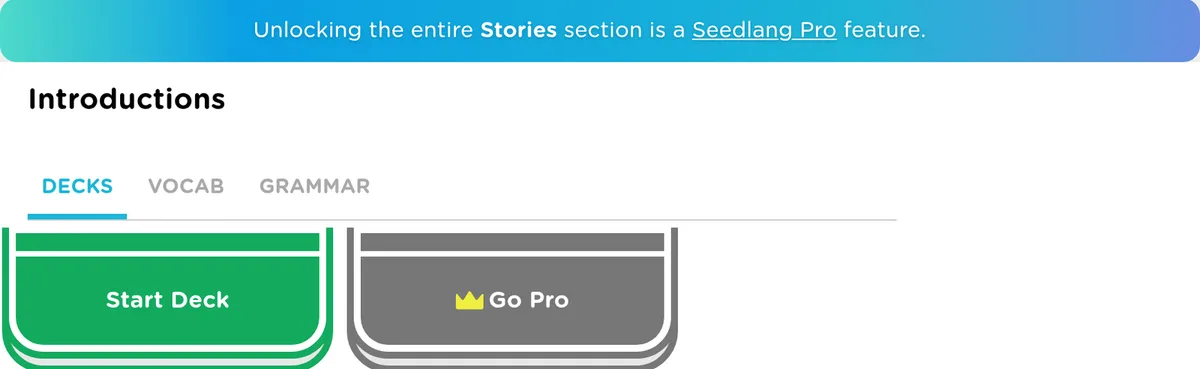
The trainers were more generous. We ran a full deck in Cases, Conjugations, Plurals, Vocab and Numbers without hitting a daily limit in about half an hour of practice. Each trainer's options also show an "Unlock All Decks" button, so expect more decks and filters behind Pro. Trivia is Pro only: all eight Trivia decks were greyed out on our free account, and the review progress chart is Pro only too.
So the free plan is enough to judge the trainers before you pay. If the stories are why you came, you'll need Pro.
How good are Seedlang's story videos?
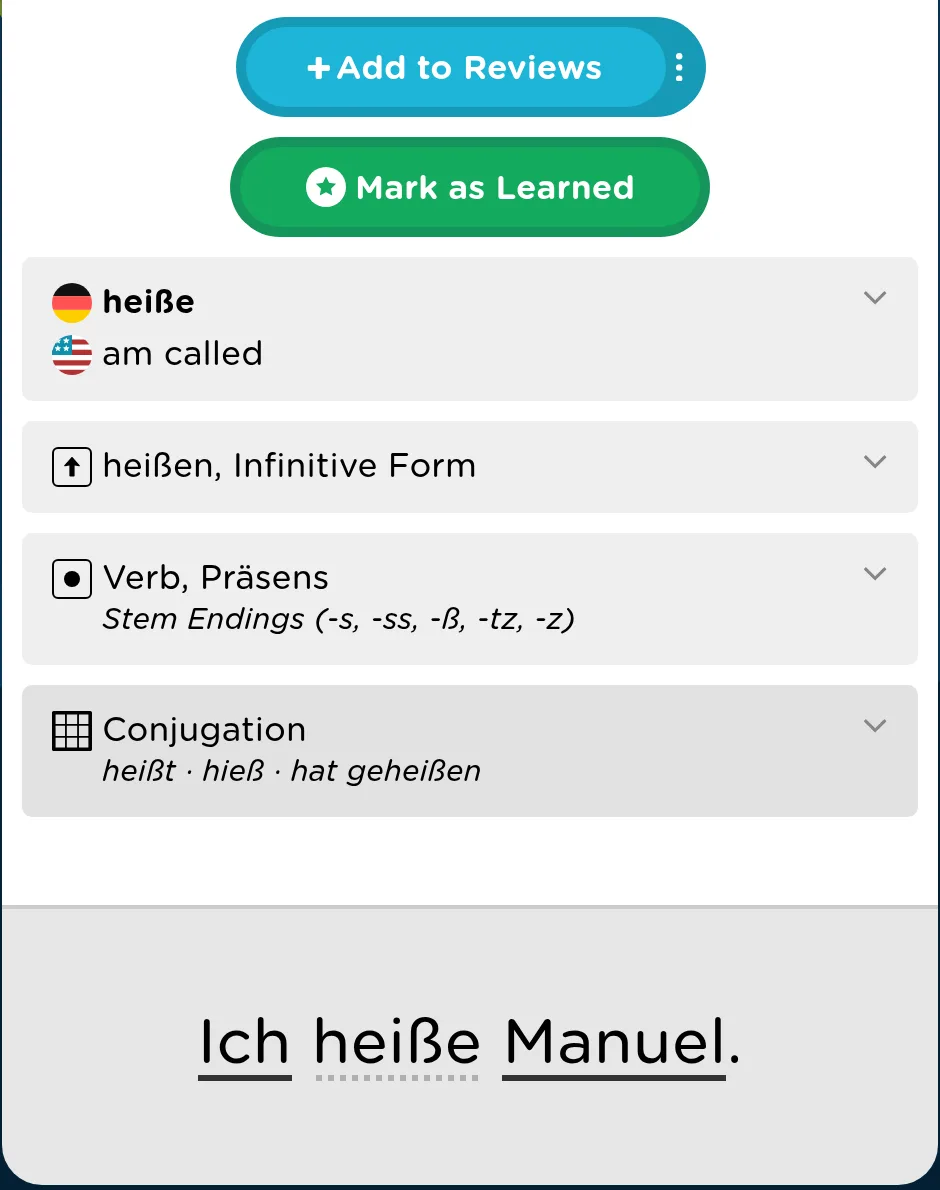
They're the best part of Seedlang: every line is a short video of a real person saying it, and the app makes you listen before you read. Our first story deck had lines like Ich heiße Manuel and Ich bin Fabian, with the subtitles hidden until you tap for them and the prompt "Repeat the German. Try without viewing the subtitles."
Tapping a word opens its grammar, not only a translation. When we tapped heiße, Seedlang showed "am called", the infinitive heißen, the stem-ending rule it follows and the forms heißt · hieß · hat geheißen. That's the kind of explanation a German learner actually needs from a word lookup.
The audio is strong. We downloaded five clips from a beginner story, an Upper Intermediate story and three trainers, and all of them sounded like recorded native speakers to us: four different voices, all in standard German, trainer clips included. When we watched the first story deck on November 12, one street clip sounded to us like it had traffic noise behind it.
Our measurements turned up two more things. The loudest clip was about 10 LU louder than the quietest, so volume can jump from one clip to the next. And one short clip in the Upper Intermediate deck we downloaded had no sound track.
Do Seedlang's grammar trainers explain your mistakes?
Some do. The Cases trainer explains a wrong case with a one-line rule, the Plurals trainer does it for some nouns, and the others mostly show you the right answer and leave the why to you. This table sums up what each trainer showed after our wrong answers:
| Trainer | What you do | After a wrong answer |
|---|---|---|
| Der Die Das | Pick the article for a noun | The right article and plural on a colour-coded card |
| Cases | Name the case of a word in a video sentence, then fill the gap | A one-line rule for a wrong case; only the right word in the gap-fill |
| Conjugations | Pick or type a verb form for a person and tense | The full tense table with the right row highlighted |
| Plurals | Pick the plural from four options | A one-line rule for some nouns, only the answer for others |
| Vocab | Video flashcard, meaning quiz, typed translation, sentence gap-fill | The right answer only |
| Numbers | Pick the meaning of a spoken number from four options | The right number only |
In short, Cases teaches you something when you get it wrong, and the rest mostly correct you.
Cases: the trainer that teaches
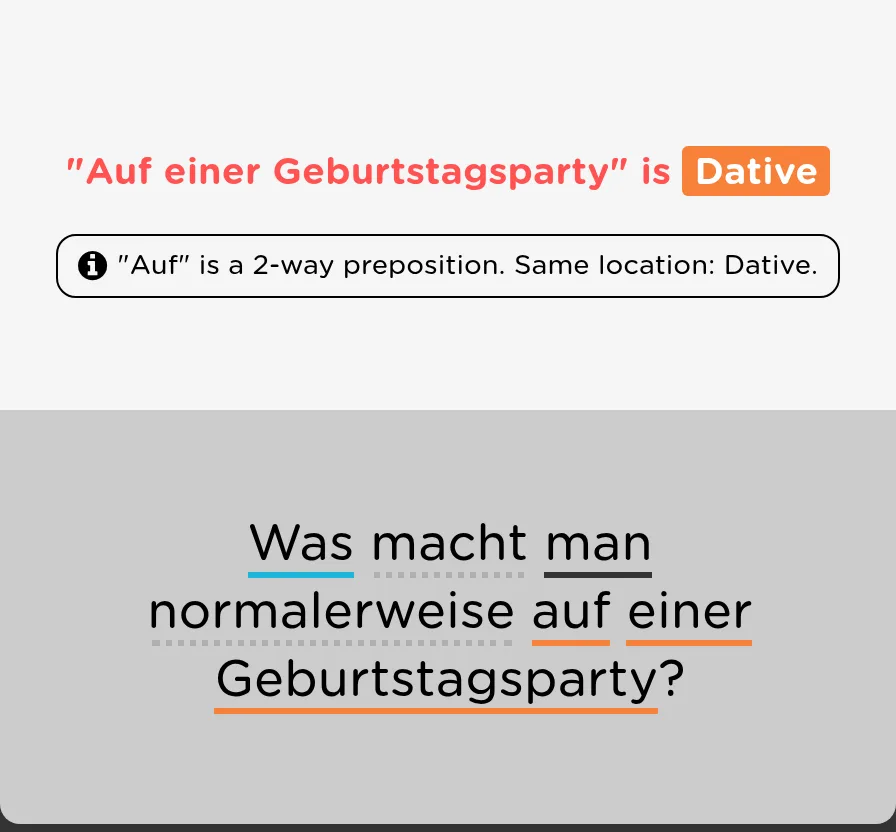
The Cases trainer is the one we'd pay for. A native speaker says a sentence on video, one phrase is highlighted, and you pick Nominative, Accusative, Dative or Genitive. When we called auf einer Geburtstagsparty Accusative, it answered: "'Auf' is a 2-way preposition. Same location: Dative." It gives the rule on right answers too, so you keep seeing why.
The second round, where you type the missing word, is stricter and quieter. Our wrong eine for einer only showed the right word, and a typo (sihc for sich) was marked wrong with no allowance for a slip of the finger. We finished the deck at 14 out of 20 on the first try.
Conjugations: a table instead of a reason
The Conjugations trainer shows you the whole tense table when you're wrong, with the right row highlighted, but no rule. When we typed gebten for wir gaben, it showed the Simple Past table and nothing about strong verbs changing their vowel. When we typed hat gegangen, it showed er ist gegangen and the Present Perfect table, with no note that verbs of movement like gehen take sein. That's an easy slip for English speakers, since English uses have for every perfect, and the table alone won't tell you why you made it.
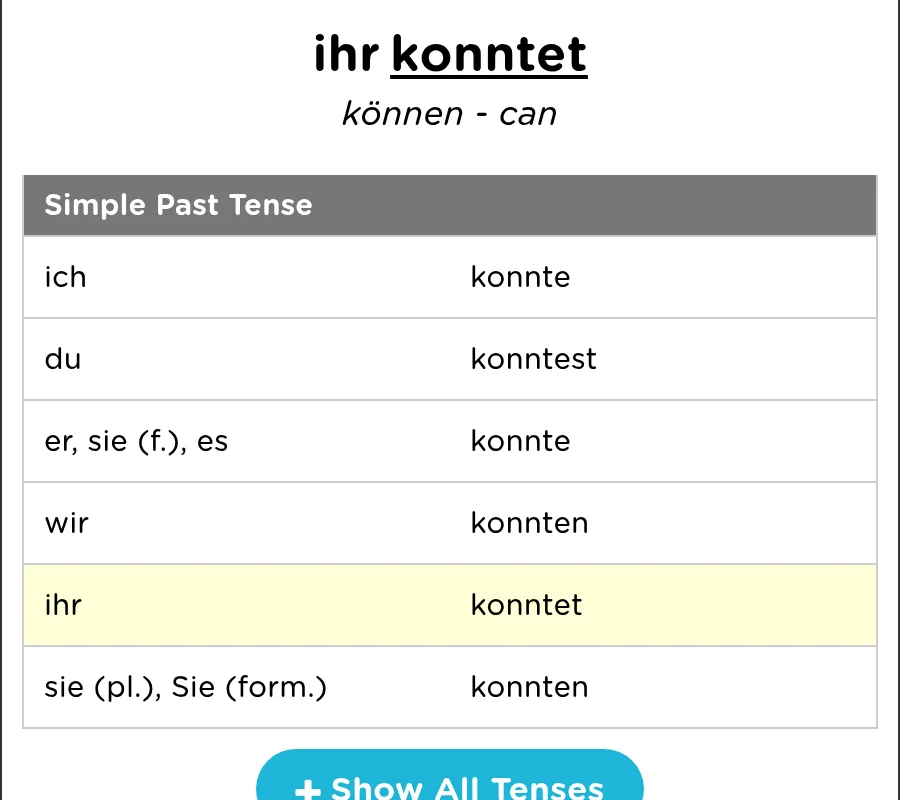
We also hit a content error: the hat gegangen card glossed gehen as "to be better than" instead of "to go". We saw it on only one card, but a beginner wouldn't know to doubt it.
Plurals, Vocab and Numbers: correct answers, few reasons
The Plurals trainer gave a rule for some nouns and not others. Picking die Zeit as the plural of Zeit brought up "Most feminine nouns add -(e)n in the plural," but die Mensche for Mensch only showed die Menschen, and Tag, Stadt and Thema had no rule line at all.
Vocab and Numbers show only the right answer. When we picked "kind" as the meaning of das Kind, the card showed "child" with no warning that it's a false friend. Typing Worter without the umlaut was marked wrong, and so was Euro without its article. That strictness is fair for German, but you have to work out what went wrong yourself. In Numbers, we picked 26 for zweiundsechzig, the classic mix-up, and the card showed only "62", with nothing about German saying the units before the tens.
Can Seedlang help you speak German?
It gets you saying German out loud, and judging how close you came is up to you. Story cards ask you to repeat each line, and story and vocab cards have a microphone button with the instruction "Compare your recorded German to the speaker in the video." Seedlang describes it as recording yourself and comparing your recording with the native speaker; nothing in the instruction mentions a score.
That's useful if you have a good ear. If you don't yet know which sounds you're getting wrong, it's hard to fix them by comparison alone. For pronunciation feedback, Copycat Cafe does it better: you say each line of an everyday conversation aloud and get a 0–100 pronunciation score on every word, with a tip on what to change for your next try. After the lesson, you use what you practised in conversation with Copy, your AI conversation partner, so you practise answering as well as repeating.
If one German sound keeps coming out wrong, our guide to reading German IPA shows what each symbol in a dictionary means and how to say it.
How much does Seedlang Pro cost?
Seedlang Pro costs $8.99 a month, $20.97 every three months or $59.98 a year on Seedlang's membership page. Prices checked November 13, 2026.
| Plan | You pay | Per month |
|---|---|---|
| Monthly | $8.99 each month | $8.99 |
| 3-Month | $20.97 every 3 months | $6.99 |
| Yearly | $59.98 a year | $4.99 |
The yearly plan costs less than seven months of the monthly one, so it's the plan to pick once the free decks have convinced you. Seedlang says you can cancel at any time and offers a 15-day money-back guarantee on all purchases. The same Pro price covers its German, French and Spanish courses.
There was no Black Friday offer on the page when we checked: the "44% Off" label on the yearly plan is Seedlang's standing discount compared with paying monthly. The US App Store lists a Pro membership at $59.99.
Is Seedlang Pro worth it for German?
Yes, if grammar drills with real voices are what you're missing. Here's how the strengths and weak spots from our test add up:
Pros
- Every clip we checked sounded to us like recorded native speakers, trainers included
- Thousands of cards for gender, cases, conjugations and plurals
- The Cases trainer explains wrong case choices with a clear rule
- Word lookups show grammar, not only a translation
- A generous free plan, and one price for German, French and Spanish
Cons
- Most trainers show the right answer without saying why
- Typed answers allow no typos
- No pronunciation score: you compare your recording yourself
- Uneven loudness between clips, and one card glossed gehen wrongly
- Most stories and all of Trivia need Pro
Seedlang suits you if you already use Duolingo or a course and German grammar is the blurry part, you like learning from real faces and voices, or you're learning more than one of German, French and Spanish. At $4.99 a month on the yearly plan, it's a low-cost add-on to whatever else you use.
Skip it if you want every mistake explained, or if your goal is speaking with feedback on how you sound. Seedlang's drills are built for recognising and recalling the right form, and its speaking practice leaves the judging to you.
What are the best alternatives to Seedlang?
It depends on what Seedlang isn't giving you. If you want a free daily habit, read our Duolingo German review. If you want a structured course with a teacher or a full curriculum, our list of the best online German courses compares nine. Our guide to the best apps to learn German puts Seedlang next to ten other apps, and our Duolingo alternatives roundup covers more options across languages. For a plan that ties these together, see the best way to learn German.
If you want to speak German, Copycat Cafe is built for that: you hear an everyday conversation, say each line with a 0–100 score on every word, then use it with Copy, your AI conversation partner. It costs $14.50 a month billed as $174 a year, or $29 a month, with a 7-day free trial and a 30-day money-back guarantee on your first payment.
Frequently asked questions
Is Seedlang free?
Partly. On our free account, the first deck of each story topic we checked opened, and the grammar and vocabulary trainers ran at the default A1 level; we ran full decks in five trainers and tried Der Die Das. The rest of the Stories section, Trivia and the review progress chart need Seedlang Pro.
Is Seedlang Pro worth it?
It is worth $59.98 a year if you want to drill German noun gender, cases, verb forms and plurals with short clips of native speakers. It is less useful if you want every mistake explained or a score on your pronunciation.
Who made Seedlang?
Seedlang, Inc makes it; its App Store listing says the app was built in partnership with the Easy German YouTube channel. Its focus is German taught with videos of real people, and it also teaches French and Spanish.
What level does Seedlang go up to?
Seedlang's vocabulary runs from A1 to C1, according to its progress page and membership page. Its stories go from Foundational to Upper Intermediate, and Trivia covers A1 to B2.
Does Seedlang check your pronunciation?
No automatic score. Story and vocab cards let you record yourself and compare your recording with the speaker in the video, so you judge the difference yourself.
Does Seedlang Pro include French and Spanish?
Yes. Seedlang's membership page says one Pro price unlocks its German, French and Spanish courses.