

Every day except Sunday, Deutsche Welle reads the news slowly for German learners. On November 13, 2026, the episode page also offered the same bulletin at its original tempo. We measured both: about 69 German words a minute in the slow version and about 111 in the original. Both are free.
That pair shows how to use German podcasts: find the speed you can just follow, then step up.
So our team measured 11 German learning podcasts: how fast they speak, how much English you hear, who's talking, and what's free. Here are the ones worth your time, ranked by level.
How we tested
On November 13, 2026, our team took the newest episode of 11 German learning podcasts from each show's official feed and saved the first two minutes, plus a minute from the middle when the start was ads or English. We measured how many German words a minute each show speaks and how much of its own talk is English, listened for who speaks, and read each show's site for transcripts and prices. For DW's slowly spoken news, we also measured its original-tempo version. The same day, we measured two Easy German YouTube episodes, played the first two tracks of Language Transfer's Complete German, and listened to Coffee Break German's first lesson. Speeds are give or take a few percent. Prices checked November 13, 2026.
Which German podcasts fit your level?
Here are the eight shows we recommend, from the most English to the most demanding German.
| Podcast | Level | German words a minute | English in the show | Transcripts | Price |
|---|---|---|---|---|---|
| Coffee Break German | Beginner | Too little German to measure | About 90% (newest episode), about 85% (Lesson 1) | Free handout with the German text; full transcripts in the paid course | Free; Level 1 course $269 once |
| Nachrichtenleicht | A2 | About 108 | None | Free news texts with audio | Free |
| Slow German | A2–B1 (site: B1 and up) | About 90 | None | Free, full text on every episode page | Free; Premium from €6.90 a month |
| News in Slow German | A2–B1 | About 79 | Only the show's name | Full Access subscription | Free episodes; Full Access $17.90 a month |
| DW Langsam gesprochene Nachrichten | B2 (DW's label) | About 69 slowly spoken, 111 original | None | Free | Free |
| Easy German Podcast | B1–B2 | About 148 | About 10% (one bilingual joke) | Members only | Free; membership from €4.99 a month |
| Deutsches Geplapper | B2 | About 118 | None | Free word list; transcript in the paid Plapperclub | Free; Plapperclub €39 a month |
| Auf Deutsch gesagt! | B2–C1 | About 139 | None | Patreon members | Free; Patreon membership |
DW's Top-Thema and Alltagsdeutsch sit between the slow news and Easy German; we cover them below.
The best German podcasts for beginners
Coffee Break German
Coffee Break German is a structured course in podcast form, and its Level 1 starts from zero. In Lesson 1, Thomas, a native German speaker from Bavaria, teaches Mark, a learner with a Scottish accent. About 85% of the first three minutes was English, which is what you want in week one.
Start at Lesson 1, though, not at the newest episode. The last three months of the feed were specials: treasure-hunt clues and companion episodes to a YouTube series. The newest, on November 9, 2026, was about 90% English in our sample, with German in bursts of three seconds or less. The last regular lesson came out on August 17, 2026.
Coffee Break German's free handout has the German text and a word list; full transcripts are in the paid course. The Level 1 course costs a one-time $269. Our guide to online German courses compares it with other paid courses.
Language Transfer: Complete German
Language Transfer's Complete German is a free audio course rather than a talk show: 50 tracks, about 6 hours 40 minutes, with no account. A teacher has a student build German sentences from what she already knows, and you pause the audio and answer before she does. It's mostly English, about 80% of the second track, and in the two tracks we played, neither voice sounded to us like a native German speaker. The site marks the course as unfinished, and the recordings are quiet, so turn the volume up. Our guide to learning German for free covers it in more detail.
Copycat Cafe's free German audio course
Copycat Cafe's free German audio course has five A1 episodes of nine to ten minutes. In each one you hear an everyday scene, such as a mix-up over coffee, learn its useful phrases, copy them aloud, then try your own answers in the pauses. Every episode has a free MP3 and a full transcript, with no sign-up. The voices are AI-generated. You can also listen on Spotify, Apple Podcasts and YouTube.
The best slow German podcasts (A2–B1)
Once you know some basics, switch to shows that are all German but slow. After DW's slowly spoken news, these three were the slowest all-German shows we measured.
Slow German
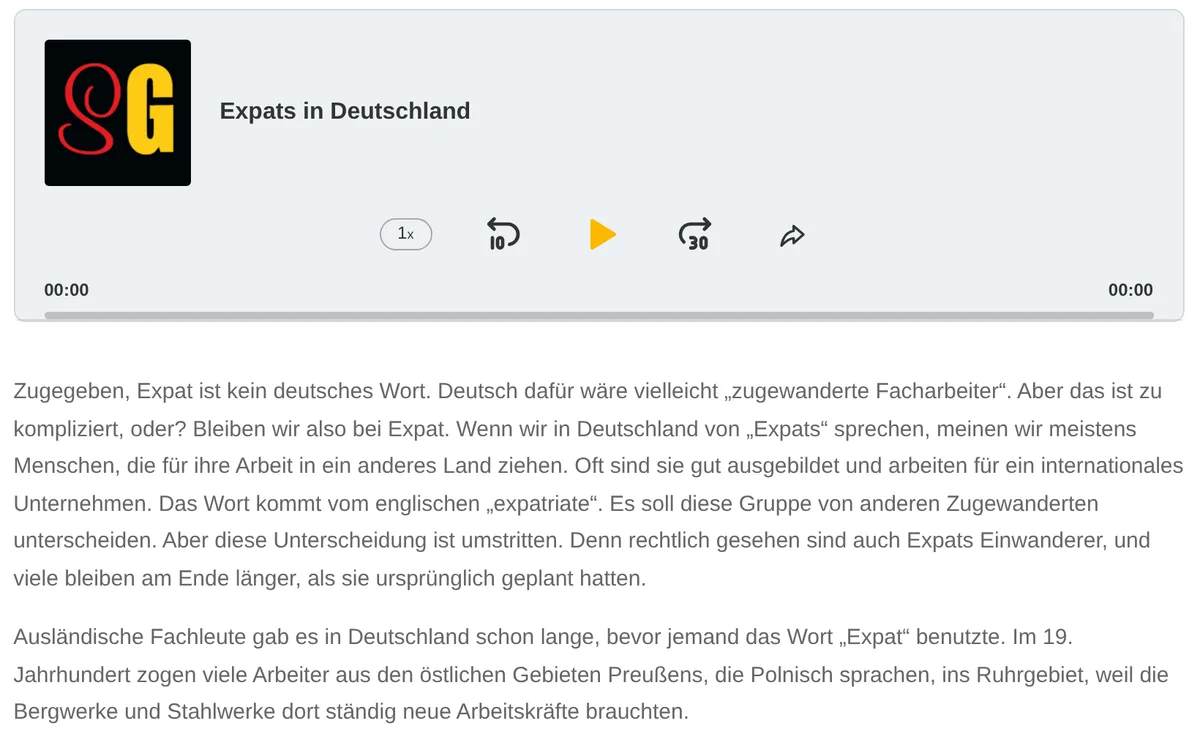
Slow German is the best slow German podcast for most learners, because every episode's full text is free. Annik Rubens has been making it since 2007, and a new episode comes out about every two weeks. In the newest, "Expats in Deutschland", eight minutes long, the host spoke at about 90 words a minute, with no English beyond loanwords like Expat, in clear standard German that sounded to us a little southern (the site says she's based in Munich).
Open the episode page and the whole text is right under the player, with no login. The RSS feed carries the text too.
Slow German's site says the podcast is for B1 and up. At 90 words a minute with no English, it's worth trying from late A2. Premium adds slow and fast versions of the audio, PDFs and exercises for €9.90 a month, or €6.90 a month on a 12-month plan, with a 7-day free trial.
Nachrichtenleicht
Nachrichtenleicht, from the public broadcaster Deutschlandfunk, reads the news in Einfache Sprache, simple German, on most days. The November 13 episode was five minutes long, read by one newsreader at about 108 words a minute. That's faster than Slow German, but the short news items sounded A2 to us. The news texts are free on the site, with audio for each item, so you can read along.
News in Slow German
News in Slow German was the slowest show we measured after DW's slowly spoken news: about 79 words a minute in its weekly intermediate episode, read mostly by one woman in what sounded to us like standard German. The catch is that transcripts and translations need a subscription: Full Access costs $17.90 a month, with a 7-day free trial.
The best German podcasts for intermediate learners (B1–B2)
For intermediate learners, DW's daily news, which DW labels B2, lets you build speed in steps, and the Easy German Podcast gives you real conversation.
DW Langsam gesprochene Nachrichten: the same news, slow and at original tempo
Langsam gesprochene Nachrichten ("slowly spoken news") is Deutsche Welle's daily news bulletin, read slowly, Monday to Saturday. It was the slowest German we measured: about 69 words a minute in the November 13 bulletin, read by one newsreader in what sounded to us like standard broadcast German. The vocabulary is real news vocabulary, and DW labels it B2.
The best part is on the episode page. DW gives you the full text and two free MP3s of the same bulletin, one slowly spoken and one "im Originaltempo".
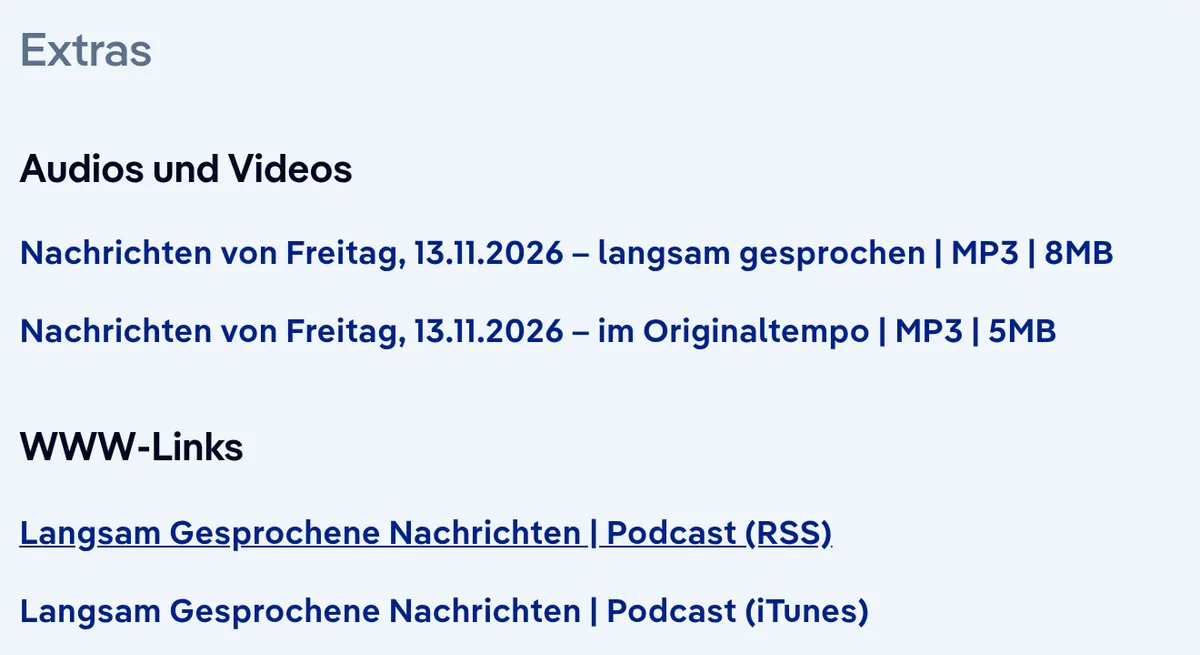
We measured both. The original-tempo version ran at about 111 words a minute, and the whole file lasted 345 seconds against 535 for the slow one. Listen to the slow version with the text, then play the original tempo without it. When the original stops feeling fast, you're ready for the shows below. DW's audio was quieter than most shows we measured, so turn it up.
DW Top-Thema and Alltagsdeutsch
Two more DW Learn German podcasts are worth a listen at this level. Top-Thema mit Vokabeln publishes short reports about twice a week; the November 13 episode, "Die schwierige Suche nach einem Endlager", was three minutes long. It's read at normal speed, about 129 words a minute in our sample, and sounded B1 to us. Deutsche im Alltag, or Alltagsdeutsch, is a weekly feature; the November 10 episode ran 11 minutes. It was a field recording from Bonn about St. Martin's Day, with a narrator at about 136 words a minute and a children's choir singing. It sounded B1–B2 to us. If you like DW's courses, our DW Learn German review covers Nicos Weg.
Easy German Podcast
The Easy German Podcast is the best German podcast for real conversation at real speed. Two hosts chat twice a week, with more than 700 episodes since 2019. In episode 709, about "Unfreundlichkeitstrainings bei Aldi", they split the talking about evenly and spoke at about 148 words a minute in what sounded to us like standard German, the fastest show on our list. About 10% of our sample was English, all from one bilingual joke in the intro, so expect almost all German. There were no ads in the clip we took from the public feed.
The study tools are for members. Episode 709's page says members get the interactive transcript and vocabulary helper for every episode.

Memberships start at €4.99 a month. The Learner membership, from €11.99 a month, includes the transcripts, an ad-free feed and an aftershow; Conversation starts at €34.99 a month. If 148 words a minute is too fast, start with Super Easy German on Easy German's YouTube channel. It's video, with no podcast feed we could find, but in episode 318 the hosts spoke slowly, about 75 words a minute in the first three minutes, with German and English subtitles burned in. Easy German's street interviews are faster: about 141 words a minute in episode 685, where the hosts and passers-by sounded to us like native German speakers. For exercises from the same team, see our Seedlang review.
The best German podcasts for advanced learners
Deutsches Geplapper
In Deutsches Geplapper, Flemming and Amelie, siblings according to their site, talk every week. The November 11 episode asked whether German children are getting dumber ("Werden deutsche Kinder immer dümmer?") and ran 35 minutes. At about 118 words a minute it's slower than Easy German, but it's unscripted and sounded northern to us (they open with "Moin"), and the episode titles say B2–C1. It sounded B2 to us.
In our check, the episode opened with a minute of English ads, noticeably louder than the quiet show, so set the volume after them; your ads depend on where you listen. The free text is thin: the newest four episodes came with only a free list of the 15 most important words. The bilingual transcript is in their Plapperclub, at €39 a month, €190 for six months or €360 a year.
Auf Deutsch gesagt!
Auf Deutsch gesagt! is Robin Meinert's show for advanced learners, with a new episode about every two weeks. Episode 179, "Germanistik trifft Humor" with his guest Raphael Breuer, runs almost 50 minutes. In the stretch we measured from the middle, the two spoke at about 139 words a minute, all in German, and Robin's intonation sounded northern to us (his site says he's from Hamburg). Transcripts of current episodes are for members on Patreon. The episode opened with Robin's own German promo for a course, then ads.
Which German podcasts did we leave out?
These still turn up in searches:
- Deutsch lernen durch Hören had published nothing in the 25 days before our check.
- Coffee Break German Advanced hasn't published since July 2023, and Coffee Break German Magazine's last episode came out in August 2022.
- GermanPod101's feed is active, but its newest items were short video lessons and promotions rather than audio lessons. Its read-along transcripts come with a paid plan.
- Duolingo has no German podcast. Its podcast site says it is winding down its podcast series, and none of them teach German. If you use the app, read our Duolingo for German review.
Can you learn to speak German from podcasts?
Podcasts train your ear. Speaking is a separate skill: you can follow a whole Easy German episode and still lose your words when the baker asks whether you want anything else. To close that gap, say what you hear out loud, get feedback on how it sounds, and use it in a conversation. Our practical plan for learning German shows where podcasts fit beside a course and an app from our best German learning apps guide, and our German IPA guide helps with the sounds you keep missing.
That speaking step is what Copycat Cafe is for. You hear an everyday German conversation at normal or slow speed, say each line aloud and get a 0–100 pronunciation score on every word with a tip on what to change, then use the same German with Copy, your AI conversation partner. It costs $14.50 a month billed as $174 a year, or $29 a month, with a 7-day free trial and a 30-day money-back guarantee on your first payment.
Start with the show you can just follow. When it gets easy, move to the next level in the table.
Frequently asked questions
What is the best German podcast for beginners?
Coffee Break German, starting from Level 1, Lesson 1. Its lessons are explained in English: about 85% of the first three minutes of Lesson 1 was English in our test. Language Transfer's free Complete German is a good audio course alongside it. Move to Slow German once you can follow some German without English.
Is there a slow German podcast?
Yes, several. DW's Langsam gesprochene Nachrichten was the slowest we measured, about 69 words a minute, followed by News in Slow German at about 79 and Slow German at about 90. Slow German and DW give you the full text free.
Is the Easy German Podcast free?
Yes, the episodes are free in any podcast app. The interactive transcript, vocabulary helper and ad-free feed come with the Learner membership, from €11.99 a month. Memberships start with Supporter at €4.99 a month, and Conversation starts at €34.99 a month.
Which German podcasts have free transcripts?
Slow German puts the full text on every episode page, DW's Langsam gesprochene Nachrichten gives the full text with each bulletin, and Nachrichtenleicht has free news texts with audio. Coffee Break German has a free handout with the German text. Easy German, News in Slow German, Deutsches Geplapper and Auf Deutsch gesagt! keep transcripts for paying members.
Does Duolingo have a German podcast?
No. Duolingo's podcast site says it is winding down its podcast series, and none of them teach German.
Can you learn German just by listening to podcasts?
Podcasts build your listening, vocabulary and feel for real speed, but speaking is a separate skill. To speak, say what you hear out loud, get feedback on how it sounds, and use it in conversation.