

Thinking about learning German with Coffee Break German? Its podcast is free in three levels of 40 lessons each, and its paid courses add videos, notes and quizzes for $269 a level. So can you learn from the free podcast alone, and is the course worth the money?
Our team listened to lessons from Level 1 and Level 3, counted the English, read the free and paid course pages and opened a free preview. Here is what we found, and who it suits.
How we tested Coffee Break German
On November 13, 2026, our team tested Coffee Break German on the web as a visitor, through the official podcast feeds and in a Coffee Break Academy course preview. We listened to the opening minutes of three episodes, Level 1 Lessons 1 and 21 and Level 3 Lesson 21, and to the closing review of Level 1 Lesson 1, and checked how much was in English, who was speaking and whether the lesson left pauses for us to answer. We timed each episode and measured its silences. We read the free Lesson 1 page and the Level 1 lesson list, compared the feeds with the lesson lists, opened the free preview of the Level 1 Lesson 1 video in the Academy course player and checked the course pages, prices and refund policy.
What is Coffee Break German?
Coffee Break German is made by Coffee Break Languages (Radio Lingua), the team behind Coffee Break Spanish and Coffee Break Italian. It has three levels, and each starts with a free podcast of 40 lessons:
| Level | Coffee Break’s label | Where the free audio is |
|---|---|---|
| Level 1 | Absolute beginner, A1–A2 | The main Coffee Break German podcast |
| Level 2 | Beginner plus, A2–B1 | The main Coffee Break German podcast |
| Level 3 | Intermediate, B1–B2 | A separate show, Coffee Break German Advanced |
When we checked the official feeds, the main Coffee Break German show still carried all 40 Level 1 lessons, the first from January 2013, and all 40 Level 2 lessons. Level 3 appeared there only as an introduction episode. Its 40 lessons, published between October 2021 and July 2023, sit in a separate show called Coffee Break German Advanced, so look that name up in your podcast app when you finish Level 2.
Level 1 comes in four blocks of ten lessons: meeting people, eating out and getting around, everyday situations, and travelling, in which Mark flies to Austria to try out his German. Level 3 takes on the genitive, the passive and the subjunctive, and ends with a story in ten episodes, Ein Zwilling studiert selten allein.
What is a Coffee Break German lesson like?
A lesson is a conversation between a teacher and a learner, in English with German worked in. Level 1 Lesson 1 runs 21 minutes. Mark plays the learner and admits early on that his German “isn’t very good at all”. Thomas teaches, and introduces himself in that first lesson: “I come from the south of Germany, from Bavaria, and I’m currently studying in Innsbruck, which is in Austria.”
In the opening minutes, Thomas takes phrases apart slowly, word by word (“Bist – du – fertig”), and Mark says them back. Mark asks the questions a beginner would ask and tries the phrases himself, so you have someone learning alongside you. To us, Mark sounded like a native English speaker with a Scottish accent and Thomas like a native German speaker. Near the end, Kirsten, Coffee Break’s “Grammar Guru”, has a segment of her own, then hands back “to Mark and Thomas in the studio”.
The three episodes we timed ran 21, 22 and 27 minutes. Coffee Break says each lesson builds on the last, so start at Lesson 1.
How much of Coffee Break German is in English?
Most of it in Level 1, a bit under half in the Level 3 lesson we heard. This was the share of English in the opening minutes of each episode, by our count:
| Episode | Length | English |
|---|---|---|
| Level 1, Lesson 1: saying how you are feeling | 21:03 | About 85 to 90% |
| Level 1, Lesson 21: talking about the weather | 22:19 | About 82% |
| Level 3, Lesson 21: the passive | 27:26 | About 45% |
Level 1 is mostly English, as you would expect when you start from zero. In Lesson 21, the German comes in fuller sentences, such as “Ich komme aus Deutschland, und zwar aus Bayern”, still slowed down and explained in English. The Level 3 lesson opens with Mark chatting with Andrea, from the Coffee Break team, about her summer trip to Berlin, Celle and Hamburg and a night train to Zürich. Andrea sounded like a native speaker to us, and more than half of that opening is in German. Three minutes in, the lesson had not yet reached the passive.
That suits you if you want every point explained in your own language. If you want to hear mostly German, know that even the Level 3 opening we heard was only a little over half German.
Does Coffee Break German get you speaking?
It gets Mark speaking more than you. In the Level 1 openings we heard, questions were addressed to Thomas: “Thomas, how would you say, what’s the weather like today?” In Lesson 1, Mark says he hopes “all our listeners will also be repeating along with me”, and the lesson ends with a review: “Before we finish the lesson, let’s go through all the words and phrases that we’ve learned today.” Mark gives the English, Thomas says the German, Mark repeats it, and a short gap follows for you to repeat it too.
We measured eight of those gaps in about a minute, each 1.6 to 2.7 seconds long. The German always comes before the gap, so you repeat after Thomas rather than recall the phrase yourself, and nothing tells you how you sounded. The openings we heard left no such gaps, and in the whole Level 3 episode we measured only three silences of 1.5 seconds or more.
For speaking practice, Copycat Cafe goes further. You rebuild each line of an everyday German conversation by ear, slowing it down if you need to, then say it aloud and get a 0–100 pronunciation score on every word, with a tip on what to change. Then you use the same German with Copy, your AI conversation partner, and answer in your own words.
What do you get for free?
Every lesson of all three levels as audio, plus a free web page for each Level 1 lesson. The Level 1 Lesson 1 page is a podcast player and a short blog-style article that covers greetings from Hallo and Guten Morgen to Tschüss and Bis morgen, then Wie geht’s? and replies up to ausgezeichnet.
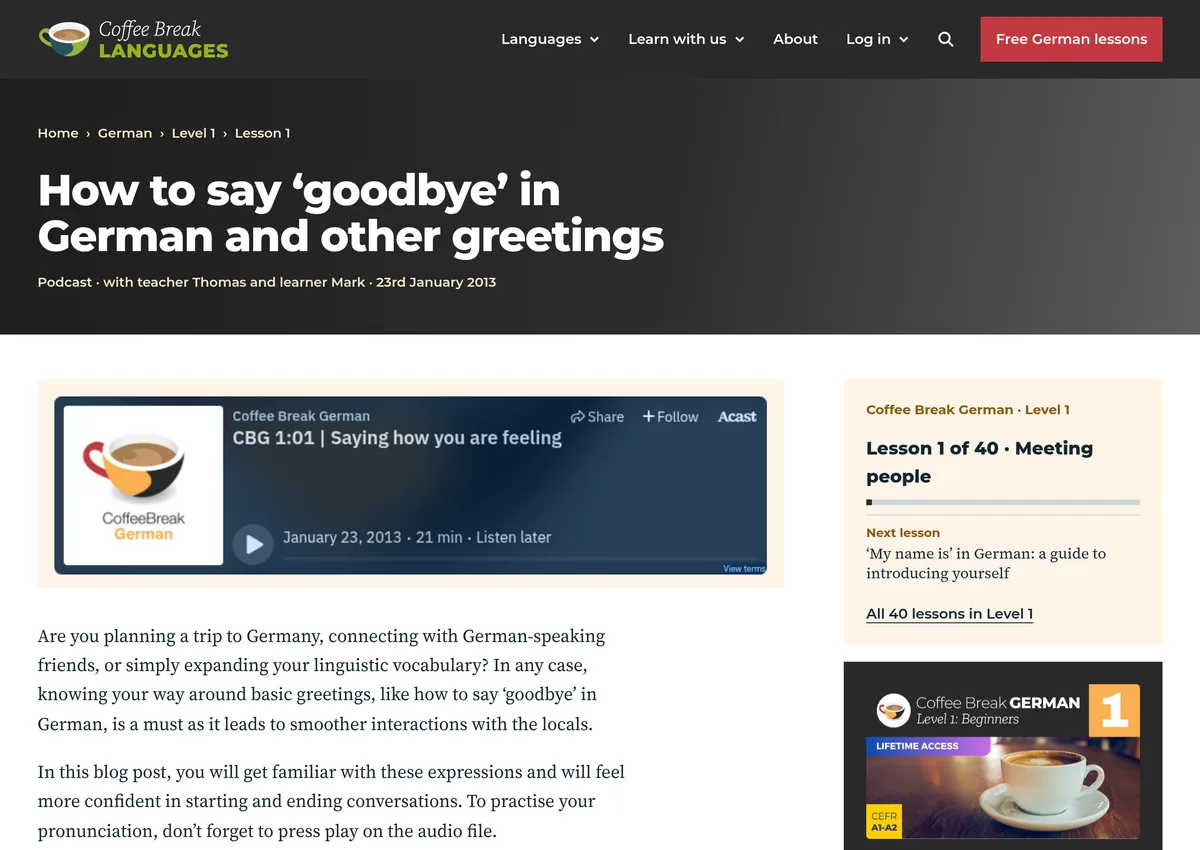
The page has no transcript of the episode and no exercises or quiz. The missing transcript hurts beginners most: when Thomas says a sentence you cannot catch, there is no written version on the page to check it against.
One sentence in the article also runs two regions together: “In Austria and Bavaria, they can say Servus or Moin in the northern part of Germany.” It means Servus in Austria and Bavaria, and Moin in the north.
In the parts we heard, the only promotions were Coffee Break’s own, pointing you to coffeebreakgerman.com and the full course.
What does the paid course add?
Coffee Break puts it plainly on the Level 1 course page: “The free podcast is the audio of each lesson. The course adds the video lessons, lesson notes, quizzes and bonus audio, all without ads.” On Coffee Break Academy, where the courses run, Level 1 has an orientation section and the 40 lessons, each with a video, the audio, lesson notes and bonus audio, plus four quizzes, one after every ten lessons. Coffee Break says the notes cover grammar and vocabulary and include transcripts, and that the videos put the German on screen.
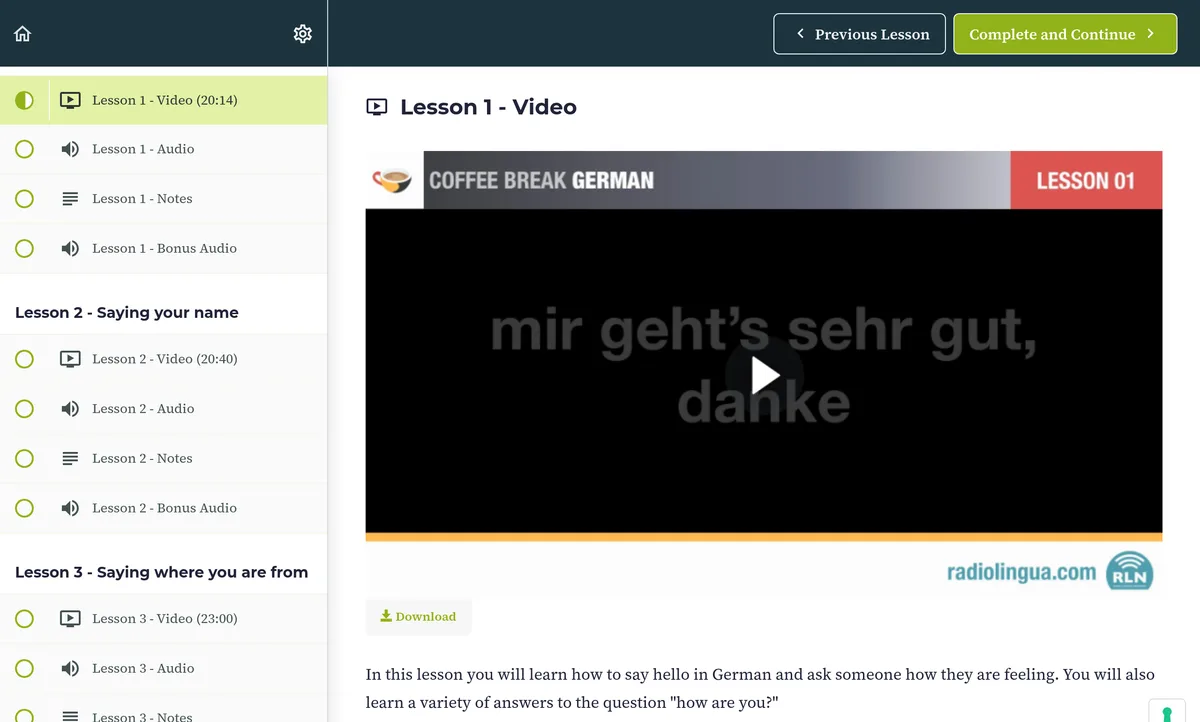
Without an account, we opened the free preview of the Lesson 1 video in the course player. The frame shows the phrase mir geht’s sehr gut, danke on screen, and the sidebar lists the Lesson 1 video at 20 minutes and the Lesson 40 video at 17. Lesson 1’s audio, notes and bonus audio are marked as previews too.
You can also try First Steps, a free Academy course with the first five Level 1 lessons, with four items each. Its contents list no quiz.
How much does Coffee Break German cost?
The podcast is free, and each course is a one-time payment with lifetime access. These were the prices on November 13, 2026:
| Option | Price | What you get |
|---|---|---|
| Podcast | Free | All 120 lessons as audio |
| First Steps | Free | The first five Level 1 lessons, with four items each |
| Level 1 course | $269 or £199, once | 40 lessons with video, notes, quizzes and bonus audio |
| Level 2 course | $269, once | The same for Level 2 |
| Level 3 course | $269, once | The same for Level 3 |
| Coffee Break TV | From $24.99 a month | Video lessons in one language, such as German, for upper beginner to intermediate learners |
Since the audio of every lesson is free, you are paying for the videos, the notes with their transcripts, the quizzes and the bonus audio, so buy a level when you know you will use those.
Read the refund policy before you pay. It says “all sales are final and no refunds are given for courses which have been downloaded.” If a level turns out too easy or too difficult within 7 days, Coffee Break says it “will consider replacing the course with another level if such a course exists.” That makes the free podcast and First Steps your real trial.
Prices checked November 13, 2026.
Is Coffee Break German worth it?
The podcast is: it costs nothing and starts from zero. If you like learning while you walk or drive and want grammar explained in English, start Level 1 today. The $269 course is worth it if you will read the transcripts and notes and do the quizzes. If you mainly listen, the free audio is the same lesson.
Pros
- All 120 lessons free as audio, from beginner to intermediate
- Thomas, a native German speaker, explains each point in plain English
- More German as you go: about 45% English in the Level 3 opening we heard, by our count
- Courses are paid once, with lifetime access
Cons
- About 85 to 90% English in the opening of Level 1 Lesson 1, by our count
- No pauses for you to answer in the openings we heard
- No transcript or exercises on the free Lesson 1 page
- Level 3 sits in a separate podcast feed
- No refunds on downloaded courses
Skip it if you want to hear mostly German from the start, or want feedback on how you sound when you speak.
Alternatives to Coffee Break German
If speaking is your goal, our pick is Copycat Cafe. You hear an everyday German conversation, rebuild each line by ear, say it aloud with a 0–100 pronunciation score on every word, then use it with Copy, your AI conversation partner. Copycat Cafe costs $29 a month or $174 a year, with a 7-day free trial and a 30-day money-back guarantee on your first payment.
If you want to read along, try GermanPod101. Without an account, we could play the audio of its Absolute Beginner Season 1 Lesson 1 and read its dialogue, vocabulary, notes and transcript. Read our GermanPod101 review. GermanPod101’s Black Friday sale takes 55% off its paid plans until November 27, 2026: on its pricing page, Basic was $1.80 a month instead of $4, Premium $4.50 instead of $10 and Premium PLUS $10.29 instead of $23, based on the cost of a 24-month subscription. Prices checked November 13, 2026. Our Pod101 Black Friday guide covers the sale.
For other options, see our guides to learning German for free, the best online German courses, the best apps to learn German and the best way to learn German. Coffee Break teaches Spanish, Italian and French in the same style; see our Coffee Break Spanish review, Coffee Break Italian review and Coffee Break French review.