

Disclosure: This post contains affiliate links. If you buy through them, we may earn a commission at no extra cost to you.
Lesson 1 of Pimsleur's German course opens with a short exchange: Entschuldigen Sie. Verstehen Sie Englisch? Near the end of the same lesson, you're the one answering, in whole sentences like Ich verstehe ein bisschen Deutsch.
That is what Pimsleur German sells: you say German out loud from the first few minutes, and you need nothing but your ears. It isn't cheap, though, and German gives you plenty to get wrong. So it's fair to ask how much German you actually say in a lesson, and what happens when you slip.
We measured the whole free German lesson, listened to its opening and closing minutes, made mistakes on purpose in its practice games and checked every price. Here's what we found, and who it suits.
Prices checked November 13, 2026.
How we tested Pimsleur German
On November 12 and 13, 2026, our team used the free Lesson 1 of Pimsleur's German Level 1 course on the web. We measured the whole 29-minute audio lesson and listened to its opening and closing minutes, picked wrong answers on purpose in Quick Match and Speed Round, went through Speak Easy, Reading, the Cultural Highlight and the Skills lists, opened the locked Lesson 2 and read every US price. Our team also used Lesson 1 of Pimsleur's French course on November 11 and 13 and of its Latin American Spanish course on November 13, and Alysa Salzberg, on our team, used Pimsleur French on her computer and phone, in both Audio-Only and Premium, for our Pimsleur review. We judged the German course on what gets you speaking: how much German you say, how it corrects you, how it sounds and what it costs.
How does a Pimsleur German lesson work?
You hear a short conversation, then an English narrator takes it apart and asks you to say each piece in German before a German speaker says it. The method is the same in every Pimsleur language, and our Pimsleur review explains it in full. Here is how it plays out in Lesson 1 of German Level 1, the 2024 edition, which runs 29 minutes and 30 seconds.
Long words are built from the end. Before you say Entschuldigen Sie in one go, you say Sie, then -digen, Schul-, -schuldigen and Ent-. Englisch gets the same treatment (lisch, Eng, Englisch), and the narrator warns you that it starts with "Eng-", not "Ing-". The German voices sounded like recorded native speakers to us, in standard German.
Then come the gaps. We counted 36 pauses of a second and a half or more in the first three minutes, about 42% of that time. Across the whole lesson there were 385, or 58% of its running time, and they grow as you go: about 2.1 seconds on average at the start and 2.8 seconds in the last three minutes, where pauses fill 55% of the time. Those gaps are there for you to fill. If you play along, you say German out loud every few seconds for half an hour.
By the end of the lesson, the prompts have moved from single syllables to a role-play. A German speaker joins in, the narrator tells you what to ask or answer, and you reply in one to five words: Verstehen Sie Deutsch? Ja, ich verstehe. Nur ein bisschen. Ich verstehe ein bisschen Deutsch. English still frames every exchange. And whenever Lesson 1 addresses someone, it uses the formal Sie; the informal du comes later in the course.
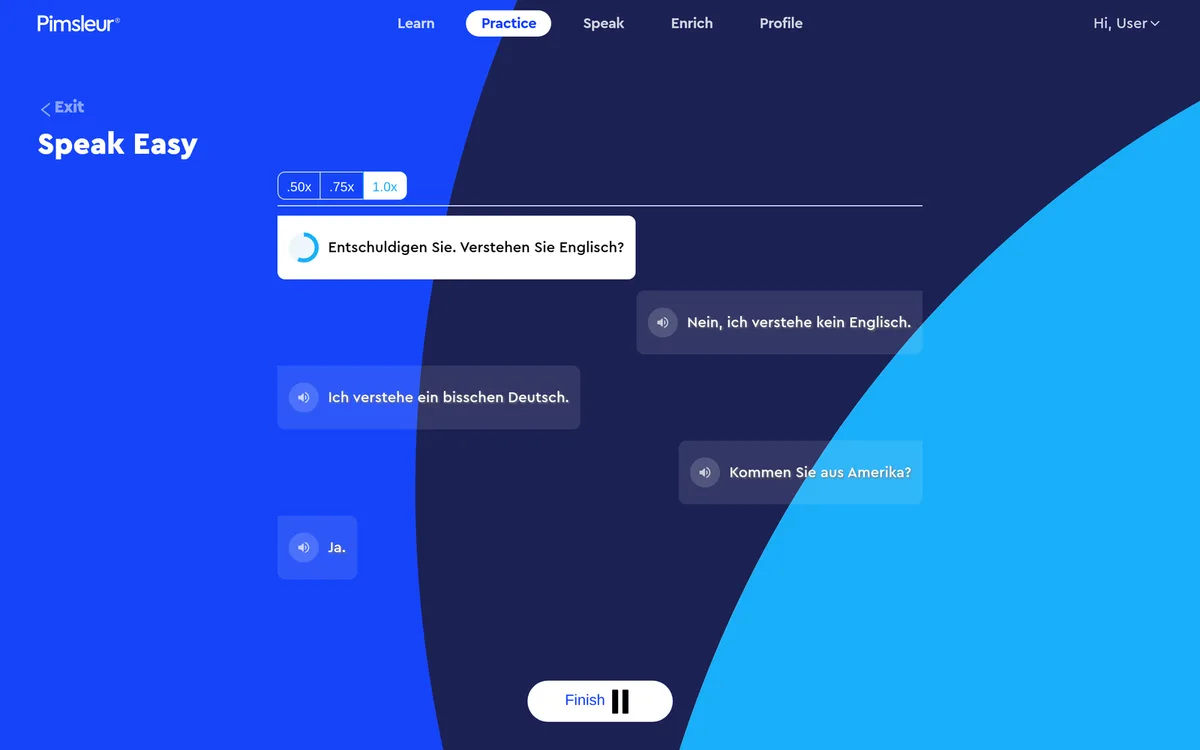
Outside the audio, Speak Easy shows the Lesson 1 conversation in writing, five lines from Entschuldigen Sie. Verstehen Sie Englisch? to Ja., and plays it at .50x, .75x or 1.0x speed with a Play & Repeat button. It has no microphone, so nothing checks what you say back.
Copycat Cafe does this step better. Our German lessons also start from an everyday conversation, such as "Looking for the bakery", which opens with Entschuldigung, wo ist die Bäckerei?, and you play it at normal or slow speed with the written lines on screen. Where Speak Easy only plays the lines for you to repeat, our lessons let you slow any line down and rebuild it by ear before you say it.
How does Pimsleur German correct your mistakes?
Quick Match shows you the right answer and Speed Round doesn't, but neither says why yours was wrong. Two of the free practice games, Quick Match and Speed Round, check your answers, and we made mistakes in both on purpose.
Quick Match gives you an English sentence and four German options. Across two rounds of 10 questions, we picked four wrong answers. For "Do you understand German? (formal)" we chose Ich leihe dir genug Geld. ("I'll lend you enough money"). Pimsleur put a red X on it and a blue check on Verstehen Sie Deutsch?, with no text at all, and moved on by itself after a few seconds. The questions we missed came back at the end of the round, as "1/2" and "2/2", which is a useful second chance.
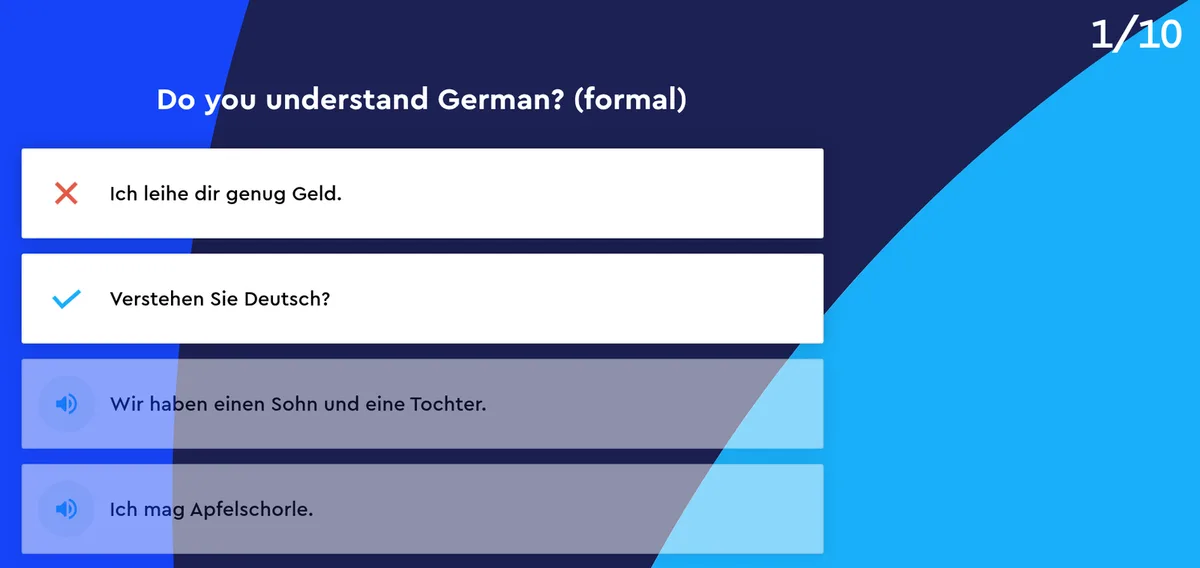
The wrong options make it easier than it looks. They are long sentences from later lessons, like Wir haben einen Sohn und eine Tochter. or Ich fahre morgen nach Düsseldorf., so a beginner can often rule them out by length or topic. At the end, Quick Match said "Well Done! You just finished 10 questions." with no score and no count of mistakes.
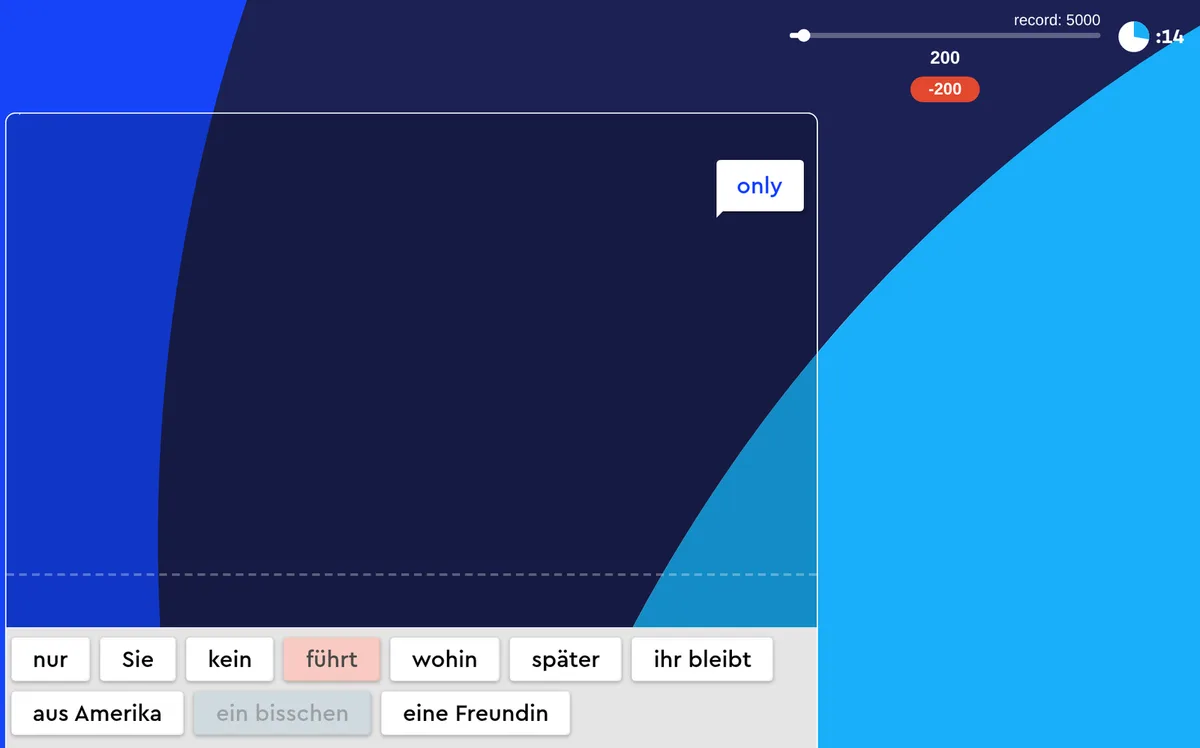
Speed Round drops English words down the screen and asks you to tap the matching German tile before they reach the line. When the cue was "only", we tapped führt. The tile turned pink and a red "-200" came off our score, but the right tile, nur, was never highlighted. The end screen still said we had "matched 13/13 words correctly", because wrong taps only cost points.
Neither game listens to you. Voice Coach, Pimsleur's pronunciation practice, sits beside the lesson, in the Speak tab and the review list, with a Pronunciation Practice mode and a Challenge mode. It opens with a screen headed "Consent to Use Speech Data with AI", where you agree to "Pimsleur’s use of AI to process my speech data". Pimsleur's newer AI Conversation Coach isn't offered for German: its App Store release notes list it for All Access learners of Japanese, Latin American Spanish and French.
For pronunciation feedback, Copycat Cafe goes further. In our lessons, you say each line of the conversation aloud as part of the lesson and get a 0–100 score on every word, with a tip on what to change, before you use the line with Copy, your AI conversation partner.
What else comes with the free German lesson?
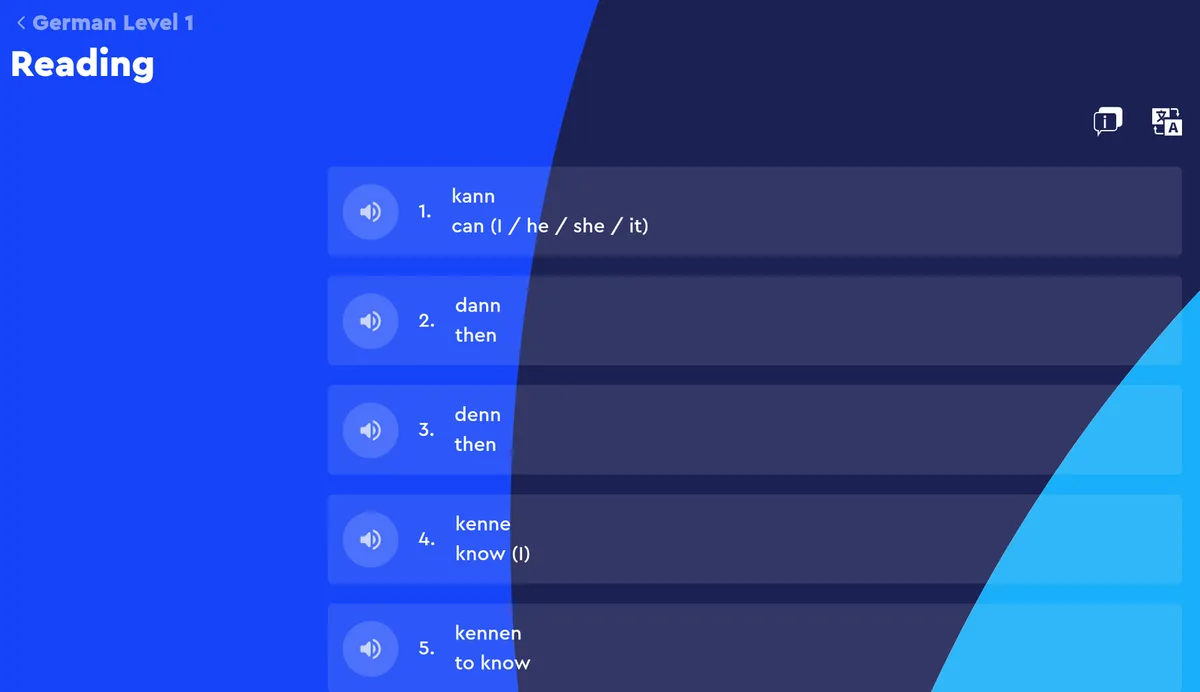
A short reading lesson, a culture card and phrase lists, all of them light. Reading Lesson 1 lists five words, kann, dann, denn, kenne and kennen, each with a play button and an English gloss. Both dann and denn are glossed "then", although denn usually means "because" or "for". The audio, mostly English narration, has you read each word aloud and then hear it. It never explains that the short a in dann and the short e in denn are what tell the two words apart. Nothing on the page checks you.
If that pair trips you up, our German IPA guide explains the two vowels, /a/ as in dann (/dan/) and /ɛ/ as in denn (/dɛn/).
The Cultural Highlight is one text card on a photo of Hamburg, with facts such as "German is spoken by 100 million people worldwide" and that .de is "the second largest domain after .com". The Skills tab sorts the lesson's phrases into four lists, such as Meet + Greet and Survival Skills, and marks every item as learned before you have completed a single lesson.
Everything else is locked. Lessons 2 to 30 carry a padlock, and clicking one opens a box headed "Continue Your Learning", which offers All Access by the month or the year, each with a 7-day free trial, or All Access Lifetime.
How much does Pimsleur German cost?
A German-only subscription costs $19.95 a month, or $14.95 for the audio lessons alone, and All Access, with every Pimsleur language, costs $20.95 a month or $164.95 a year. You can also buy German for life. These are the US prices on Pimsleur's German page and its German lifetime page on November 13, 2026.
| Plan | Price | What you get |
|---|---|---|
| Audio Monthly | $14.95/month | German audio-only lessons |
| Premium Monthly | $19.95/month | German only, with the practice tools |
| All Access Monthly | $20.95/month | 50+ languages |
| All Access Annual | $164.95/year | 50+ languages, billed yearly |
| German Level 1 lifetime | $112.50 (list price $150) | Level 1, 30 lessons, one payment |
| German Levels 1–5 lifetime | $431.25 (list price $575) | The complete German course, one payment |
| All Access Lifetime | $478.80 (list price $798) | All levels of 50+ languages, one payment |
All Access costs a dollar a month more than German Premium and adds every other language, and the annual plan works out to about $13.75 a month. The lifetime prices were shown struck through with no reason given, a cut of 25% on the German levels and 40% on All Access Lifetime. If you want to own just Level 1, buy it from the lifetime page: the upgrade box inside the app mentions "Level 1 lifetime access for one language" but only offers subscriptions and All Access Lifetime.
Subscriptions start with a 7-day free trial. For All Access Monthly, the small print in the app says: "If you do not cancel within the free trial, you will be billed $20.95 (plus applicable taxes if any) per month until you cancel." The lifetime page lists a 30-day money-back guarantee on each lifetime plan.
We saw no Black Friday sale on Pimsleur's German pages on November 13. Last year, All Access Lifetime dropped to $299 from Thanksgiving, and our Pimsleur Black Friday guide tracks this year's deal. Our Pimsleur cost guide explains every plan and the ways to pay less.
Pimsleur German pros and cons
Here is how it adds up after the free lesson.
Pros
- You say German out loud every few seconds, from the first few minutes.
- Long words are built from the end, so Entschuldigen Sie comes out in one piece.
- The German voices sounded like recorded native speakers to us.
- It works hands-free, on a walk or a commute.
- Missed Quick Match questions come back at the end of the round.
Cons
- In the practice games, mistakes are marked but not explained.
- Speak Easy has no microphone, and Voice Coach sits outside the lesson behind an AI consent screen.
- Grammar comes through examples, and nothing is typed, so the free activities never check articles, cases or word order.
- English frames every exchange, even at the end of Lesson 1.
- Reading glosses can mislead: dann and denn are both "then".
- No AI Conversation Coach for German.
- Each lesson takes about 30 minutes.
For most German learners, the trade is plain: lots of speaking out loud, with very little feedback on it.
Who should use Pimsleur German, and who should skip it?
Pimsleur German suits you if you learn well by ear, have half an hour a day away from a screen, and want to answer simple questions in German without freezing. Try the free lesson first: talking back to the narrator for 30 minutes is the best test of whether the method suits you.
Skip it, or pair it with something else, if you need to read and write German or want rules for der, die and das and the cases. For grammar in short lessons, Babbel is the better fit, and our Pimsleur vs Babbel comparison sets the two side by side. For a free daily habit, Duolingo is the usual start: read our Duolingo for German review and Pimsleur vs Duolingo.
For a full course with a teacher or a free curriculum, our guide to online German courses compares them, and the best apps to learn German gives one pick for each goal. Our Pimsleur Spanish review shows the same practice games in the Spanish course, and the best way to learn German turns speaking out loud into a daily plan.
What's a better alternative for speaking German with feedback?
If your goal is to answer Verstehen Sie Deutsch? and know how your answer sounds, Copycat Cafe is our pick. You rebuild each line of an everyday German conversation by ear, say it aloud with a 0–100 score on every word, then use it with Copy, your AI conversation partner, right after the lesson. It costs $14.50 a month billed as $174 a year, or $29 a month, with a 7-day free trial and a 30-day money-back guarantee on your first payment.
Frequently asked questions
Is Pimsleur good for learning German?
Yes, if you learn by ear and want to speak from the first lesson. Lesson 1 has you answer out loud every few seconds and builds long words like Entschuldigen Sie from the end. It is weaker on reading, grammar and feedback: its practice games mark mistakes without explaining them, and nothing in the free lesson's activities checks your articles or cases.
How much does Pimsleur German cost?
US web prices checked November 13, 2026: Audio Monthly costs $14.95 a month, German Premium $19.95 a month, and All Access $20.95 a month or $164.95 a year. Lifetime German costs $112.50 for Level 1 (list price $150) or $431.25 for Levels 1–5 (list price $575), and All Access Lifetime is $478.80 (list price $798). Subscriptions start with a 7-day free trial.
Can you try Pimsleur German for free?
Yes. With a free account, Lesson 1 of German Level 1 is free on the web, along with its practice games, Speak Easy, Reading Lesson 1 and phrase lists. Lessons 2 to 30 are locked. Subscriptions also start with a 7-day free trial, and the app's small print says you are billed when it ends unless you cancel.
How many levels and lessons does Pimsleur German have?
Five levels of 30 audio lessons, so 150 in all. Each lesson lasts about 30 minutes; Lesson 1 of Level 1 runs 29 minutes 30 seconds.
Does Pimsleur German correct your pronunciation?
Not in the core audio lessons, which can't hear you, and not in Speak Easy, which has no microphone. Pronunciation feedback comes from Voice Coach, a separate activity beside the lesson that first asks you to consent to Pimsleur processing your speech data with AI.
Does Pimsleur German have an AI Conversation Coach?
Not at the moment. Pimsleur's App Store release notes list its AI Conversation Coach for All Access learners of Japanese, Latin American Spanish and French, not German.
Does Pimsleur teach German grammar?
In Lesson 1, through examples rather than rules. It teaches whole phrases such as Ich verstehe ein bisschen Deutsch, and nothing in the free practice activities is typed, so nothing checks your articles, cases or word order.