

Disclosure: This article contains affiliate links. If you sign up through them, we may earn a commission at no extra cost to you.
Maybe you’ve kept a Duolingo streak going for months. You can read a café menu and tap the right tiles, and you still go quiet when someone asks you a question. Speak promises the opposite: lessons built around talking.
So is Speak better than Duolingo if you want to actually speak? We compared the two on that goal: how much each one makes you say out loud, what it tells you about how you said it, how much conversation you get, which languages each teaches and what you pay.
How we tested: On November 12, 2026, I took a lesson in Duolingo’s German course on my iPhone with a Super account and finished a Speak practice set in its Practice tab. On November 12 and 13, our team took the first lessons of Duolingo’s French, Spanish, German and Italian courses on its website as a guest, getting answers wrong on purpose. Alysa Salzberg, on our team, used Duolingo’s French course for several days at different levels, and Nerissa, also on our team, used Duolingo Max for two weeks, taking Roleplays in French and trying Video Call. For Speak, Nur Baysal, on our team, took a beginner Tutor Lesson, a Speaking Drill and a café Guided Conversation in its Spanish course on her iPhone, and Nerissa held conversations in Speak by voice and text, mostly in French. We checked both apps’ prices and plans on November 13, 2026.
How does each app get you speaking?
Speak puts speaking first: in Nur’s test, every step of its lesson had her talking. Duolingo’s first lessons are mostly tapping and typing, and its speaking practice sits in separate exercises and in calls in its mobile apps.
In Speak’s Spanish course, Nur’s beginner lesson ran in three steps. The Tutor Lesson came first: a virtual tutor introduced a few phrases in a situation, each with its English meaning and a short note on how to use it. In her “¡Buenas!” lesson, Speak put her at an airport café in Mexico City and taught ¡Buenas! as an informal greeting for any time of day. After each example, she tapped the microphone and said the phrase aloud. The Speaking Drill came next and worked like voice flashcards: at first she could see each phrase, then the words were hidden and she had to say the Spanish after hearing it or seeing its English meaning. The lesson ended in a Guided Conversation at a café, which we come back to below.
Speak’s microphone sometimes missed her, though. Nur had to repeat ¡Vamos! before the app moved on, although she thought her first attempt was loud and clear, and ¡Buenas! hit the same hesitation. Our Speak app review follows her whole lesson.
Duolingo’s first lessons are mostly taps and typing. When our team took the first lessons of its French, Spanish, German and Italian courses on its website, none of them asked us to speak. The French lessons mixed word tiles, picture choices, listening exercises, matching pairs, a short chat and fill-in-the-blank. Speaking exercises do turn up later: Alysa met them in her French lessons, and the Practice tab of Duolingo’s iOS and Android apps has free speaking lessons.
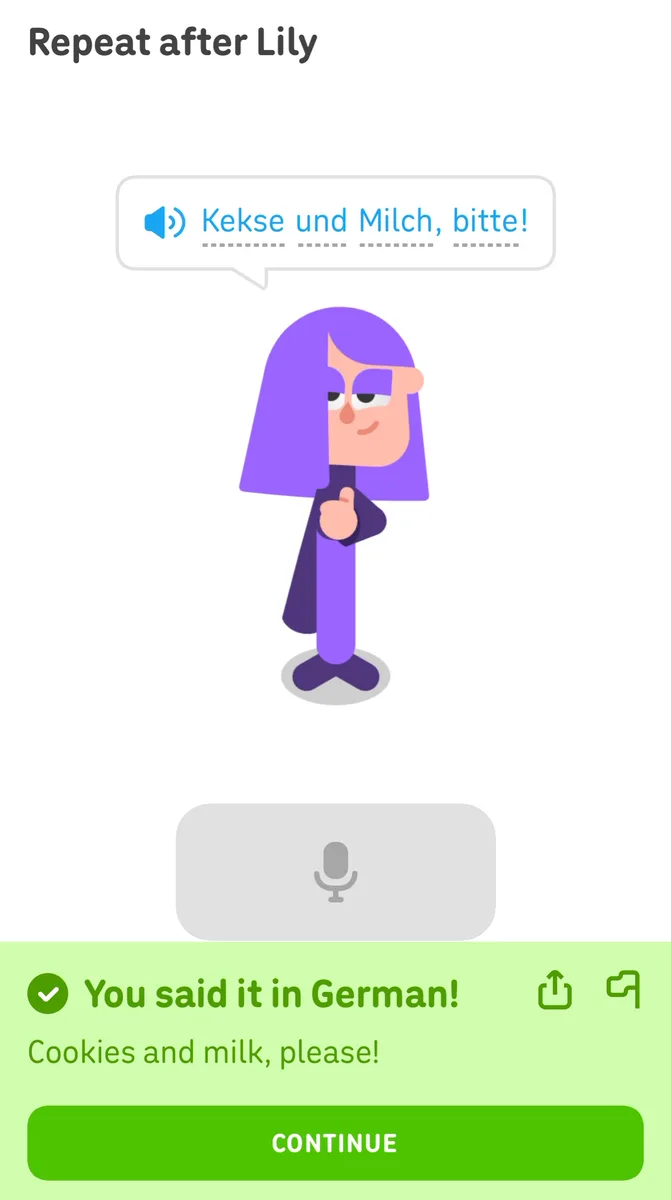
That’s where I tried them, in Duolingo’s German course on my iPhone. Confusingly, Duolingo calls its own speaking practice Speak, and lists it under “Conversation”. It had me repeat ten short lines after Duolingo’s characters, such as Kekse und Milch, bitte! It just made me listen to things and then repeat them, which for me is not a conversation. Our Duolingo for German review has the rest of that test.
What feedback do you get on your speaking?
Very little from either app. In our tests, both answered a good attempt with an encouraging message, without a score or a word to work on.
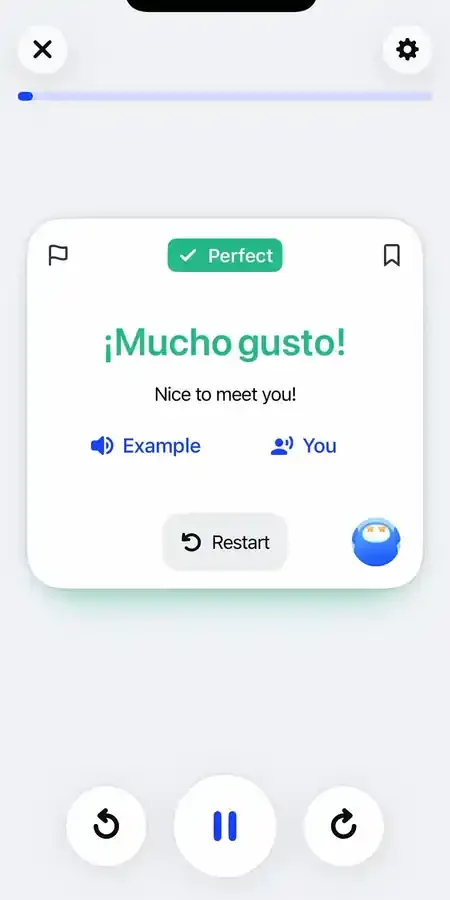
In Nur’s Spanish Tutor Lesson, each attempt Speak recognized got a badge such as “Perfect”, “Good” or “Great”, a green check mark and two buttons: Example plays Speak’s recording and You plays yours. Comparing the two is handy for hearing how your pace and tone differ. She didn’t see a pronunciation score or a word-level explanation of what to change. Speak’s plan guide explains part of the gap: “Pronunciation Coach is only available for users learning English.”
Speak was also easy to please. Nerissa found that in French it sometimes accepted mispronounced words or reversed word order, which matters in a language where un homme grand is a tall man and un grand homme a great one. Her notes on Speak are in our guide to the best AI language learning apps.
Duolingo’s Speak practice also answered with a message, not a score. After each of my ten German lines, a short message such as “You said it in German!” came up with the English translation, then the next line. I said every line correctly, so my test doesn’t show how it handles a mistake. In the French exercises Alysa tried, the pronunciation feedback was basic, and she wanted more detail. Our Duolingo review has her full verdict.
Duolingo’s lessons check what you tap and type, and some mistakes slip through there too. On its website, our French answer “Bonjour, un cafe.”, typed without the accent, passed with “Pay attention to the accents.” Our une thé, with the wrong gender, passed as “You have a typo.”
This is where Copycat Cafe has the edge over both. Where Speak says “Perfect” and Duolingo says “You said it in German!”, Copycat Cafe gives you a 0–100 pronunciation score on every word of the line you just said, with a tip on what to change in the words that need work. You know which word to say again, and how.
Which app gives you more conversation practice?
Speak, because the lesson Nur took built up to a role-play, and its plan guide lists situational role-plays in both plans. Duolingo’s open conversation is Video Call with Lily, in its mobile apps, and it is moving into Super.
Nur’s café Guided Conversation began simply: she was at the counter, and the barista was about to take her order. Then two virtual companions, Kai and Noa, started chatting with each other and with the barista, and a fourth character, Lumi, joined later. Nur found it hard to follow who was speaking and when it was her turn, which is a lot to ask of a beginner ordering a coffee. Speak also has a separate Free Talk area with character role-plays and a turn-based Chat mode.
Nerissa held conversations in Speak by voice and text, mostly in French. She liked its polished interface, but the lenient recognition left her wanting more detailed correction.
On Duolingo, open conversation means Video Call with Lily, which runs in its iOS and Android apps. Duolingo stopped selling its Max plan to new subscribers in November 2026, and its shareholder letter says new Super subscribers already get unlimited Video Call and every Super subscriber will by the end of 2026. When Nerissa used Max, she could review the whole conversation after a Video Call and replay Lily’s messages, and Roleplay gave her feedback on her replies. What she wanted more of was pronunciation feedback. Our Duolingo Max guide covers what changed.
For a beginner, Copycat Cafe’s conversation practice is easier to follow: after you copy an everyday conversation, you use the same language with one partner, Copy, your AI conversation partner, out loud or by typing, instead of several characters at once.
Which languages do Duolingo and Speak teach?
Duolingo teaches far more. Its App Store listing says 40+ languages, and you can take lessons on its website as well as in its apps, though Video Call runs only in the iOS and Android apps.
For English speakers, Speak’s help center lists six languages: Spanish, French, Japanese, Korean, Italian and Simplified Chinese. Speak’s website also lists German and Portuguese as “Coming Soon”, and Speak teaches English to speakers of 15 other languages. Speak runs on phones and tablets only. Its help center says “Speak is not available on desktop (PC)”, and its website is for creating and managing your account.
So if you’re learning German today, or any language outside Speak’s list, Duolingo is the one of the two that teaches it. If you’re learning Japanese, Korean or Chinese and want to speak it, Speak deserves a look. For Spanish, our guide to the best AI apps to learn Spanish compares Speak with other speaking apps.
How much do Duolingo and Speak cost?
Duolingo is free, with an optional Super plan. Speak needs a subscription after its 7-day free trial, though a year of Speak Premium costs less than a year of Duolingo Super.
| Plan | Duolingo | Speak |
|---|---|---|
| Free | The whole course, with ads and a limit on mistakes | A 7-day free trial, then a subscription |
| Monthly | Super: $16.99 | Premium: $17.99; Premium Plus: $39.99 |
| Yearly | Super: $119.99 ($9.99 a month) | Premium: $83.99 (about $7 a month); Premium Plus: $164.99 |
| Family | Super Family: $143.99 a year for up to six accounts | Not listed |
Prices checked November 13, 2026: Duolingo’s on its US website, Speak’s in the US App Store.
On the yearly plan, Speak Premium works out to about $7 a month, against $9.99 for Super. Premium Plus mainly adds personalization: according to Speak’s plan guide, you get unlimited “Made For You” lessons instead of up to three a day, a Personalized Study Plan and practice that targets your frequent mistakes. Start with Premium unless you keep hitting that daily limit.
Check the price on your own screen before you pay. Speak says the most accurate price is in its app, and the App Store also lists Premium at a second price, $21.99 a month or $109.99 a year. Duolingo’s App Store listing shows Super purchases from $9.99 to $119.99. Our Speak Black Friday guide tracks whether a discount is coming.
Which should you choose?
Pick by what you want the app to do for you:
- A free daily habit: Duolingo. The whole course is free, it works on a computer as well as your phone, and its streaks keep you coming back.
- A language Speak doesn’t teach, such as German: Duolingo, with its 40+ languages.
- Speaking-first lessons on your phone: Speak, if it teaches your language. Every step of Nur’s lesson had her speaking, and Premium is listed at $83.99 a year.
- Conversation inside the app you already use: Duolingo Super, which Duolingo says will include Video Call for every subscriber by the end of 2026.
- Feedback that tells you which word to fix: Copycat Cafe, below.
Speak gets you talking sooner, and Duolingo keeps you coming back for free. If you’re the learner who freezes when someone asks a question, Speak is the better of the two, as long as you know its badges won’t tell you what to fix.
If you want to know what to fix: Copycat Cafe
Both apps cheered our testers on with “Perfect” and “You said it in German!”. Copycat Cafe is built to tell you what to change: you hear an everyday conversation, slow a line down and rebuild it by ear, say each line aloud with a 0–100 pronunciation score on every word, then use it with Copy, your AI conversation partner. It teaches French, Spanish, Italian and German, and costs $29 a month or $174 a year, with a 7-day free trial and a 30-day money-back guarantee on your first payment.
Still comparing? Read our Speak app review and our look at whether Duolingo works, or see Busuu vs Duolingo, Duolingo vs Memrise and our guide to the best Duolingo alternatives.