

Disclosure: This article contains affiliate links. If you sign up through them, we may earn a commission at no extra cost to you.
Busuu and Duolingo both promise a new language in a few minutes a day, and both let you start for free. So the choice comes down to how you like to learn, and whether you plan to pay.
The biggest difference shows up when you get something wrong. Duolingo shows you the right answer and takes a heart. Busuu gives you grammar lessons to fall back on and a community of native speakers who can correct what you write or record. Here is how the two compare on lessons, corrections, grammar, speaking and price, from our team’s time with both apps.
How we tested: Alysa Salzberg, on our team, used Busuu’s French course for several days on a free trial, on the web and on her phone, for our Busuu review. Nerissa, on our team, also used Busuu and scored it out of five for our guide to Duolingo alternatives. For Duolingo, I took a lesson in its German course on my iPhone with a Super account on November 12, 2026, then tried Explain My Answer and a Speak practice set. On November 12 and 13, our team took the first lessons of Duolingo’s French, Spanish, Italian and German courses on the web, made mistakes on purpose and listened closely to the audio. Alysa also used Duolingo’s French course for several days at different levels, and Nerissa used it for months. We checked both apps’ prices and plans on their websites on November 13, 2026.
How do Busuu and Duolingo lessons work?
Both apps teach in short lessons that you take in order. Duolingo wraps them in a game, with cartoon characters, streaks and rewards. Busuu keeps them plainer and puts real people on video.
In Duolingo’s French course, Unit 1 is “Order at a café”. When our team took its first two lessons on the web as a guest, they mixed word tiles, picture choices, listening exercises, matching pairs, a short chat and fill-in-the-blank. I rate my German at around B1, yet Duolingo’s German course started me in the same café unit on my iPhone, with lines like Kaffee mit Milch, bitte. After the lesson came about 54 seconds of reward screens: a streak, a streak-goal offer, a widget prompt, a puzzle piece, a quest point, a chest and a notification prompt. It felt very gamified, and I was craving actual learning.
That game is also what keeps many people coming back. Alysa enjoyed how many kinds of exercise Duolingo fits into one lesson, and Lily, its eye-rolling teenage character, quickly won her over. Our Duolingo review has her full verdict.
In Busuu’s French course, Alysa found the lessons laid out in chapters that build up from beginner level, and she could highlight a lesson to see a quick summary of what it covered. The lessons she tried were very short. Some early A1 lessons took about a minute, and most of the later ones she tried took around five. They were mostly listening and comprehension practice, with some vocabulary and translation, and many words and phrases came with videos of native French speakers saying them, and she enjoyed seeing the speakers outdoors, in real places in France. She liked putting faces to the language, but felt the lessons moved through new points without reinforcing them enough. Nerissa liked Busuu’s clear progression. Busuu’s course list takes French from A1 to C1.
Alysa also couldn’t find a way to slow down Busuu’s lesson audio. She could pause and replay it, but found no speed control. For getting from hearing a line to saying it, Copycat Cafe does better: you can slow any line of the conversation down and rebuild it by ear before you say it.
How does each app correct your mistakes?
Duolingo shows you the right answer and moves on, usually without saying why. Busuu adds people: you can send some answers to native speakers in its community for correction. Both rejected correct French in our tests.
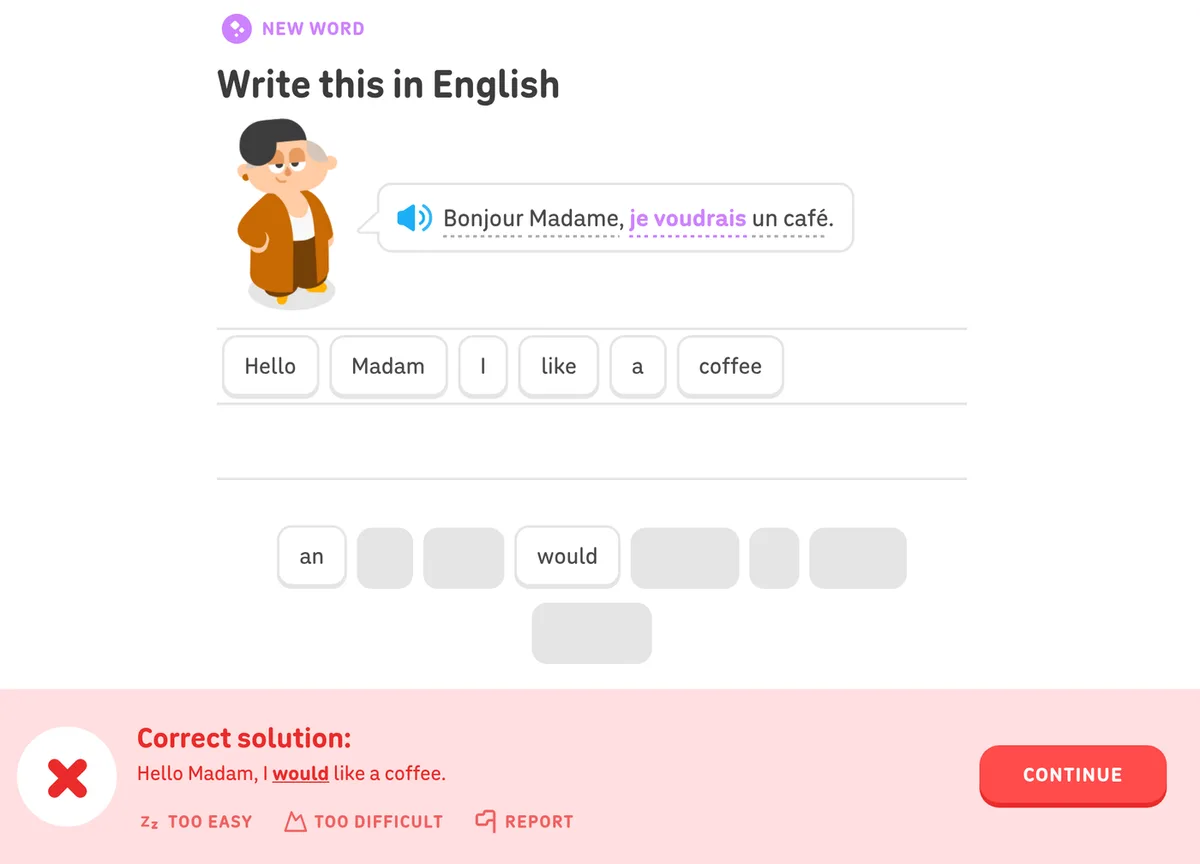
In Duolingo, a wrong answer turns the band at the bottom red, shows “Correct solution:” and costs you a heart. When we translated Bonjour Madame, je voudrais un café. as “Hello Madam I like a coffee”, the band showed “Hello Madam, I would like a coffee.” with would underlined, and nothing more. Our une thé, with the wrong gender, passed as “You have a typo.”, and nothing said that thé is masculine. In Duolingo’s Spanish course, our wrong answers got the same red band and a lost heart, and the exercise came back later marked “Previous mistake”.
Duolingo can also turn down a correct answer. Alysa’s French translation of “What would you suggest?” was counted wrong, because Duolingo’s list of accepted answers didn’t include it.
Alysa ran into the same thing in Busuu. When she translated a question into French using inversion rather than intonation, Busuu marked it incorrect, even though it was right. In a fill-in exercise, an otherwise correct sentence failed because she wrote weekend rather than week-end, though both spellings are accepted in French today. One small help on the web: an “Extra French letters” section below write-in exercises let her click accented letters into her answer.
Busuu’s community is what sets its corrections apart. At points in a lesson, you can type or record an answer and send it to native or fluent speakers to correct, and Alysa posted her recorded answers there. Busuu’s help centre says every exercise you post is public, stays open until it gets at least five corrections, and may get a reply from Busuu’s “Correction Bot” while you wait for people. Its corrections page says free members can only send a limited number of exercises and may wait longer for a correction.
Which app explains grammar better?
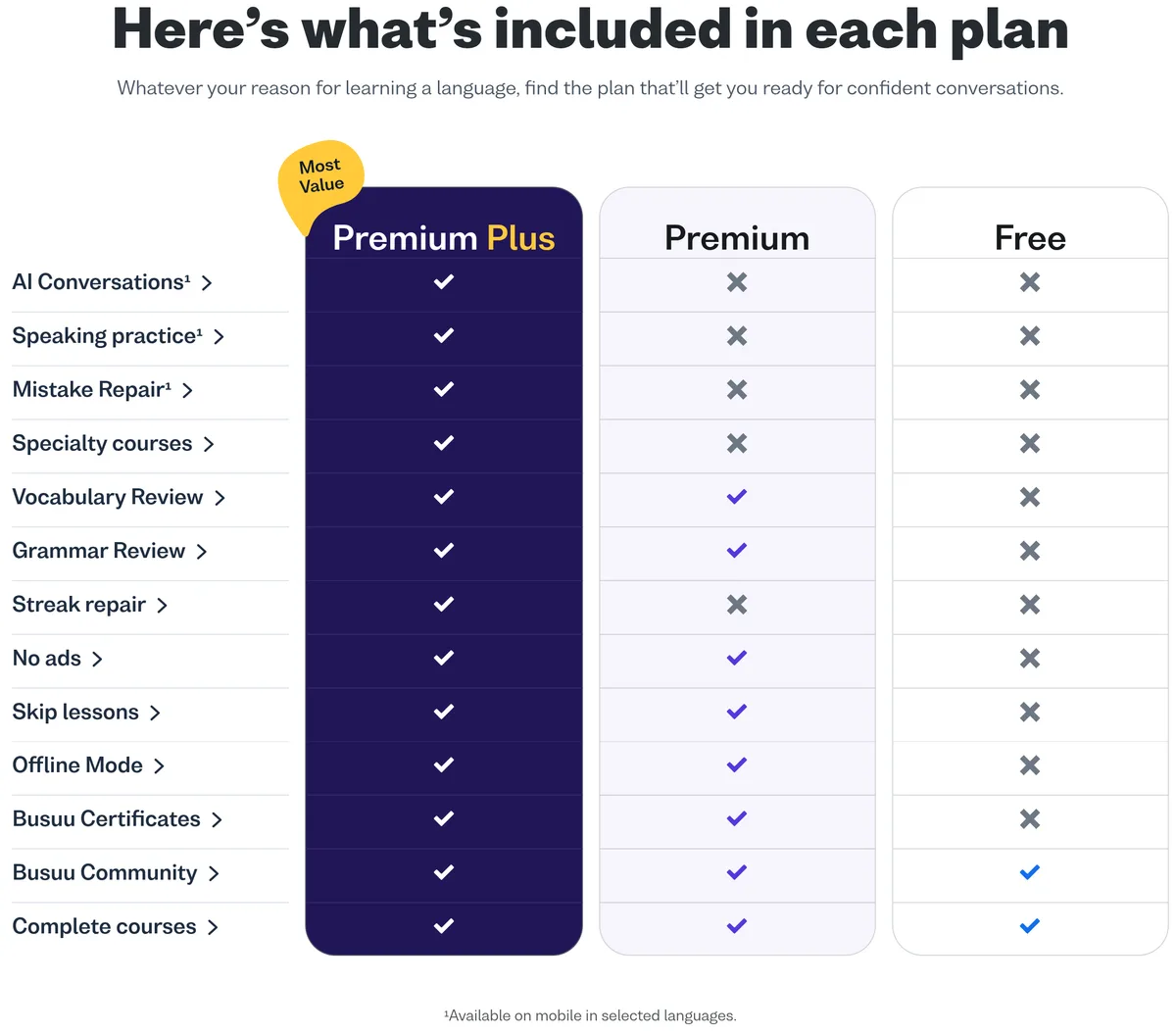
Busuu, in Alysa’s tests. She found its Grammar section excellent: each topic she looked at was explained clearly and concisely, which she thought would help learners who already have a good grasp of French and want to review it or get more practice. Busuu’s plans page puts Grammar Review in Premium. Its word definitions were sometimes too narrow: one lesson defined vous only as “formal, singular you”, though it can also be plural. Nerissa gave Busuu’s grammar 3 out of 5 in her scores for our Duolingo alternatives guide.
Duolingo teaches grammar mostly through examples. Alysa found its unit guidebooks too brief, and the French Unit 1 Guidebook we opened on the web had five key phrases and one tip. Its tips can also miss the point. When we wrote le café where the sentence needed un café, Duolingo called it a “Common mistake!”, and its tip said “The word café is masculine, so it goes with un and le.” Our gender was already right; the mistake was the instead of a.
In its apps, Duolingo also offers Explain My Answer, now free in its biggest courses. When I opened it on Kaffee in my German lesson, it told me that Kaffee means “coffee” and is “a common drink made from roasted coffee beans.” It felt like AI blindly explaining something obvious. If grammar is your main reason for comparing apps, our Babbel vs Duolingo comparison covers a course built around it.
Which is better for speaking practice?
Neither does much in its core lessons: Duolingo’s first lessons asked us to say very little, and Alysa wanted more speaking from Busuu’s. Both apps now sell conversation practice with an AI partner in a paid plan.
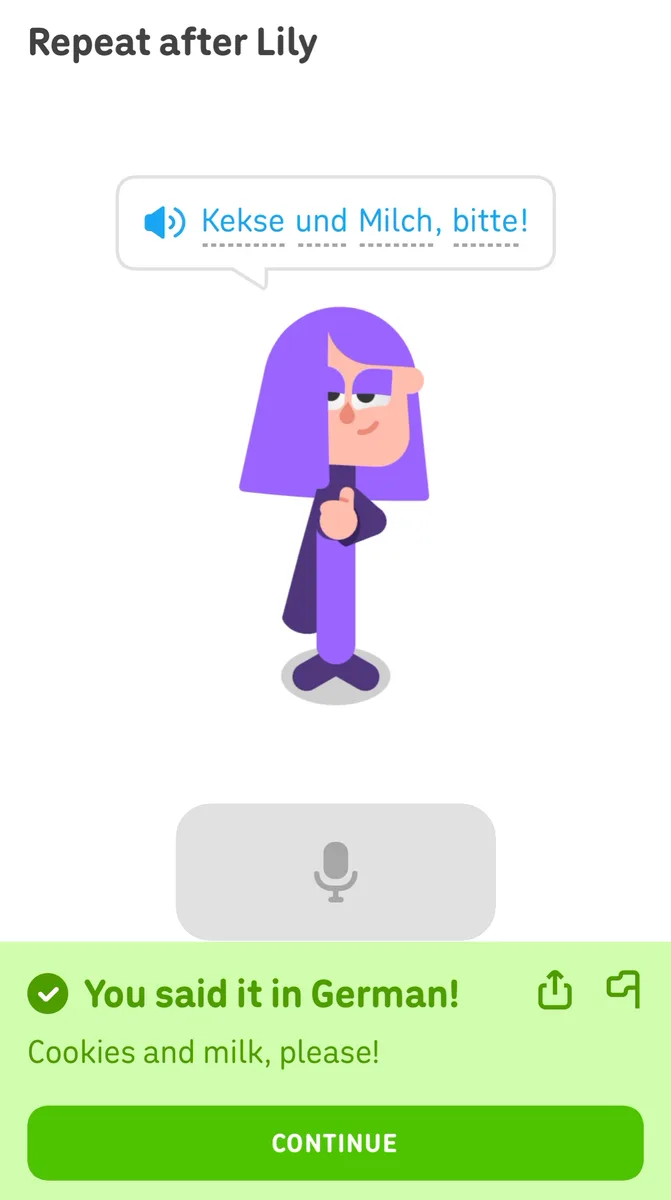
None of Duolingo’s first web lessons we took, in French, German or Italian, asked us to speak. On my iPhone, I opened Speak, which Duolingo lists under “Conversation” in its Practice tab. It had me repeat ten short lines after its characters, and each one ended with a short message such as “You said it in German!” and the English translation, with no score. It just made me listen to things and then repeat them, which for me is not a conversation. Nerissa found Duolingo’s speech recognition lenient: a word that was close enough passed, which she found a bit frustrating at times because it didn’t push her to get the pronunciation just right. Our Duolingo for German review has the rest of my screenshots.
Duolingo’s open conversation feature is Video Call with Lily, in its iOS and Android apps. In its November 2026 shareholder letter, Duolingo said new Super subscribers already get unlimited Video Call and every Super subscriber will by the end of 2026. It used to come with Duolingo Max, which Duolingo said it would stop selling to new subscribers in November 2026.
Alysa wanted more chances to speak than Busuu’s lessons gave her. On the web, Busuu couldn’t get a recording from her microphone however much she tried, and it didn’t notice the recordings weren’t working. On her phone, the app recorded her fine. After her audio answers went up on the Community, several learners messaged her to say they couldn’t hear them. Nerissa rated Busuu 4 out of 5 for speaking and pronunciation.
Busuu’s speaking tools are in Premium Plus. Its help centre describes Speaking practice as listen-and-repeat after a full-screen video of a fluent speaker, with three attempts. In the French course, words you pronounce incorrectly are highlighted in red, and its more detailed AI feedback is only in the English and Spanish courses. You get a limited number of free tries before you need Premium Plus. Busuu’s plans page lists Speaking practice and AI Conversations as Premium Plus features, “Available on mobile in selected languages.”
For pronunciation feedback, Copycat Cafe goes further than both. Duolingo’s Speak answered me with messages such as “You said it in German!” and no score, and Busuu says its French speaking practice marks the words you got wrong in red. Copycat Cafe gives every word you say a 0–100 pronunciation score with a tip on what to change, then you use the same lines with Copy, your AI conversation partner.
What do you get for free?
Both apps let you take their lessons for free, with ads. Duolingo gives free learners more practice around those lessons.
On Duolingo’s Super page, the free column ticks only the learning content, not unlimited hearts or an ad-free app. On the web, our French lessons used hearts: each wrong answer cost one, and the hearts menu said “Next heart in 5 hours”. On mobile, Duolingo is moving to an Energy meter, and its guide to the Practice tab says speaking, listening, vocabulary and mistakes practice became free for everyone on iOS and Android in February 2026. Alysa found the ads grew with use: one or two print ads on her first day, and video ads by her fourth.
Busuu’s free plan is mostly the lessons. Its plans page ticks only two things for free learners: complete courses, with every lesson at every level, and the Busuu Community. Its help centre says free learners watch a brief ad before each lesson. Vocabulary and grammar review, offline mode, skipping lessons and certificates come with Premium.
If you never plan to pay, Duolingo gives you more to do. If you’ll pay for a year, Busuu gives you its grammar and review tools for less.
How much do Busuu and Duolingo cost?
Busuu costs less on every plan we compared. These are the US website prices on November 13, 2026: Busuu’s prices page at 19:06 UTC, and Duolingo’s Super prices as its website listed them to a guest at 11:50 UTC.
| Plan | Busuu | Duolingo |
|---|---|---|
| Monthly | Premium $12.49 a month | Super $16.99 a month |
| Yearly | Premium $72.99 ($6.08 a month) | Super $119.99 ($9.99 a month) |
| Speaking and AI conversation tier | Premium Plus $14.90 a month or $87.90 a year ($7.33 a month) | Super, which now includes Video Call for new subscribers |
| Family | Not listed | Super Family $143.99 a year for up to six accounts |
Prices checked November 13, 2026.
A year of Busuu Premium Plus, with its speaking tools, still costs $32.09 less than a year of Duolingo Super. Busuu marks its yearly plans “SAVE 51%”, which compares them with paying monthly for 12 months ($149.88 for Premium). Our Busuu Black Friday guide explains why waiting for Black Friday is unlikely to beat $72.99. Busuu’s refund policy offers a 14-day money-back guarantee on your first payment; App Store purchases are refunded by Apple.
Compare before you buy in the app. Busuu’s US App Store listing includes “12 Months Premium Plus” at $139.99 and “12 Months’ Premium” at $138.99, well above the web prices, but also cheaper items such as “12 Months Premium” at $70.00, and Apple doesn’t say which offer you’ll see. Duolingo’s App Store listing shows Super Duolingo purchases from $9.99 to $119.99 without saying which is monthly or yearly. Our guide to Duolingo’s paid plans shows what Super includes.
Which should you choose?
Pick by what you want the app to do for you:
- A free daily habit: Duolingo. Its streaks and rewards are hard to argue with, and the free plan includes its Practice tab on mobile.
- Grammar explained clearly: Busuu. Alysa found its Grammar section clear and concise, where Duolingo’s guidebooks felt too brief.
- Corrections from native speakers: Busuu, through its community.
- The cheapest paid year: Busuu Premium at $72.99, or Premium Plus at $87.90 if you want its speaking tools.
- A language outside the big ones: Duolingo, with more than 40 languages against Busuu’s 14.
- Pronunciation feedback and speaking practice: Copycat Cafe, below.
You can also use both: Duolingo for a free daily streak, and Busuu for grammar and a native speaker’s eye on what you write. Still deciding on Duolingo itself? Our guide to whether Duolingo works follows Nerissa’s months with the app.
If you want to speak: Copycat Cafe
Busuu and Duolingo are good at teaching you to recognise a language. Copycat Cafe is built for saying it: you hear an everyday conversation, slow a line down and rebuild it by ear, say each line aloud with a 0–100 pronunciation score on every word, then use it with Copy, your AI conversation partner. It teaches French, Spanish, Italian and German, and costs $29 a month or $174 a year, with a 7-day free trial and a 30-day money-back guarantee on your first payment.
Still comparing? See Duolingo vs Memrise, Duolingo vs Speak and our guide to the best Duolingo alternatives.