

You want one language app on your phone, and it has come down to Duolingo or Memrise. Both are free to start, both ask for a few minutes a day, and in the app store they look much alike.
They teach in very different ways. Duolingo walks you down a path of short, game-like lessons voiced by cartoon characters. Memrise teaches you phrases from short videos of real people in the street. Here is what we found when we used both: how the lessons feel, what each app does when you get something wrong, how they sound, how much you speak, and what you pay.
How we tested: On November 12, 2026, I took a lesson in Duolingo’s German course on my iPhone with a Super account, then tried Explain My Answer and a Speak practice set. On November 12 and 13, our team used the French courses of both apps on the web: Duolingo’s first two lessons as a guest and Memrise’s first lessons on a free account. We made mistakes on purpose, listened closely to the audio and checked each app’s prices. On November 12 we also took the first German lesson in each app, and on November 13 Duolingo’s first Spanish and Italian lessons. Alysa Salzberg, on our team, used Memrise’s French course on the web and on her phone, and Duolingo’s French course for several days at different levels. Nerissa, on our team, used Duolingo for months; our guide to whether Duolingo works covers her experience.
How do Duolingo and Memrise lessons feel?
Duolingo feels like a game with a syllabus, and Memrise like a phrasebook that talks back. Duolingo gives you one path of units and short lessons, and you always know what comes next. Memrise gives you small sets of phrases, each taught by people on video.
In Duolingo’s French course, Unit 1 is “Order at a café”. Its first two lessons mixed word tiles, picture choices, listening exercises, matching pairs, a short chat and fill-in-the-blank, and we could take them as a guest without making a profile. I rate my German at around B1, yet Duolingo’s German course started me in the same café unit, translating Kaffee mit Milch, bitte. After the lesson came about 54 seconds of reward screens: a streak, a streak-goal offer, a widget prompt, a puzzle piece, a quest point, a chest and a notification prompt. It felt very gamified, and by the end I was craving actual learning.
Those rewards are also why many people stick with Duolingo. Nerissa enjoyed the daily streaks and the satisfaction of finishing each lesson, though she doesn’t think Duolingo alone will make you fluent. Our guide to whether Duolingo works follows her months with the app, and our Duolingo review has Alysa’s full verdict.
Memrise started our French account on a “7-day start”. The first scenario was “Expressing Frustration”: ten phrases, from c’est dommage ! (what a shame!) and je n’ai pas le temps to j’en ai marre and a few swear words. Each phrase card played a short video of a native speaker in the street, with Replay and Slow buttons, several speakers to switch between, and a literal translation under the meaning: “what a shame! (it's damage !)”. Quizzes followed, such as matching a video to its phrase, typing what you hear and ordering word tiles. At the end, each phrase was set to “Review in 4 hours”, Memrise’s spaced repetition deciding when you see it again.
Alysa liked choosing how many words to learn in each Memrise lesson. She also found the app confusing to find her way around, and the videos she loved seemed to disappear once she had watched them. Our Memrise review covers her experience in full.
Neither app is a grammar course. Duolingo’s French Unit 1 Guidebook had five key phrases and one tip, and Alysa found its guidebook explanations too brief. In Memrise she couldn’t find the grammar explanations she wanted. If clear grammar matters most to you, our Babbel vs Duolingo comparison covers an app built around it.
How does each app correct your mistakes?
Both apps show you the right answer and move on. In our French tests, neither one explained why our answer was wrong.
In Duolingo, a wrong answer turns the band at the bottom red, shows “Correct solution:” and costs you a heart. When we translated Bonjour Madame, je voudrais un café. as “Hello Madam I like a coffee”, the band showed “Hello Madam, I would like a coffee.” with would underlined, and nothing more. Small slips get a nudge: “Bonjour, un cafe.”, typed without the accent, passed with “Pay attention to the accents.” A real grammar mistake got the same easy pass. Our une thé, with the wrong gender, was accepted as “You have a typo.”, and nothing said that thé is masculine.
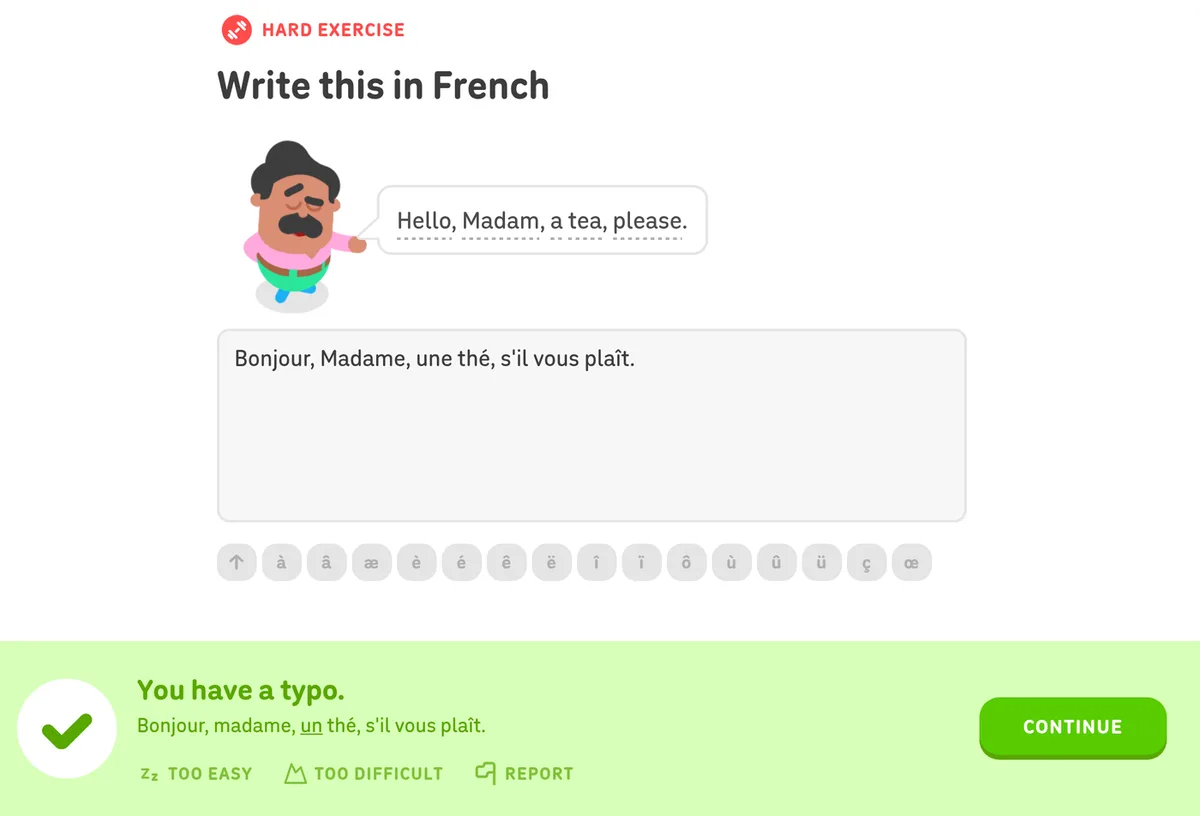
Duolingo’s one tip missed the point. We wrote le café where the sentence needed un café. Duolingo called it a “Common mistake!”, and its tip said “The word café is masculine, so it goes with un and le.” Our gender was already right; the mistake was the instead of a. In its apps, Duolingo also offers Explain My Answer, now free in its biggest courses. When I opened it on Kaffee in my German lesson, it told me that Kaffee means “coffee” and is “a common drink made from roasted coffee beans.” It felt like AI blindly explaining something obvious.
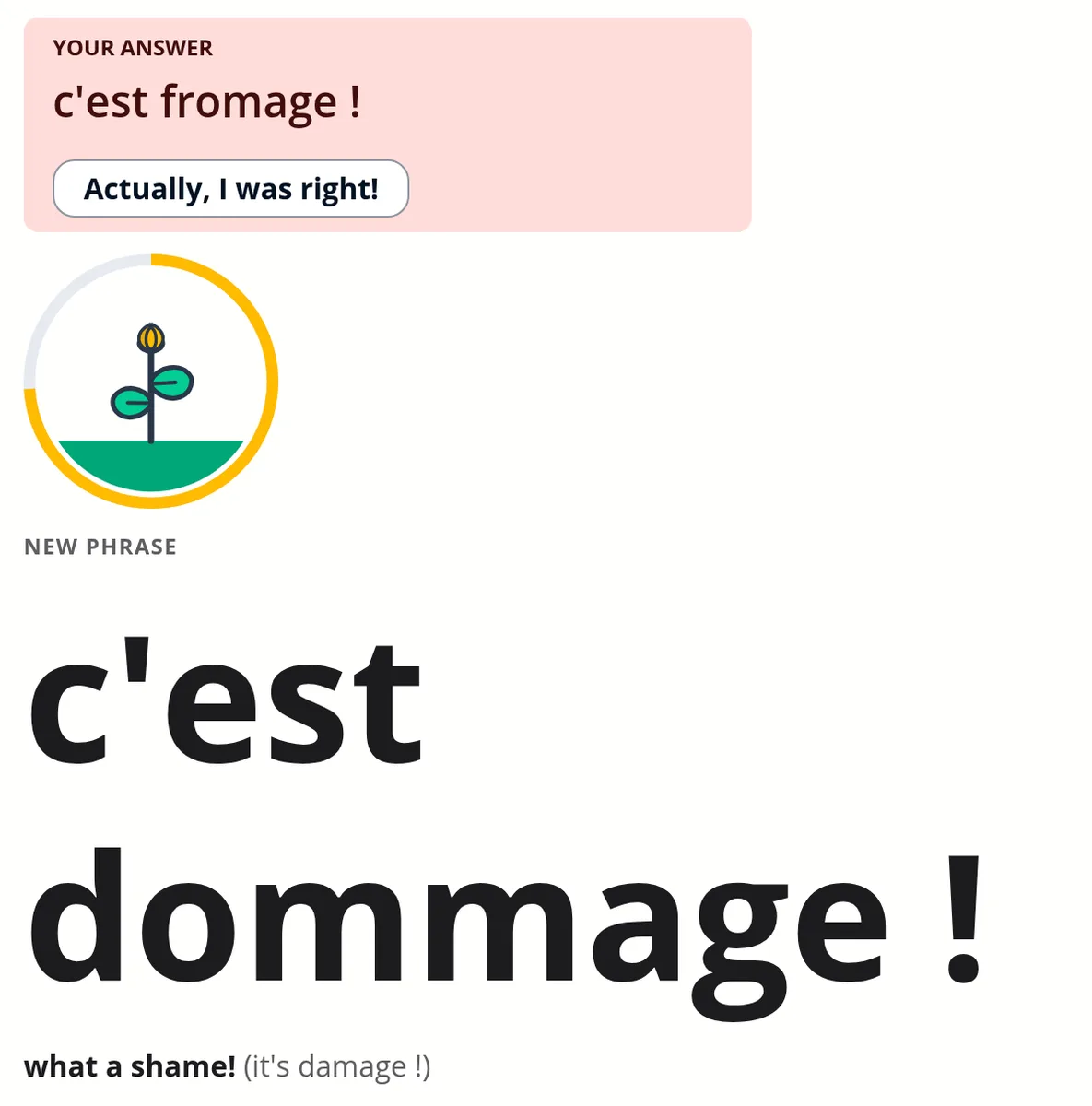
Memrise says even less. When we typed “c'est fromage !” for c’est dommage !, it showed our answer in red with an “Actually, I was right!” button, then showed the phrase card again. It didn’t say which word was wrong. A missing accent passed in silence: “arrete !” for arrête ! went green with no note, where Duolingo would at least have told us to check our accents.
Both apps check what you tap and type. For feedback on how you say the language, Copycat Cafe goes further: you say each line aloud and get a 0–100 pronunciation score on every word, with a tip on what to change in the words that need work.
Which app sounds better?
Memrise, clearly. Its lessons use recordings of real native speakers, while Duolingo’s lessons are voiced by synthetic character voices.
We listened closely to 14 clips from Duolingo’s first French lessons. They were text-to-speech voices with a metropolitan French accent, and they read every line correctly, including the liaison in un éclair, though a few character voices sounded stylized. In Alysa’s French lessons, word-order exercises sometimes played words one at a time, so C’était came out as “ce était”. In my German lesson, some of the recordings felt slightly unnatural.
All 11 Memrise clips we checked were human recordings of native speakers of metropolitan French. The studio clips were clean, and the street videos sounded like real streets, traffic noise included. One street speaker said J’ai pas le temps while the card read je n’ai pas le temps, which is how people actually say it. If your goal is to understand French as it’s spoken, that is worth more than a tidy recording.
Which is better for speaking practice?
Neither app gives you much speaking practice in its core lessons. Duolingo’s practice is mostly repeating lines after its characters. Memrise has a “Say it yourself” button on every phrase card and a set of AI chat partners that were unreliable in our test.
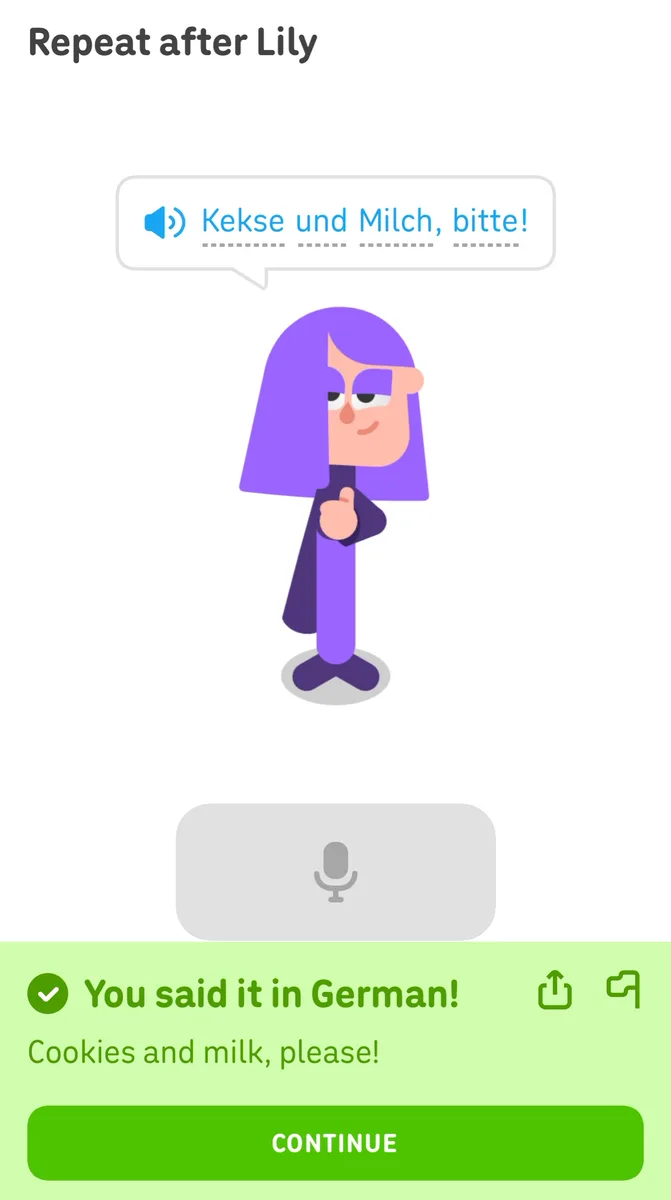
None of Duolingo’s first web lessons we took, in French, German or Italian, asked us to speak. On my iPhone, I opened Speak, which Duolingo lists under the heading “Conversation” in its Practice tab. It had me repeat ten short lines after Duolingo’s characters, such as Kekse und Milch, bitte!, and each one ended with a short message such as “You said it in German!” and the English translation, with no score. It just made me listen to things and then repeat them, which for me is not a conversation. Our Duolingo for German review has the rest of my screenshots.
Duolingo’s open conversation feature is Video Call with Lily, which runs in its iOS and Android apps. In its November 2026 shareholder letter, Duolingo said new Super subscribers already get unlimited Video Call and every Super subscriber will by the end of 2026. It used to come with Duolingo Max, which Duolingo stopped selling to new subscribers in November 2026.
Memrise’s phrase cards include “Say it yourself”, which showed 10 attempts left on our free account, and Memrise’s homepage says you can “record yourself and compare”. Alysa chatted in French with MemBot, Memrise’s chatbot, by typing or by speaking, and found its replies reasonable and in correct French.
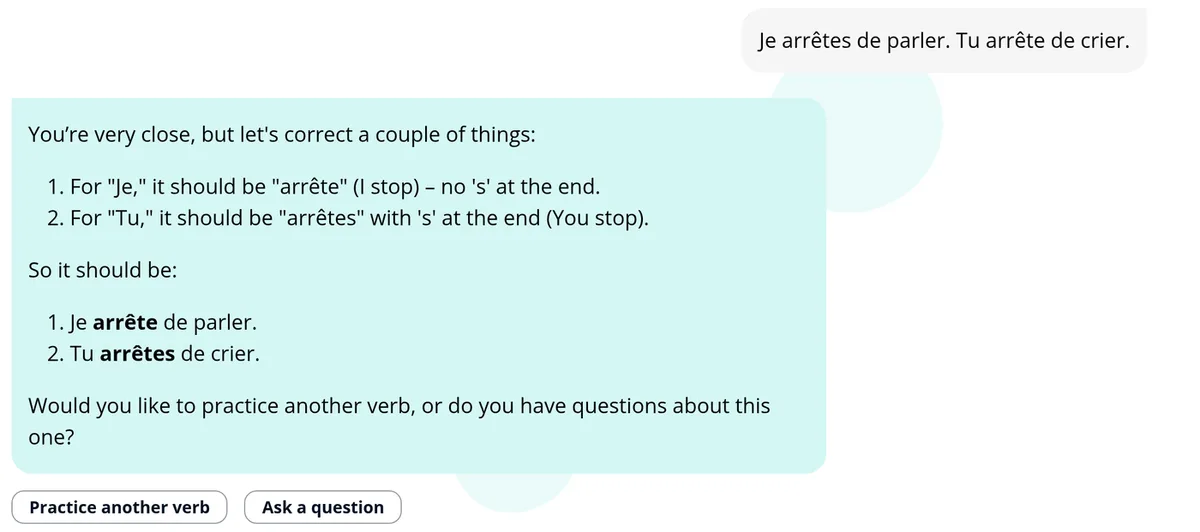
The newer AI Buddies were harder going. On the web we found them only through the account menu, under Help. The Conjugation Buddy opened with arrêter, which it called “an irregular verb”; it’s a regular -er verb. We then wrote “Je arrêtes de parler. Tu arrête de crier.” It fixed both endings but kept “Je arrête”, where French needs J’arrête. The Grammar, Role-Play, Sentence Builder and Assistant Buddies each replied “Something went wrong generating completion. Please give it a few minutes and try again.”
For speaking practice, Copycat Cafe goes further than either app. Where Duolingo’s Speak tells you “You said it in German!”, Copycat Cafe gives you a 0–100 score on every word you said and a tip on the words that need work. You then use the same lines with Copy, your AI conversation partner, out loud or by typing.
What can you do for free?
More with Duolingo. Its whole course is free, with ads and a limit on mistakes, and you can start as a guest. On the web our lessons used hearts: each wrong answer cost one, and the hearts menu said “Next heart in 5 hours”, with unlimited hearts on Super. On mobile, Duolingo is moving to an Energy meter, and it says its Practice tab is free on iOS and Android.
Memrise’s free plan teaches the lessons but caps the practice around them. Its plans page says free speaking practice is “limited to one session per day”, and when we were signed in, the same page also limited reviews to 50 words a day and left out Speed review, Difficult words and custom word lists. After its failed replies, the Grammar Buddy told us “You’ve reached your free limit.” Alysa also found it hard to tell what the free version included until something was locked.
How much do Duolingo and Memrise cost?
Memrise is cheaper for a year, and Duolingo is cheaper by the month. These are the prices each app showed on its US website on November 13, 2026: Duolingo Super in its web checkout, and Memrise Pro on its plans page.
| Plan | Duolingo Super | Memrise Pro |
|---|---|---|
| Monthly | $16.99 a month | $24.99 a month |
| Yearly | $119.99 ($9.99 a month) | $61.99 ($5.17 a month) |
| Family | $143.99 a year for up to six accounts | Not listed |
| Lifetime | Not listed | $99 one-time, shown as 70% off $329.99 |
Prices checked November 13, 2026.
A year of Memrise Pro costs about half as much as a year of Super. The $99 lifetime offer costs less than one year of Super, but Memrise gave no end date for it, and on November 11 lifetime cost the full $329.99. Our Memrise Black Friday guide tracks how often that price comes and goes. Prices in the apps can differ from the websites, so check the price your app shows before you pay; our guide to Duolingo’s paid plans shows where to find yours.
Which should you choose?
Pick by what you want the app to do for you:
- A free daily habit with a clear path: Duolingo. The whole course is free, and its streaks are hard to argue with.
- Real native speakers and phrases people actually say: Memrise. Its street videos and literal translations give every phrase a face and a voice.
- The cheapest paid plan: Memrise, at $61.99 a year, or $99 for lifetime while that offer lasts.
- A language outside the big ones: both are worth a look. Duolingo teaches more than 40 languages, and Memrise’s homepage lists 149.
- Pronunciation feedback and speaking practice: Copycat Cafe, below.
You can also use both. Duolingo keeps the daily habit going for free, and a Memrise session trains your ear on real voices.
If you want to speak: Copycat Cafe
Duolingo and Memrise are good at getting you to recognize a language. Copycat Cafe is built for the next step, saying it: you hear an everyday conversation, slow a line down and rebuild it by ear, say each line aloud with a 0–100 pronunciation score on every word, then use it with Copy, your AI conversation partner. It teaches French, Spanish, Italian and German, and costs $29 a month or $174 a year, with a 7-day free trial and a 30-day money-back guarantee on your first payment.
Still comparing? See Busuu vs Duolingo, Duolingo vs Speak and our guide to the best Duolingo alternatives.