

LingoDeer has a loyal following among people learning Japanese, Korean and Chinese, mostly because of its grammar explanations. If you're learning French, Spanish, Italian or German, you probably want to know two things: does it hold up for your language, and is it worth $14.99 a month now that the lifetime plan is gone?
This review covers what a LingoDeer lesson is actually like, how long each course is, what you get for free, every current price, and who should choose something else.
How we tested LingoDeer
We used LingoDeer's French 2.0 course on the web in November 2026. We completed the first two lessons of Unit 1, made a few mistakes on purpose to see how it corrects them, read the unit's Learning Tips, ran a spaced-repetition flashcard review, and counted the lessons in eight of its courses. Prices come from LingoDeer's website and the US App Store, checked on November 11, 2026, and learner opinions from recent App Store reviews and Reddit.
What is LingoDeer?
LingoDeer is a language app with short, game-style lessons built around grammar. It launched on iOS in 2017, and the company behind it is registered in Singapore and Beijing. It now teaches 19 languages in 20 courses, including French, German, Italian, Brazilian Portuguese, and two separate Spanish courses for Spain and Latin America. French comes in two versions, 1.0 and 2.0; the newer 2.0 course is the one LingoDeer puts first.
You can use it on the web, iPhone and Android, and learners rate it highly: 4.7 stars from about 28,000 ratings on the US App Store, and 4.4 stars from about 455,000 on Google Play. LingoDeer says each course takes a complete beginner to an intermediate level, roughly A1 to B1 on the CEFR scale.
What is a LingoDeer lesson like?
A LingoDeer lesson is about 5 minutes of tapping, matching and typing exercises that introduce a handful of words and sentences, and you can tap a word to open a grammar card. Our first French lesson, on greetings, took 4 minutes 43 seconds; the second took a little over 6.
Each new sentence appears first with its audio, its English translation and a turtle button that replays it slowly. Then the exercises recycle it: choose the right picture, complete the sentence, tap the matching pairs, tap the words you hear, and build a translation from a word bank. Both our lessons ended with a typed "hard exercise" and a review of the questions we got wrong.
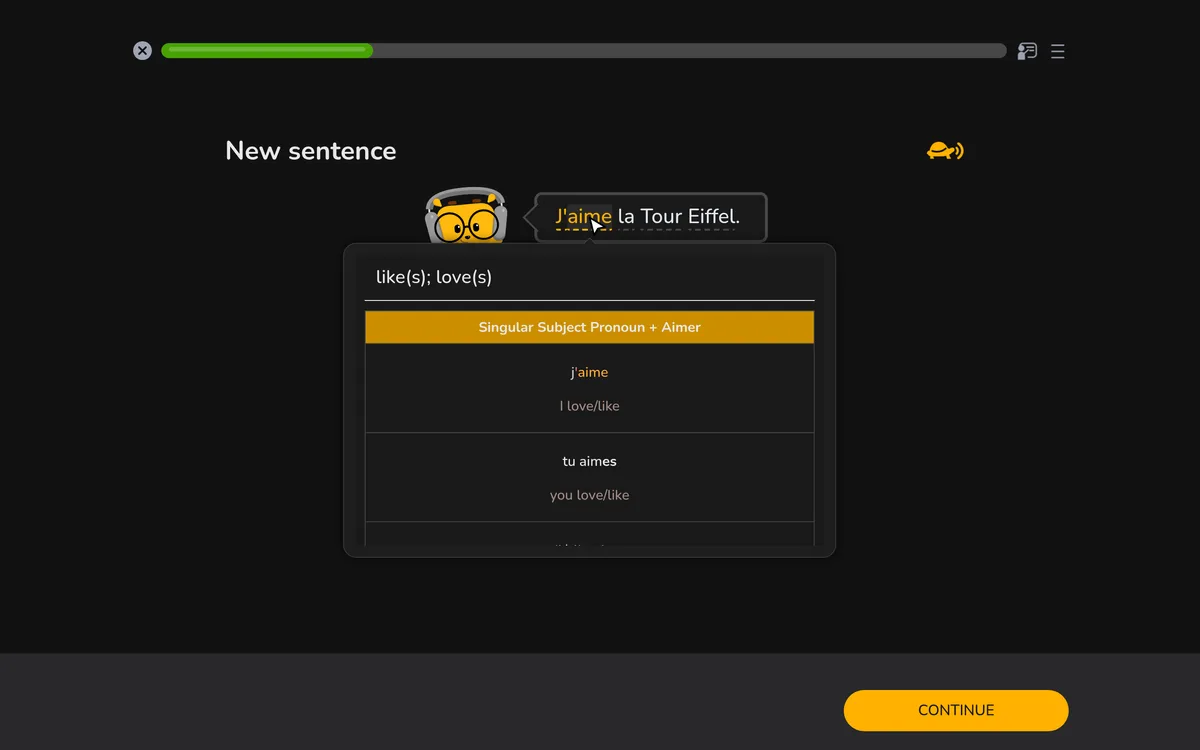
The grammar is where LingoDeer earns its reputation. Tap aime in "J'aime la Tour Eiffel" and a card opens with the conjugation of aimer, then three short rules: why je aime becomes j'aime, why "I like apples" needs les, and what happens when another verb follows. Each unit also has a Learning Tips page; the first one covers greetings, subject pronouns, être and yes-no questions in tables you can scan in a minute.
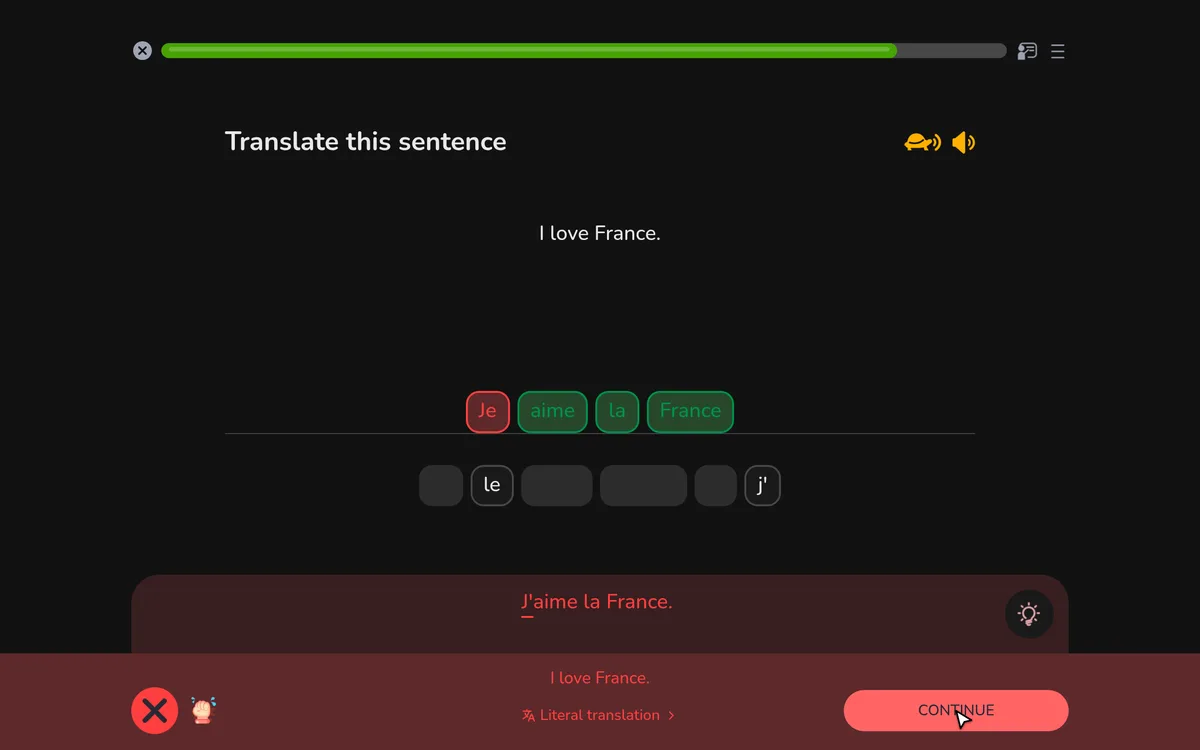
The corrections are precise. When we built "Je aime la France" on purpose, LingoDeer turned only Je red and underlined the J' in the correct answer, so the mistake was obvious at a glance. It's forgiving with accents: when we typed "Ca va, et toi ?" without the cedilla, it accepted the answer and showed "Ça va, et toi ?" underneath. That keeps you moving, but you'll need to notice the correct spelling yourself.
When you get an answer wrong, a "Tell me why" button offers an AI-written explanation. LingoDeer added these explanations to its Android app between December 2025 and January 2026, and they're now on iPhone and the web too. You can switch them off in the settings.
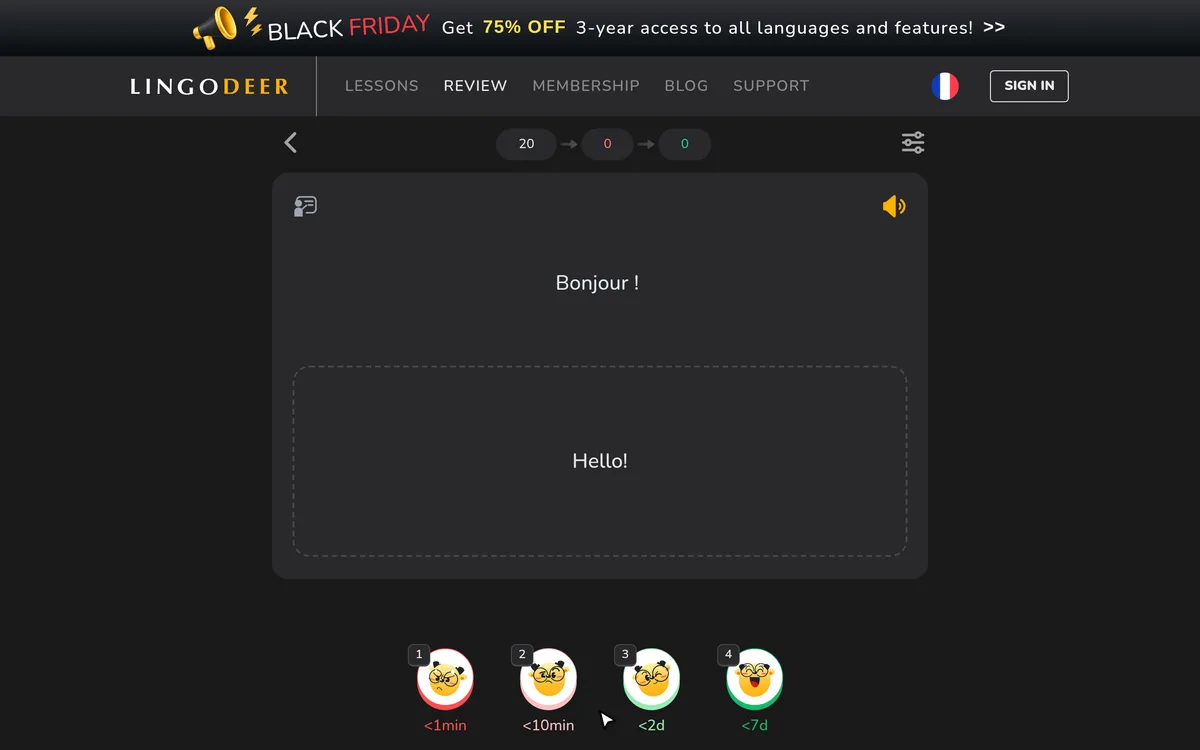
Between lessons, the Review tab turns what you've learned into spaced-repetition flashcards. You grade each card from 1 to 4, and the grade decides when it comes back, from under a minute to under a week; you can also review by listening or by spelling.
How good is LingoDeer's audio?
Very good. LingoDeer says its lessons are voiced by native speakers, and the French sentences in our first lesson were clean studio recordings of a native speaker with a standard French accent, at natural speed. That's a real advantage over apps that use synthetic voices, and it's one of the things learners praise, as you'll see below.
Can you practice speaking on LingoDeer?
Yes, mostly by repeating native-speaker lines. In our web lessons, each new sentence had a microphone button for recording yourself, but recording was optional and every exercise that counted toward our score was tapped or typed. There's more speaking practice outside the core lessons: LingoDeer's help center says Story-Speaking and the Travel Phrasebook have you record yourself after a native speaker, and Fluency Builder (called Fluent until November 2026) adds speaking exercises around longer dialogues. Its developer log also mentions speech recognition that grades speaking exercises, at least in Japanese.
If speaking is what you're after, our guide to French conversation practice covers apps built around it.
How long are LingoDeer's courses?
Longer than you might expect from an app best known for Asian languages, at least for French and Latin American Spanish. We counted the lessons on each course map, levels I and II together:
| Course | Level I | Level II | Total lessons |
|---|---|---|---|
| Spanish (Latin America) | 188 | 167 | 355 |
| Japanese | 180 | 126 | 306 |
| Korean | 192 | 114 | 306 |
| French 2.0 | 143 | 137 | 280 |
| Italian | 80 | 130 | 210 |
| German | 75 | 113 | 188 |
| French 1.0 | 70 | 109 | 179 |
| Spanish (Spain) | 61 | 100 | 161 |
Latin American Spanish is longer than the Japanese and Korean courses LingoDeer is known for, and French 2.0 is close behind. German, Italian and Spain Spanish are shorter. At 5 to 6 minutes a lesson, French 2.0 is roughly 25 hours of lessons, or about nine months at one lesson a day, before reviews.
Is LingoDeer free?
Only the start of each course is free. According to LingoDeer's help center, free users get the alphabet section, all of Unit 1 with its review, the test-out quizzes for every unit, the Travel Phrasebook, and the first Fluency Builder (formerly Fluent) lesson of each beginner level. Everything else, plus offline learning and syncing between devices, needs Premium.
That's enough to judge the teaching style. On the web you can even try the first lessons without an account, though you'll need one to see the "Tell me why" explanations.
How much does LingoDeer cost?
LingoDeer Premium costs $14.99 a month, $39.99 a quarter or $95.99 a year on its pricing page, and every plan covers all its languages. If you know you'll study for years, the one-time 3-year and 6-year plans bring the cost down further.
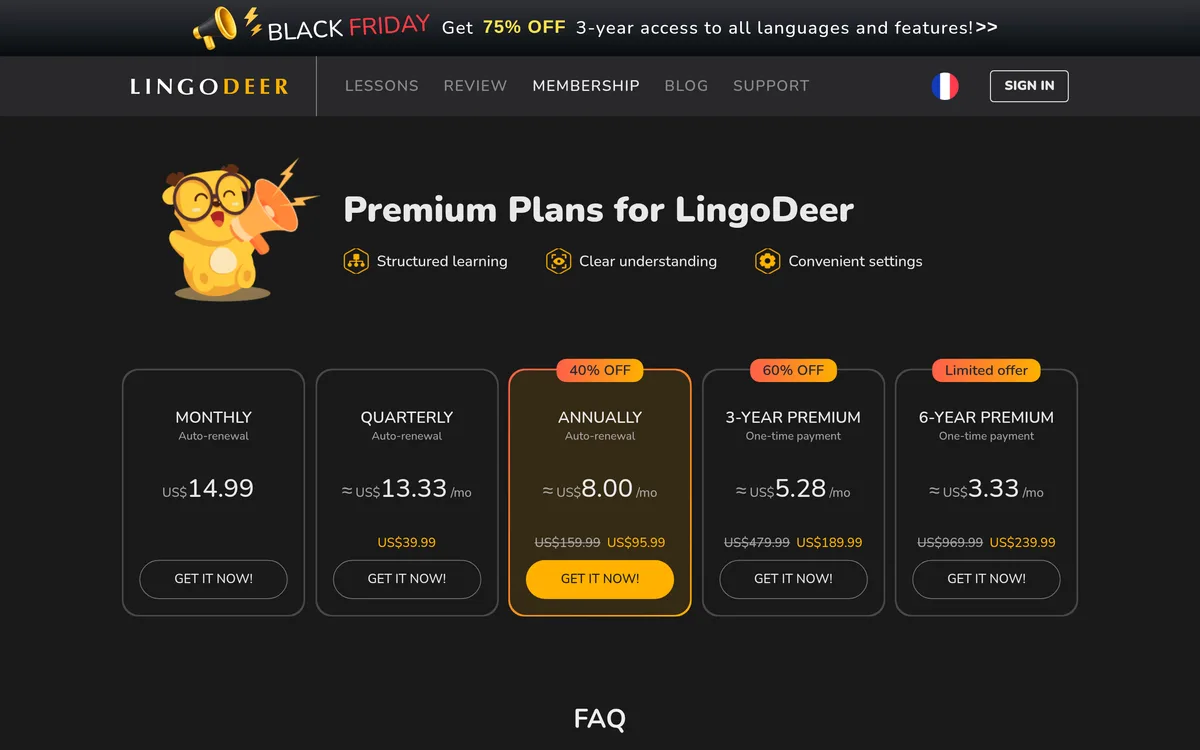
| Plan | LingoDeer website | US App Store |
|---|---|---|
| Monthly | $14.99 | $14.99 |
| Quarterly | $39.99 | $34.99 |
| Yearly | $95.99 (about $8 a month) | $95.99 |
| 3 years, one payment | $189.99, or $119.99 in the Black Friday sale until November 28 | Website only |
| 6 years, one payment | $239.99 | Website only |
For most learners the yearly plan is the sensible buy: it works out to about $8 a month, a little over half the monthly price. If you buy on iPhone, the quarterly plan is $5 cheaper than on the website. The Black Friday deal works out to $3.33 a month, the same rate as the 6-year plan for half the commitment, and our LingoDeer Black Friday guide explains what it really saves. For other brands, see our Black Friday language learning deals.
A few terms are worth knowing before you pay:
- Free trial: LingoDeer offers one 7-day free trial per learner, only in the iOS and Android apps and only on the yearly plan.
- Refunds: yearly, 3-year and 6-year plans bought on the website come with a 7-day money-back guarantee. Refunds for in-app purchases go through Apple or Google.
- Cancelling: if you subscribed in the app, cancel through your Apple or Google subscriptions. Deleting your LingoDeer account doesn't stop the renewal.
- Lifetime: LingoDeer stopped selling lifetime access around the start of 2026 and replaced it with the 3-year and 6-year plans. Existing lifetime members keep their access.
LingoDeer pros and cons
Here's how LingoDeer stacked up in our lessons and in what learners report.
Pros
- Clear grammar cards when you tap a word, plus a Learning Tips page for each unit
- Native-speaker audio with a slow-motion button on each new sentence
- Precise corrections that show exactly which word you got wrong
- Short lessons of about 5 minutes
- Long French 2.0 and Latin American Spanish courses
- One subscription covers all 19 languages
- Spaced-repetition flashcards for review, with listening and spelling modes
Cons
- Speaking practice means repeating native-speaker lines, and in the lessons we did it was optional: every scored exercise was tapped or typed
- The free content ends after Unit 1
- Paying monthly costs almost twice as much as the yearly plan ($14.99 against about $8 a month), and the free trial is only in the apps, on the yearly plan
- No lifetime plan any more
- German, Italian and Spain Spanish are much shorter than French 2.0 or Latin American Spanish
- Missing accents are accepted, so you have to watch your own spelling
What do learners say about LingoDeer?
Learners mostly agree on the strengths and split on the price. Praise centres on the human voices and the grammar. One App Store reviewer wrote in October 2026 that LingoDeer "is clearly richer and more thoughtfully put together than Duolingo," and hoped it would "continue to emphasize human voices and content over AI slop." On Reddit, a learner praised its "great, hand-written grammar explanations in every lesson," but found it "just too slow" for easier languages such as Romance languages or German.
Most complaints are about the paywall. A two-star App Store review from November 2026 said that after the first module "I can't do anything else without a subscription… $15 a month is way too expensive for me." Some dislike the new AI explanations: a four-star reviewer in September 2026 who praised the lessons said the AI "almost always spits out irrelevant nonsense." On r/lingodeer, a learner who had been saving up for lifetime access was upset to find it gone in early January 2026.
Is LingoDeer better than Duolingo?
LingoDeer is better than Duolingo if you want grammar explained; Duolingo is better if you want to learn for free. Both use short game-style lessons, but LingoDeer explains grammar in word cards and Learning Tips pages and uses native-speaker recordings, while Duolingo's main strength is a long free path through its courses. LingoDeer's free content stops after the first unit. Our Duolingo review and our list of Duolingo alternatives compare the two with other apps.
Who should use LingoDeer?
LingoDeer suits you if you learn best when you understand the rules, want a structured course in small daily doses, or study more than one language. It's especially strong value if you're learning Japanese, Korean or Chinese alongside French or Spanish, since one subscription covers them all. If you're comparing it with other courses, our guides to the best apps for French, Spanish, German and Italian rank the alternatives.
If your goal is to speak, LingoDeer will give you the sentences, the grammar behind them and native-speaker lines to repeat, but nothing in our two lessons needed us to speak. Copycat Cafe is built for that step. You hear an everyday conversation, say each line aloud and get a 0–100 pronunciation score on every word, then use the same language with Copy, your AI conversation partner. It teaches French, Latin American and Spain Spanish, Italian and German, and costs $29 a month or $174 a year in the US, with a 7-day free trial and a 30-day money-back guarantee on your first payment.