

If you've looked for an app to build vocabulary, Lingvist has probably come up. Each card is a short sentence in the language you're learning with one word missing, and you type that word. When our team started French as a beginner, Lingvist promised: "You will learn the 5091 most common words with practical, everyday sentences!"
Before you pay, you probably want to know how far the free account goes, what a subscription costs and whether Lingvist tells you why an answer was wrong. To find out, we typed our way through 50 French cards until the free account stopped us, and tried its Spanish and German courses too, getting answers wrong on purpose along the way.
Here's what we found.
How we tested Lingvist
Our team used Lingvist on the web with a free account on November 13, 2026. We started French from English as a beginner and worked through 50 cards, until the next card locked. We also did 15 cards in Spanish (Europe), 5 in Spanish (Latin America) and 6 in German. Along the way we typed wrong words, wrong endings, the wrong gender, typos and missing accents on purpose. We opened the free Grammar Tips and the Challenges list, listened to clips of the card audio from each course, and read the prices on Lingvist's pricing page.
What is Lingvist, and how does it work?
Lingvist is a vocabulary trainer: you learn a language's common words by typing each one into a gap in a short sentence. Our first French card was le ___ et la nuit, with the English word and a translation of the whole sentence underneath, so you know which word you're looking for (here, jour). A small chip names the part of speech, and a counter tracks your progress through a set of 50 cards.
A right answer on a new word often brought up "Maximum memory strength!" A wrong answer keeps the card on screen until you type the correct word. After three cards, Lingvist offered a placement test or a start as a beginner; we started as a beginner.
Switching languages was free through "Change language". Spanish comes as two separate courses, Spanish (Europe) and Spanish (Latin America), with different word lists and sentences: the Europe course listed 5944 words, the Latin America course 4993, and German 6006. The first Spanish (Europe) cards were short phrases such as la casa and el hombre rather than full sentences. If you're not sure which Spanish to pick, our guide to Latin American and Spain Spanish explains the differences.
Is Lingvist free?
You can start free, but in our test the free account ran out after 50 French cards. Signing up asked for no payment, and the first card opened about a minute later. After card 50, the next card was greyed out with a padlock and this banner: "To continue, you need to opt in to a free trial, which will unlock all of Lingvist's content and features."
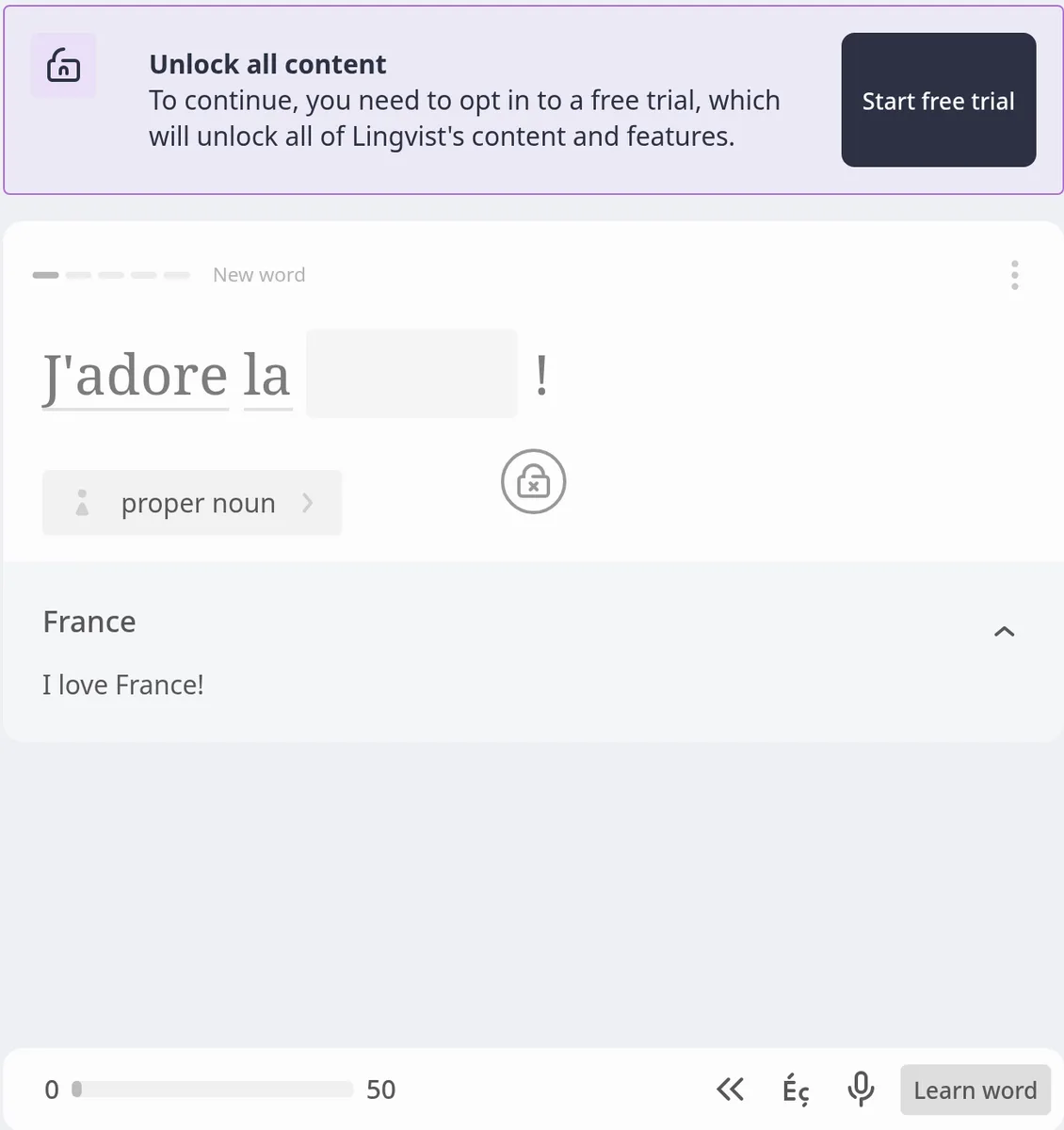
In our test, the limit applied to the French course, not to the whole account. Once French had locked, our Spanish (Europe) course still served a new card. Asked "Is Lingvist free?", Lingvist's own pricing page says: "Lingvist is a subscription based app. However, there's a trial period that comes at no cost when you choose the 12-month subscription."
Other parts of the free account were mixed. The Grammar Tips reference was open to read. All 40 French Challenges (listening, reading and grammar exercises such as "The Verb Être" and "Ça or Sa?") showed a padlock, and clicking one did nothing.
So the free account is enough to see whether you like the card format.
Does Lingvist explain your mistakes?
Not in the feedback you get after a wrong answer. Lingvist shows the correct word in the gap, colours each letter green or red, and waits for you to type it correctly. None of the nine French answers it marked wrong came with a sentence explaining what we'd done wrong.
Red and green letters, with no reason
The letter colours compare your answer with the right one position by position, which works for a small slip and confuses things for a bigger one. Typing musiqe for musique turned the last two letters red, which shows you roughly where the problem is. Typing home for homme coloured h, o and m green and the rest red, because the missing m shifted every letter after it.
Some mistakes weren't pointed out at all. When we typed nome for nom, the right word appeared with no red letters, so the extra e went unmarked. When we typed the plural verb jouent for joue in Il ___, all four letters of joue showed green and the extra nt was never flagged. A wrong article, le for la in C'est la vie !, got a red letter a and no explanation.
The feedback we saw was all about spelling. For feedback on how you say a word, Copycat Cafe is built for that: you say each line of an everyday conversation aloud and get a 0–100 pronunciation score on every word, with a tip on what to change for your next try.
"Similar words" that don't count as mistakes
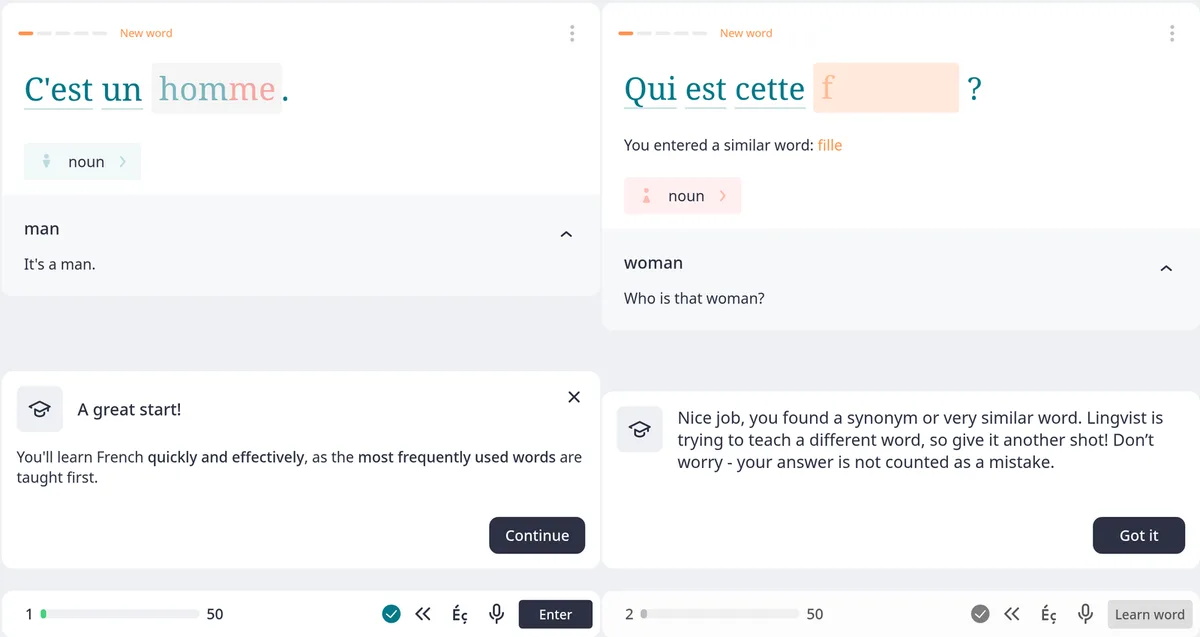
Sometimes a wrong answer isn't marked wrong at all. When we typed fille for femme in Qui est cette ___ ?, Lingvist said "You entered a similar word: fille" and added: "Don't worry - your answer is not counted as a mistake." Fille means girl or daughter, not woman. The gap then showed only the first letter, f, as a hint, and when we typed femme the card showed "Maximum memory strength!"
The same thing happened in the other courses. In Spanish (Europe), la for el and tiempos for tiempo were both called similar words, and in German so was Jahre for Jahr. Other wrong words and endings were marked as plain mistakes, such as señora for mujer and casas for casa in Spanish (Europe), so it's hard to predict which wrong answers will count as mistakes.
Missing accents pass by default
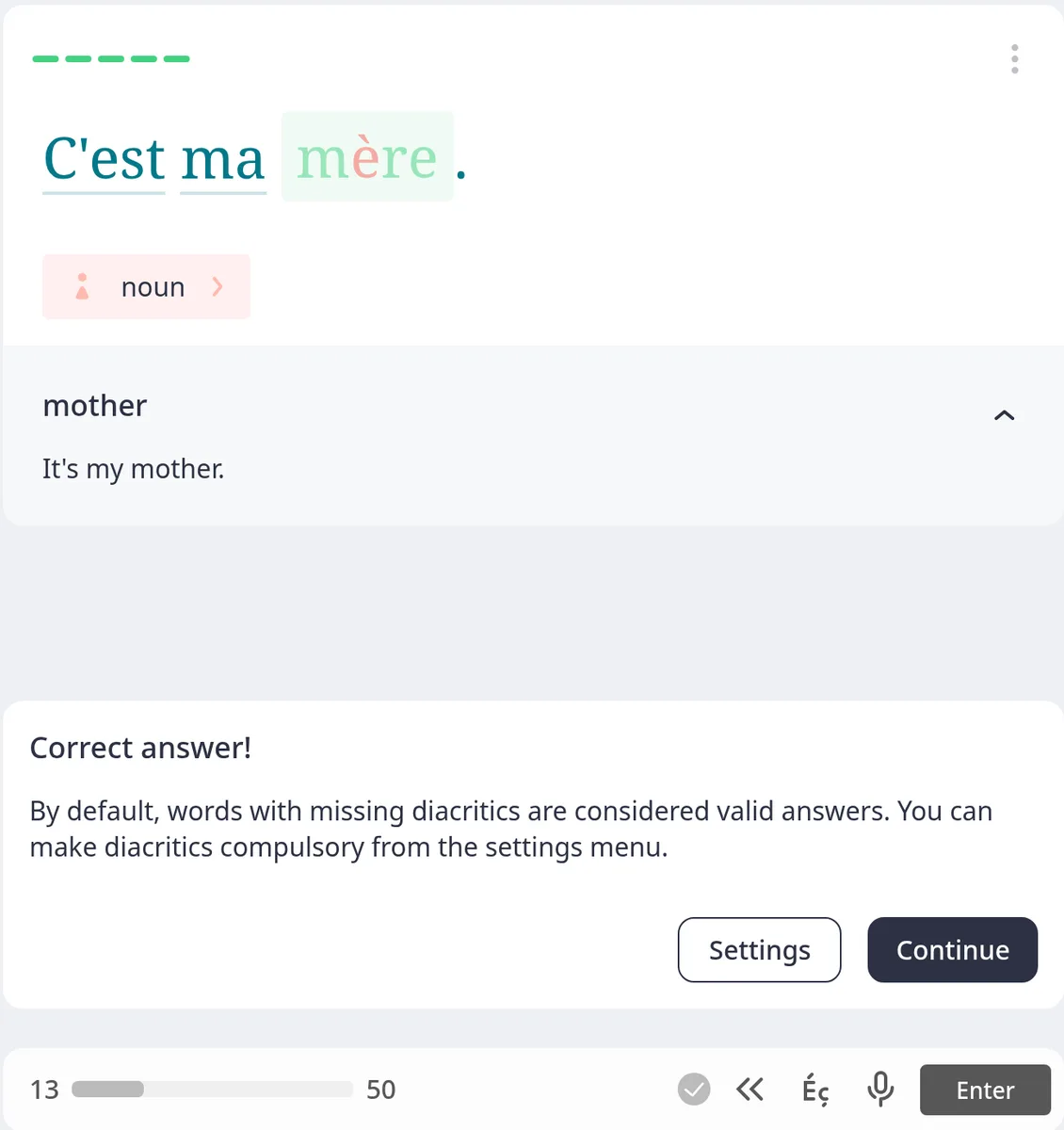
With its default settings, Lingvist accepts a word with a missing accent as correct. When we typed mere for mère, it said "Correct answer!" and explained: "By default, words with missing diacritics are considered valid answers. You can make diacritics compulsory from the settings menu." The missing è was shown in red, and the card still counted at full memory strength. Later, annees for années was accepted with no message at all.
The other courses were just as relaxed. Spanish (Europe) accepted dia for día without a word. German accepted leben for Leben, though German nouns take a capital, gross for groß, and schon for schön, which is a different word that means "already". If you want accents to count, switch on the diacritics setting from your first session. We kept the default setting, which is what a new learner gets.
Where the grammar help is
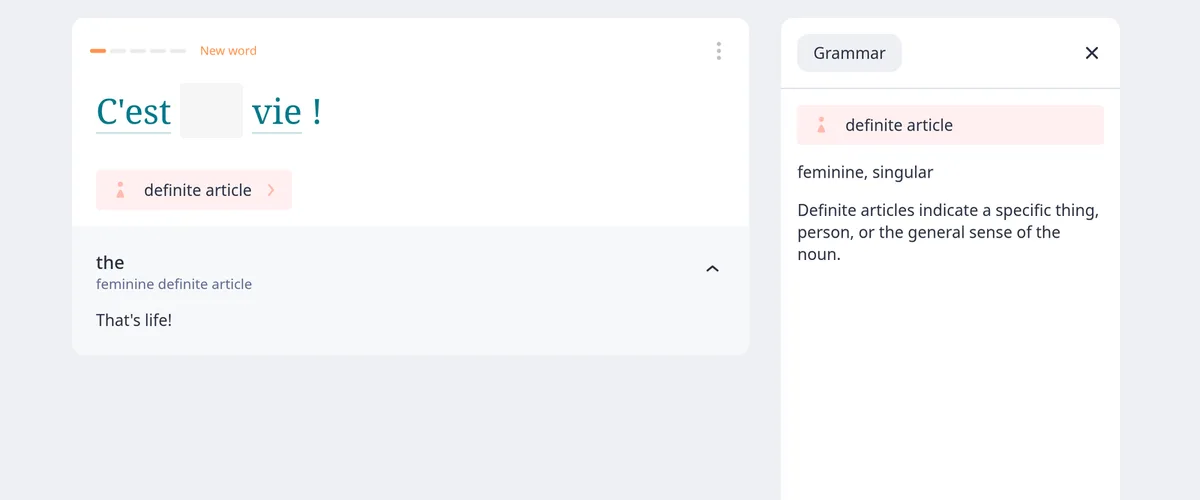
Lingvist does have grammar explanations; you have to go and open them. The part-of-speech chip on each card opens a Grammar panel. On the C'est la vie ! card, the chip read "definite article", and the panel said "feminine, singular" and "Definite articles indicate a specific thing, person, or the general sense of the noun." The card had also shown the hint "the / feminine definite article" before we answered.
The free Grammar Tips reference goes further. The French list we opened ran from "Pronunciation" and "Definite articles" through "Subjunctive", "Passé composé" and "Passé Simple", with tables and examples such as "le, l' (masculine) / la, l' (feminine) / les (plural)". It's a useful reference, but the feedback after a wrong answer never pointed us to it.
How does Lingvist's audio sound?
Clear to us in all four courses, and in three of them it sounded to us like generated speech. Each card comes with two short clips, one of the word and one of the sentence. French sentence clips lasted under two seconds.
In French, the sentences sounded to us like one generated male voice with a standard France accent. The liaison in C'est un homme was right, and we heard no mispronunciations. One word clip sounded to us like it read the elided c' aloud as "C apostrophe".
Spanish (Latin America) and German also sounded to us like generated voices: a female voice with a Latin American accent that said difícil with an s sound, and a female voice in standard German that read Das Jahr 2018 correctly as zweitausendachtzehn. Spanish (Europe) sounded to us like one clear female voice with a Spain accent.
How much does Lingvist cost?
Lingvist costs $79.99 a year or $9.99 a month on Lingvist's pricing page, prices checked November 13, 2026. Of the two plans with a public price, only the yearly one comes with a free trial.
| Plan | You pay | Per month | Free trial |
|---|---|---|---|
| Annual | $79.99 a year | $6.67 | 14 days |
| Monthly | $9.99 each month | $9.99 | None |
The yearly plan costs about the same as eight months of the monthly one, so it's the better deal if you expect to use Lingvist for longer than that. There is also a Lingvist for Business plan with no public price.
The trial needs a payment method. Lingvist's FAQ asks "Why do I need to give you my payment details for a 'free' trial?" and answers that its subscriptions renew automatically, so it needs payment details "to be able to trigger the next payment automatically in the future." It also says "your payment method will be billed in the 24-hour window before your trial expires," and "Cancel the free trial before it ends and you will not get charged." If you start the trial, set a reminder for day 13.
Is Lingvist worth it?
It is if you want to type your way through a language's common words in short daily sets and you're happy to look up the grammar yourself. Here's how our test adds up:
Pros
- Quick, focused cards that teach common words inside short sentences
- Separate Spanish courses for Spain and Latin America
- A free Grammar Tips reference with tables and examples
- Card audio sounded clear to us in all four courses
- No payment step to start, and free course switching
Cons
- Wrong answers get red and green letters with no explanation
- Missing accents, umlauts and lower-case German nouns pass by default
- Some wrong words count as "similar words", not mistakes
- Our free French course stopped after 50 cards, and all 40 French Challenges were locked
- The trial comes only with the yearly plan, not the monthly one, and needs payment details
Lingvist suits you if you're already following a course and want a steady supply of high-frequency words, you like short typed drills, and you'll switch on compulsory accents. At $6.67 a month on the yearly plan, it's an add-on rather than a full course.
Skip it if you need to understand why an answer was wrong, or if you want to get better at speaking. Every card we did asked us to recall a word and type it.
What are the best alternatives to Lingvist?
It depends on what you want Lingvist to do. If you like learning words in sentences, Clozemaster also builds vocabulary with fill-in-the-blank sentences, and our Clozemaster Black Friday guide covers what its Pro plan costs and when it usually goes on sale. For more ways to make new words stick, see our guide to learning French vocabulary.
If you want a full app rather than a vocabulary trainer, our guides to the best apps to learn French, the best apps to learn Spanish and the best apps to learn German compare the main options, and our Duolingo alternatives roundup covers more across languages.
If your goal is to speak, Copycat Cafe is built for that: you hear an everyday conversation, say each line aloud with a 0–100 score on every word, then use it with Copy, your AI conversation partner. It costs $14.50 a month billed as $174 a year, or $29 a month, with a 7-day free trial and a 30-day money-back guarantee on your first payment.
Frequently asked questions
Is Lingvist free?
You can start for free, but not for long in one course. Our free account gave us 50 French cards, then asked us to opt in to a free trial to continue. The Grammar Tips reference was free to read, and the French Challenges were locked.
How much does Lingvist cost?
Lingvist costs $79.99 a year ($6.67 a month) or $9.99 a month in US dollars, checked November 13, 2026. The yearly plan comes with a 14-day free trial; the monthly plan has none.
Do you need a card for the Lingvist free trial?
Yes, according to Lingvist's FAQ. It says it needs payment details for the trial because its subscriptions renew automatically, and that it bills your payment method in the 24 hours before the trial ends unless you cancel first.
Does Lingvist accept answers without accents?
Yes, by default. In our test it accepted mere for mère, dia for día and schon for schön. Lingvist says you can make accents compulsory in its settings.
Does Lingvist explain your mistakes?
Not after a wrong answer. It shows the right word with each letter coloured green or red. Grammar notes are in a panel you open from the part-of-speech chip on each card, and in the separate Grammar Tips reference.