
Disclosure: This post contains affiliate links. If you buy through them, we may earn a commission at no extra cost to you.
Maybe there's a family in Belo Horizonte you'd like to talk to without your partner translating. Maybe it's a Carnaval trip, or a colleague in São Paulo who keeps switching to English for your sake.
Either way, you want Portuguese as it's spoken in Brazil, not a textbook version. So which app will actually get you there?
What is the best app to learn Brazilian Portuguese in 2026?
Here's the app we'd pick for each goal, and why.
| Category | Our pick | Why |
|---|---|---|
| Best free | Duolingo (our review) | The whole Brazilian Portuguese course is free, in short game-like lessons. |
| Best for grammar and short lessons | Babbel | 10–15 minute lessons with grammar tips, built on Brazilian Portuguese with speakers from across Brazil. |
| Best app to learn to speak Brazilian Portuguese | Copycat Cafe | Hear an everyday Brazilian conversation, say each line aloud with a pronunciation score on every word, then use it with Copy, your AI conversation partner. |
| Best audio course | Pimsleur (our review) | 30-minute listen-and-answer lessons, 150 of them across five levels of Brazilian Portuguese. |
| Most complete course, including reading and writing | Rocket Portuguese | Audio lessons, grammar and culture lessons, and speaking and writing drills, for a one-time price. |
| Best AI conversation partner | Langua (our review) | Open conversation by voice or text with detailed corrections and a hands-free Call Mode. |
| Best with a human tutor | Preply (our review) | Book live 1-on-1 lessons with a tutor from Brazil. |
We also cover Busuu below, for feedback on your writing from Portuguese speakers in its community.
How we tested
We compared these apps on what matters for speaking Brazilian Portuguese: pronunciation feedback, conversation practice, audio, grammar help, daily time, value for money and which Portuguese they teach. On November 23 and 24, 2026, our team took the first lesson of Duolingo's Portuguese course on the web twice, making a different mistake on purpose each time and listening to its word recordings. Benjamin Houy, our co-founder, used Babbel's Latin American Spanish course on his iPhone, and our team took the first lessons of Pimsleur's and Rocket Languages' Spanish courses on the web. Nerissa, on our team, used Langua's French course for open conversations by voice and text. Nerissa also took live lessons with a Portuguese tutor on Preply, and Alysa, on our team, used Busuu's French course. We checked each app's Portuguese course details and prices on its official site.
Brazilian or European Portuguese: which should your app teach?
Learn Brazilian Portuguese if the people you want to talk to are in Brazil, and European Portuguese if they're in Portugal. Speakers understand each other, but the sounds and a lot of everyday words differ, and a beginner notices.
In most of Brazil you say você for "you" to almost everyone, put the pronoun first in Eu te amo ("I love you") and call a dog a cachorro. In Lisbon you'll hear Amo-te and cão, and the vowels are much more swallowed. Brazilians also soften d and t before an i sound in most of the country, so dia sounds close to "JEE-ah".
Every app in this guide teaches the Brazilian variety, and on Preply you choose your tutor's. If you need Portugal's Portuguese, look at Practice Portuguese, which teaches only European Portuguese, or Pimsleur's separate European Portuguese course.
Duolingo
Portuguese variant: Brazilian.
Duolingo is the easiest way to start Portuguese without paying, and it's our best free pick. Its short, gamified lessons are good for building a daily habit with basic words, but you'll want to pair it with practice where you speak in full sentences.
Duolingo teaches more than 40 languages on the web and in its mobile apps. Our Duolingo for Portuguese review covers the course in more depth, and our best Duolingo alternatives guide covers what to use next.
What's good about Duolingo for Portuguese
- It's free, and it's easy to come back to every day, with streaks and reminders built around a five-minute habit.
- It teaches Brazilian vocabulary from the first lesson: our first lesson used cachorro for "dog", the Brazilian word.
- Lessons are short enough for a coffee break.
- The word audio sounds Brazilian: in our lesson, carro and cachorro had the Brazilian h-like rr, though some of the voices sound synthetic.
What's not good about Duolingo for Portuguese
- Lots of tapping, little speaking: Every exercise in the first lesson we took was a tap: pick the word, match the pairs, choose the meaning. Nothing asked us to type or say anything.
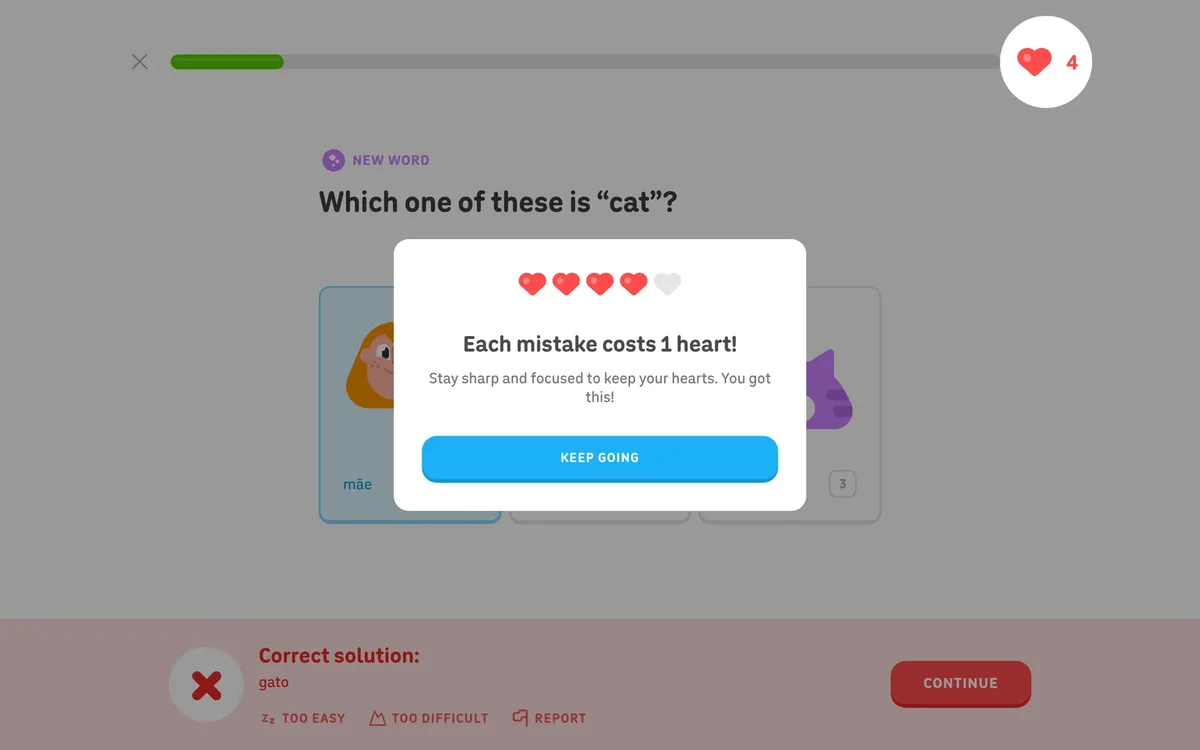
- Little explanation when you get it wrong: When we tapped mãe ("mom") for "cat", Duolingo showed "Correct solution: gato" and took a heart, with nothing about the mistake. The item came back at the end of the lesson. When we retook the lesson and paired "dog" with gato in a matching exercise, the cards flashed red and cost a heart, with no correction at all.
- Single words first: the first lesson was six nouns (gato, cachorro, água, carro, mãe, pai) rather than a line you could say to someone.
How much does Duolingo cost?
The Portuguese course is free, with ads and a Hearts or Energy system that limits how much you practise at once. Super Duolingo removes ads and adds unlimited practice; the US App Store listing shows Super purchases from $9.99 to $119.99 without naming their billing periods, so check the total in your account. See our guide to what Super costs now.
Babbel
Portuguese variant: Brazilian, with speakers from across Brazil. Babbel has no European Portuguese course.
Babbel explains the grammar as you go, in 10–15 minute lessons built around everyday situations, and it's our pick for grammar and short lessons. Its help center says the Portuguese (Brazil) courses go up to B1, with extra topics up to B2.
What's good about Babbel
- Short English grammar tips explain why a Portuguese sentence is built the way it is, which helps with things like ser and estar.
- Lessons mix listening, reading, writing and speaking, and a review tool brings words back.
- Every plan on Babbel's website includes all 14 of its languages; app-store plans can cover a single language.
What's not good about Babbel
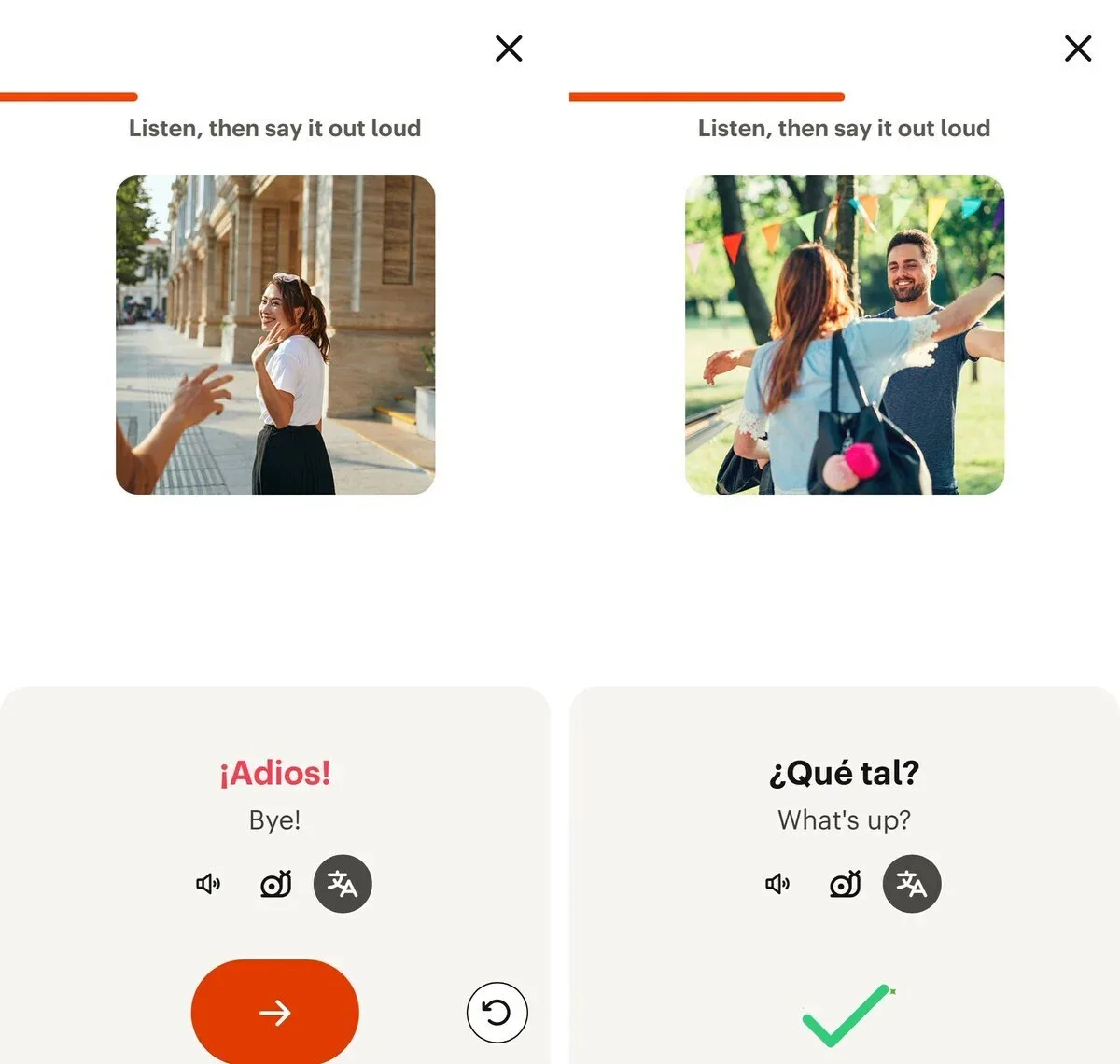
- A loose speaking check: When Benjamin used Babbel's Latin American Spanish course, its speaking review passed a phrase he mispronounced on purpose, with no score.
- Intermediate learners run out of structured material sooner than in the bigger courses.
How much does Babbel cost?
On Babbel's US site, the 12-month plan costs $107.40 a year ($8.95 a month), and the first lesson of every course is free. Prices vary by country and purchase channel, so check your offer at checkout. Waiting for a sale? See our Babbel Black Friday guide.
Official sources: Portuguese course and levels; US prices; our Babbel speaking test (Spanish course).
Copycat Cafe
Portuguese variant: Brazilian, with 200 structured lessons from A1 to B2.
Copycat Cafe takes you from hearing an everyday Brazilian conversation to saying it yourself and using it in a chat, and it's our pick for learning to speak. Where Duolingo's first lesson had us tapping single words, one of our first Brazilian Portuguese lessons, "First Coffee Before Work", starts with a whole line you can use the next morning: Bom dia! Eu queria um café pequeno. ("Good morning! I'd like a small coffee.")
Each lesson has three steps: Watch, Copy and Chat. In Watch, you hear the conversation at normal or slow speed and rebuild its lines by ear. In Copy, you say each line aloud and get a 0–100 pronunciation score on every word, with a tip for your next attempt, so you find out whether your dia sounds Brazilian before anyone in Brazil hears it. In Chat, you use the same Portuguese with Copy, your AI conversation partner.
The dialogues are set in Brazilian life: sizing up a new designer at work with E aí? Você é o designer novo?, waiting forty minutes for a pastel, being asked CPF na nota? at the checkout, or getting a signature notarized (reconhecer firma). One subscription includes all eight courses: French, two Spanish courses, Italian, German, Brazilian Portuguese, Turkish and Finnish.
What's good about Copycat Cafe
- Each pronunciation score comes with focused feedback, and you can see what the app heard you say.
- Every dialogue has normal-speed and slowed-down audio, with the written lines available.
- Notes on every lesson explain the grammar you just copied and the Brazil behind the scene, such as why Eu queria is the soft way to order, or why market vendors call you freguesa.
- You can text or voice-call Copy every day, and spaced-repetition review keeps phrases fresh.
What's not good about Copycat Cafe
- No App Store or Google Play app yet: Copycat Cafe runs in your web browser on a computer or phone, so there is nothing to install.
- Eight courses: far fewer languages than Duolingo or Pimsleur.
- Little reading or writing practice: grammar comes through the dialogues rather than explanations, and most of your time goes into listening and speaking. For a grammar-first course with writing, choose Babbel or Rocket Portuguese.
- Generated voices: the lesson audio uses natural-sounding generated voices rather than recordings of individual speakers.
How much does Copycat Cafe cost?
Copycat Cafe costs $104.40 a year ($8.70 a month) or $17.40 a month until December 1, 2026 (40% off for Black Friday), with a 7-day free trial and a 30-day money-back guarantee on your first payment. See the pricing page for prices in your currency.
Pimsleur
Portuguese variant: Brazilian, plus a separate European Portuguese course.
Pimsleur is our pick for an audio course: 30-minute lessons where a narrator prompts you and you answer out loud, which suits commutes and walks. Pimsleur's Brazilian Portuguese page lists five levels and 150 lessons, plus reading lessons, flashcards and a hands-free mode.
What's good about Pimsleur
- You speak from the first minute, and words come back at timed intervals.
- You can learn without looking at a screen.
What's not good about Pimsleur
- Short gaps to answer: When our team played Lesson 1 of Pimsleur's Latin American Spanish course, the pauses for our answers ran from about 2 to 3.6 seconds, so you press pause yourself when you need longer.
- Your ear is the judge in the audio lessons: they give you the right answer to compare with, not a score on how you said it. Pronunciation feedback sits in a separate Voice Coach. Read our Pimsleur review for the full picture.
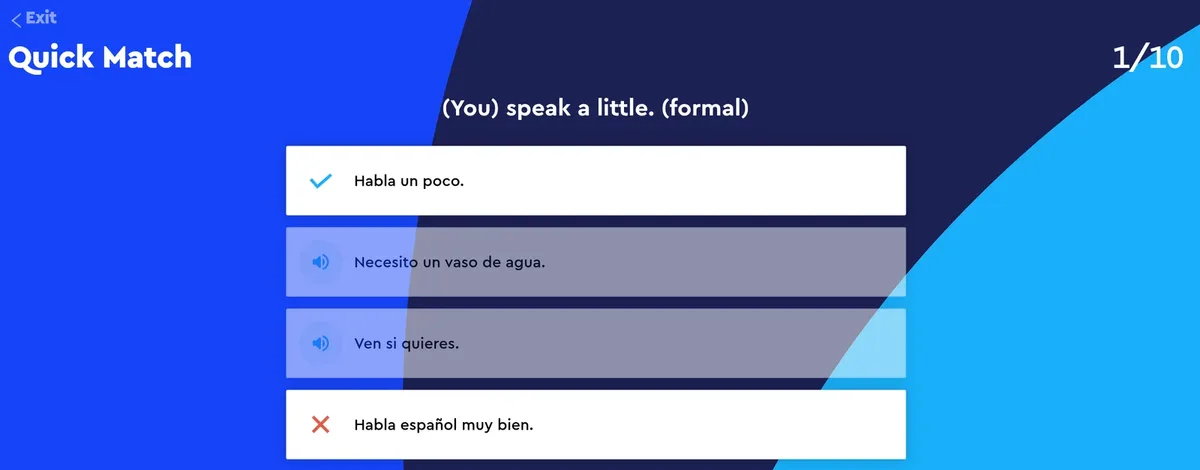
- No explanation for a wrong answer: in the same Spanish course's Quick Match quiz, our deliberate wrong pick got a red cross and the right answer a check mark, with nothing about why.
Pimsleur offers a 7-day free trial; check its site for current plan prices, and our Pimsleur Black Friday guide for the sale.
Official sources: Brazilian Portuguese course; our Pimsleur Spanish test.
Rocket Portuguese
Portuguese variant: Brazilian.
Rocket Portuguese is the most complete course here: audio lessons, separate language and culture lessons, speaking drills with voice recognition, and writing practice. Its pricing page lists 31 audio lessons, 33 language lessons and 33 culture lessons in its beginner-to-intermediate level, for $149.95 once, with lifetime access and a 60-day money-back guarantee.
What's good about Rocket Portuguese
- Thorough grammar and culture lessons, with recordings of real speakers.
- One payment, no subscription.
What's not good about Rocket Portuguese
- Long lessons, thin feedback: when our team took Lesson 1.1 of Rocket Spanish, it was a 26-minute podcast-style lesson with an English-speaking host, its quiz rejected correct answers, and its writing drill never explained our mistakes. See our Rocket Languages review.
Sales are common; see our Rocket Languages Black Friday guide.
Official sources: Rocket Portuguese pricing; our Rocket Spanish test.
Langua
Portuguese variant: Portuguese is one of Langua's 23 languages; choose your dialect in its settings.
Langua is our pick for an AI conversation partner once you have some Portuguese to work with. You chat by voice or text about anything, and it corrects you as you go. When Nerissa, on our team, used it in French, she had open conversations by voice and text, with written and spoken corrections, a feedback report after each chat and Call Mode. Read our Langua review.
What's not good about Langua
- Open conversation is hard for a complete beginner; it works best once you can already put a few sentences together.
Official sources: Langua's languages; our Langua review.
Preply
Portuguese variant: your choice. Filter Preply's Portuguese tutors by country to find one from Brazil.
Preply is our pick for live lessons with a human tutor. Tutors set their own prices, and a real person can tell you why a sentence sounds off and push you to keep talking. Nerissa, on our team, chose a Portuguese tutor on Preply before a trip to Portugal and took a few lessons on a subscription, which made it much easier for her to stay on track; the cost can feel high with top-tier tutors. Read our Preply review.
Busuu
Portuguese variant: Brazilian.
Busuu didn't win a category, but it's worth a look if you want a human to check your writing. Its Complete Portuguese course has more than 140 lessons from A1 to B2, and Portuguese speakers in its community correct your written and spoken exercises. When Alysa, on our team, used Busuu's French course, its own answer checking marked some correct alternatives wrong, such as weekend for week-end. Read our Busuu review.
Official sources: Busuu's Portuguese course.
Which app should you choose?
Start with what you want to do in Portuguese. If you want to try it without paying, open Duolingo. If you want rules explained, choose Babbel. If you want to sit down with your partner's family and actually join in, you need to practise saying whole lines aloud and hearing how they sound, and that's where Copycat Cafe fits.
Not sure how to fit an app into your week? Our guide to the best way to learn Brazilian Portuguese lays out a daily plan.
Whichever you pick, say something out loud today. Bom dia is a good first line.