

You're reading a French article or a Spanish short story, you hit a word you don't know, and you stop to paste it into a translator. Readlang is built to remove that step. You click any word in a text, its English translation appears right above it, and every word you click becomes a flashcard.
So the questions are whether those translations fit the sentence, how far the free plan goes before it asks you to pay, and whether Readlang Premium is worth $48 a year. To find out, we read French and Spanish texts in Readlang, clicked 39 words and phrases, and got flashcards wrong on purpose.
How we tested Readlang
Our team used Readlang's web app on a free account on November 13, 2026, for about half an hour of reading and practice. In French and in Spanish, we read a beginner story from Readlang's community library and clicked words and phrases to see whether each translation fit the sentence. Those stories didn't contain the double-meaning words we wanted to try, so we also uploaded two short texts of our own, kept private, with words like avocat (lawyer or avocado) and tiempo (time or weather). Then we practised the flashcards Readlang made from our clicks, typing wrong words, a wrong word order, wrong genders, a wrong ending, typos and missing accents on purpose. We noted where the free plan stopped us, listened to Readlang's premium voice samples, and read the prices on its pricing and checkout pages.
How does Readlang work?
Readlang is a reading tool. You open a text from its library or upload your own, and you click words as you read. When we clicked a word, its English translation appeared above it in the text, and a panel on the right explained what the word means in that sentence. Dragging across several words translates the whole phrase. Readlang says its Web Reader extension brings its translations to other websites.
Everything you click is saved. While we read, Readlang told us: "We generated 14 flashcards for you while you were reading." Those cards come back in practice sessions, with the sentence you met them in, so the vocabulary you review is the vocabulary from your own reading.
Getting started took us about two minutes: pick a language, enter a name, an email and a password, and you land on your dashboard. The beginner stories we read had been shared to the library by other Readlang users rather than written by Readlang, so think of the library as a shelf of texts to choose from.
How accurate are Readlang's translations?
Very accurate in our test. Of the 39 words and phrases we clicked, 36 got an English translation that fit the sentence: 16 of 18 in French and 20 of 21 in Spanish. The misses were single words whose meaning depends on the words around them.
French: 16 of 18 fit the sentence
Words with two meanings were Readlang's best moments. In our own text, avocat came out as "lawyer" in Mon frère est avocat à Lyon and as "avocado" in il mange un avocat. Louer was "rent" for an apartment and "praise" when the mayor praises the firefighters' courage. Personne n'est venu got "Nobody", while Une personne got "person". The explanation for the first avocat said exactly why: "“Avocat” can mean either “avocado” or “lawyer” in English. In this context, it means “lawyer”".
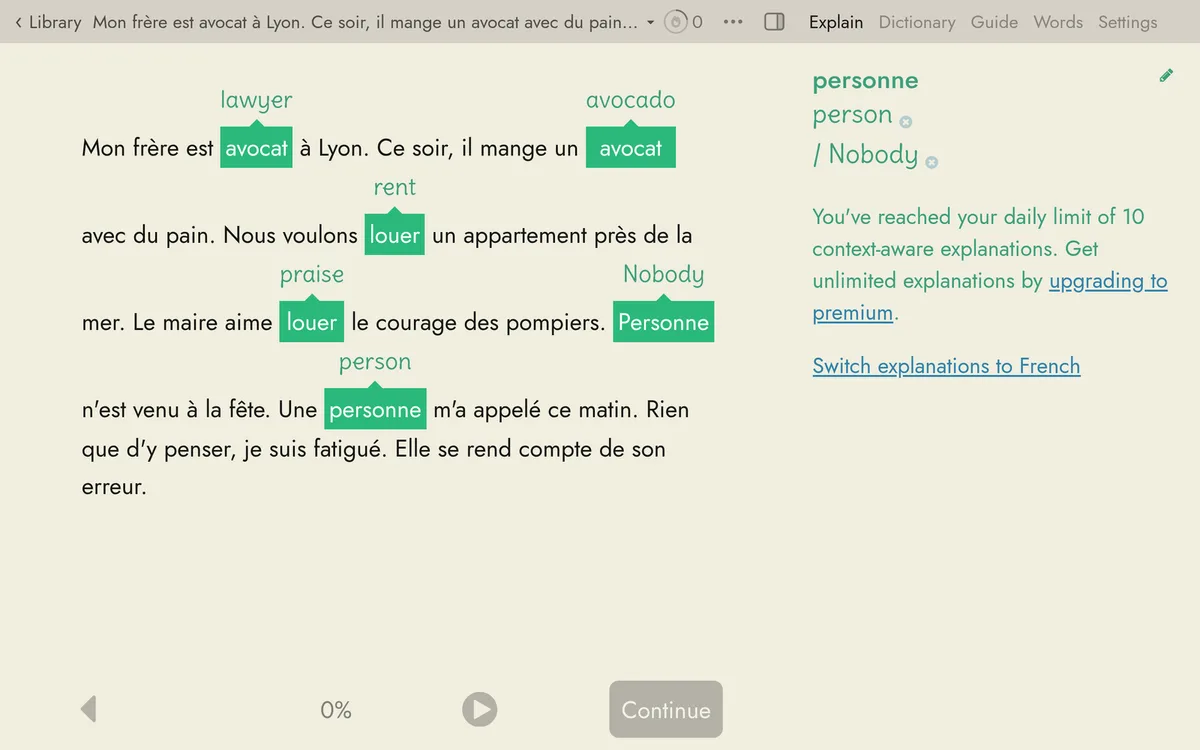
It also avoided a French false friend: in the library story, content became "happy" rather than the English "content". And court in Max court sur l'herbe was read as "runs" rather than "short", with a note that "“Court” usually means short as an adjective."
The two misses were reflexive verbs. Je m'arrête was glossed "stop myself" and je m'assois "sit myself", which isn't how English says it here. The explanations underneath gave the right meanings, "to stop" and "to sit down", so the panel caught what the one-word gloss missed.
Spanish: 20 of 21 fit the sentence
Spanish went just as well. Tiempo was "weather" in Hoy hace mal tiempo and "time" in por mucho tiempo. Queda in Esta camisa te queda muy bien was "fits", and coger el autobús got "take" with a useful warning: "In many Latin American countries, it can also be a vulgar term for having sex, so “tomar” is often preferred for taking a bus."
The miss was Ya in Ya voy, glossed "already". There it means "right now", and "already" was the same translation we had saved earlier for ya. When we selected the whole phrase Ya voy, Readlang gave "I'm coming", which is right. Two explanations in the library story also slipped: the story is about a man called Luis, but the explanations translated its sentences as "I had wanted…" and "I had already planned…".
The lesson from both languages: when a word looks like part of an expression, select the whole phrase. On the free plan, that's where the limits start.
What does Readlang's free plan limit?
The limit you'll feel first is the AI explanations. Readlang's pricing page lists 10 context explanations a day on the free plan, and in our test the panel explained every word we clicked without being asked. Our 11th French click, less than ten minutes after we started reading, brought up this message: "You've reached your daily limit of 10 context-aware explanations. Get unlimited explanations by upgrading to premium."
The good news is that single-word translations kept working after that, with no limit, and they stayed just as accurate: the second avocat, both meanings of louer and both meanings of personne were all glossed correctly after the explanations ran out.
Phrases are limited twice. A phrase can be at most 6 words on the free plan: when we dragged across 7 words, Readlang said "Limit of 6 words per phrase. 🚀 Increase to 12 words." And you get 10 phrase translations a day. Our 11th Spanish phrase opened the upgrade screen below, which also offered a one-time freebie of 10 more phrase translations. The same screen shows what the free plan leaves out: written conversation practice, audio upload and transcription, and the Story Bot that generates stories.
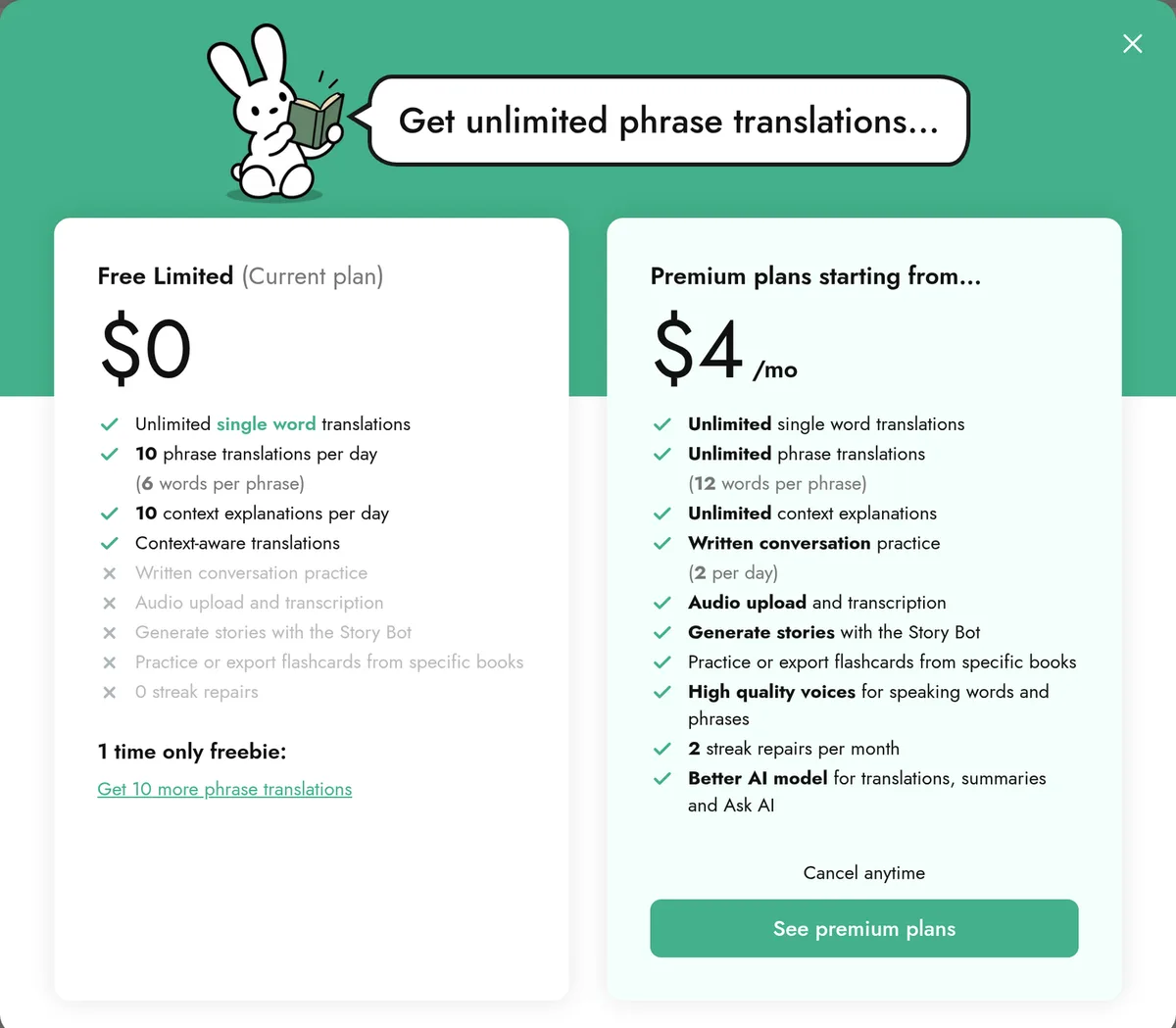
In our test, the daily limits seemed to count per language. After the French explanations ran out, Spanish ones still worked until our 11th Spanish click, and the Spanish phrase limit arrived on our 11th Spanish phrase even though we had already translated five French ones. That's what we saw; Readlang's pricing page just says 10 a day.
How do Readlang's flashcards correct mistakes?
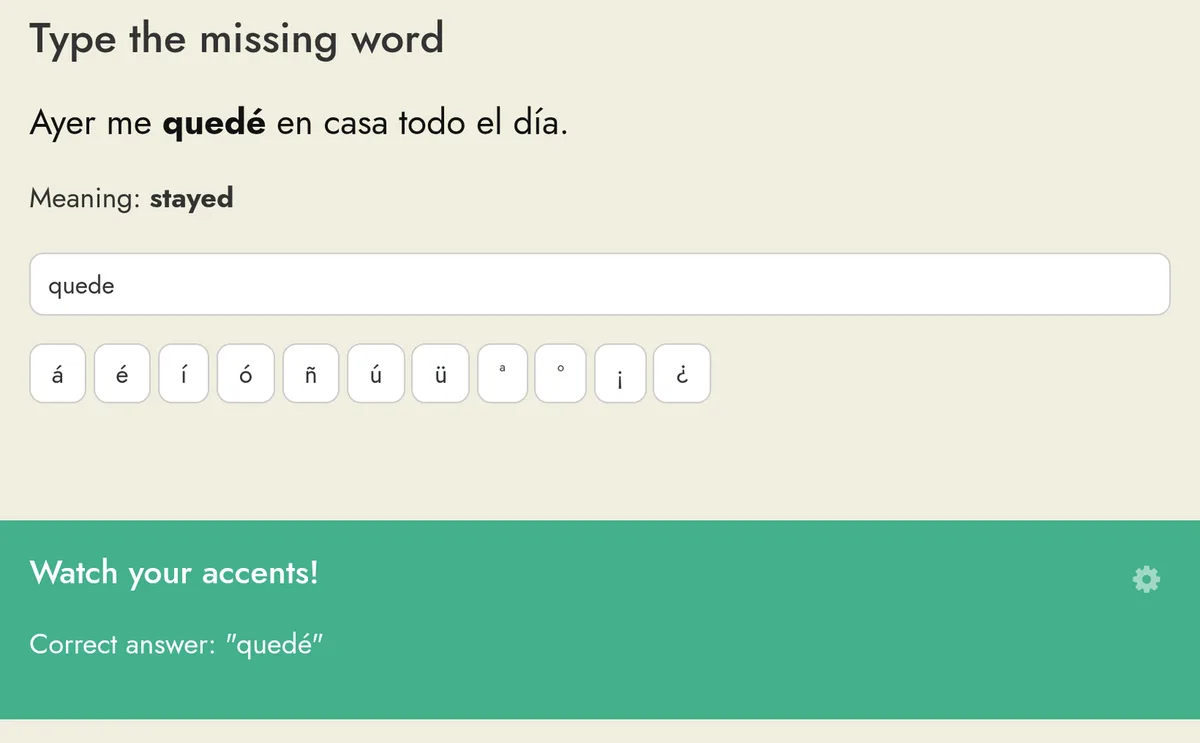
They tell you the right answer, and that's all. The default practice mode, Blitz, shows each new card with its meaning, then quizzes you with four options. We switched to Mastery, which adds typing: you see the sentence with a gap, the meaning, and an accent keypad, and you type the missing word or phrase. Here's what Readlang said to the mistakes we made on purpose:
| Mistake | What we typed | What Readlang said |
|---|---|---|
| Wrong word | acheter for louer; todavía for ya | "Incorrect" and the right answer |
| Wrong word order | rend se compte; No ya | "Incorrect" and the right answer |
| Wrong gender | un baguette fraîche; el plaza | "Watch the typo!" |
| Wrong verb ending | loue for louer | "Watch the typo!" |
| Typo | m'asois; tienpo | "Watch the typo!" |
| Missing accent | m'arrete; quede for quedé | Counted as correct, with "Watch your accents!" |
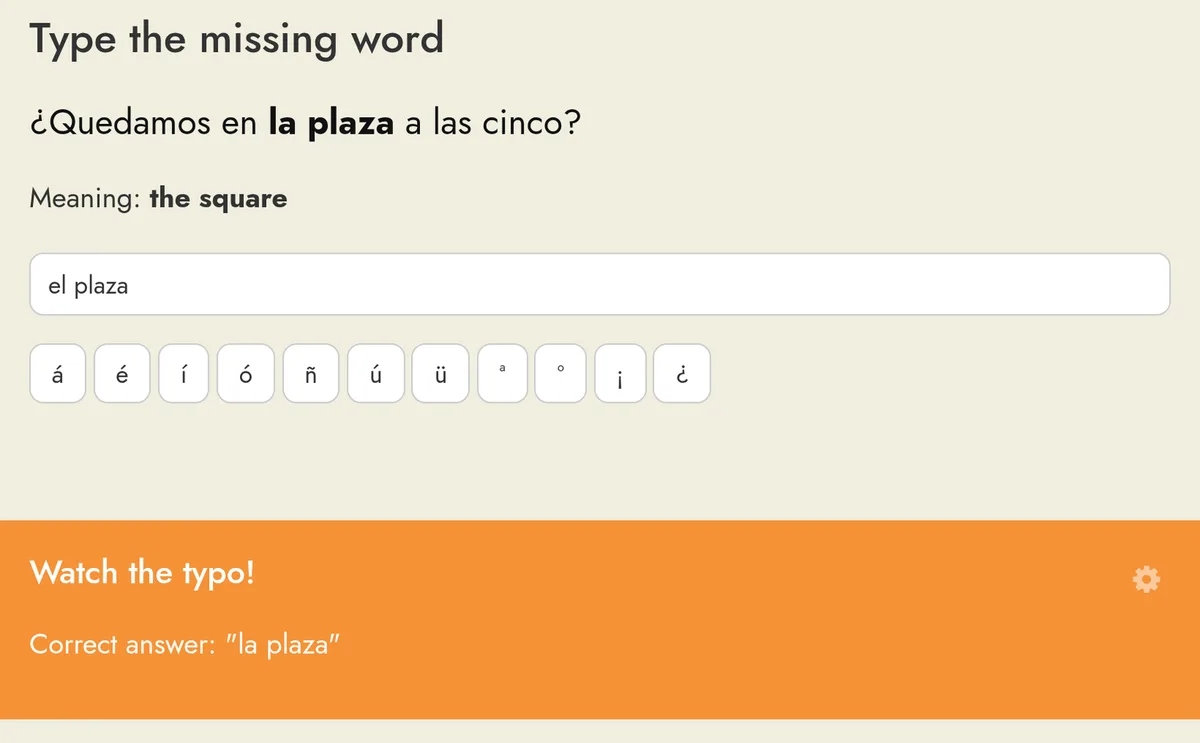
The trouble is the middle rows. A wrong gender is a grammar mistake, but Readlang filed un baguette and el plaza under typos, in the same orange as a slip of the finger, with no word about why plaza takes la.
Missing accents were marked correct, with a green "Watch your accents!". That's forgiving when you can't find the key, but in Spanish quede and quedé are different verb forms, and the card still counted our answer as right.
After a wrong answer, the "Explain or edit" option only let us add a synonym, a translation or a note, plus the context explanation, which our daily limit had already used up. So the flashcards are good for remembering words you met in your reading. For grammar, you'll want explanations from somewhere else.
Can Readlang read texts aloud?
Yes, but on the free plan it uses your device's own voices, so the sound depends on your phone or computer. Our test browser had none, and Readlang said so ("This device has no French voices.") and offered to "Upgrade for 21 high quality voices" (70 for Spanish). Readlang says Premium's voices read words and phrases, and Premium Plus reads whole texts.
The upgrade window lets you preview the paid voices, with French voices from France, Canada and Belgium, and Spanish voices from Spain, Mexico, other Latin American countries, the US and Equatorial Guinea. The four five-second samples we played, Brigitte and Henri in French and Abril and Dalia in Spanish, sounded to us like clear generated speech. Brigitte and Henri sounded to us like standard French from France, with Henri a little flat, and Dalia sounded Mexican to us.
Readlang reads to you, and in our test its reader had no speaking exercise, so it never heard us say anything. For speaking practice, Copycat Cafe does it better: you say each line of an everyday conversation aloud and get a 0–100 pronunciation score on every word, with a tip on what to change, then use the same language with Copy, your AI conversation partner.
How much does Readlang Premium cost?
Readlang Premium costs $6 a month or $48 a year, and Premium Plus costs $15 a month or $120 a year, on Readlang's pricing page. Prices checked November 13, 2026.
| Plan | Price | What it adds |
|---|---|---|
| Free | $0 | Unlimited single-word translations; 10 phrase translations and 10 context explanations a day; phrases up to 6 words |
| Premium | $6 a month or $48 a year | Unlimited phrases and explanations; phrases up to 12 words; high-quality voices for words and phrases; a better AI model |
| Premium Plus | $15 a month or $120 a year | Everything in Premium, plus high-quality voices for whole texts, the best AI model and more audio storage |
Paid yearly, Premium works out to $4 a month, the figure Readlang's upgrade screen advertises, and Premium Plus to $10 a month. Readlang says one Premium subscription works across all its languages, so French and Spanish together cost the same as one, and that you can cancel at any time.
Is Readlang Premium worth it?
For a regular reader, yes. Because every click uses an explanation, the free plan's 10 a day go within minutes, and $4 a month on the yearly plan removes that limit and the daily phrase limit. Here's how our test adds up:
Pros
- 36 of 39 click translations fit the sentence, double-meaning words included
- Unlimited single-word translations on the free plan
- Read anything: upload your own texts or pick from the library
- Flashcards built automatically from the words you clicked, with their sentences
- One low price for every language
Cons
- The free plan's 10 daily explanations are used by ordinary clicks
- Single words inside expressions can get a literal gloss
- Flashcards don't explain mistakes, and wrong genders count as typos
- Missing accents are marked correct
- Free read-aloud depends on your device's voices
Readlang suits you if you can already follow simple texts and want to read things you choose, such as articles, stories or your own material, while building vocabulary as you go. It's also a good deal if you read in more than one language.
Skip it if you want grammar explained when you get something wrong, or you want to practise speaking. Readlang is a reading tool, and it does that job well.
What are the best alternatives to Readlang?
The closest alternative is LingQ, which also turns texts into lessons where you tap unknown words, and adds short Mini Stories with audio for beginners. Our LingQ review covers what it costs and how good its word meanings are. If you're looking for things to read, our guide to the best resources to practise reading in French lists more tools and texts. For a full app to pair with Readlang, see our picks of the best apps to learn French and the best apps to learn Spanish.
If you want to speak the French or Spanish you're reading, Copycat Cafe is built for that: you hear an everyday conversation, say each line aloud with a 0–100 score on every word, then use it with Copy, your AI conversation partner. It costs $14.50 a month billed as $174 a year, or $29 a month, with a 7-day free trial and a 30-day money-back guarantee on your first payment.
Frequently asked questions
Is Readlang free?
Yes, with limits. The free plan gives unlimited single-word translations, 10 phrase translations a day (up to 6 words each) and 10 context explanations a day. In our test, the explanations ran out first, because Readlang explains every word you click.
How much does Readlang Premium cost?
Readlang Premium costs $6 a month or $48 a year, which is $4 a month paid yearly. Premium Plus costs $15 a month or $120 a year. Prices checked November 13, 2026.
How accurate are Readlang's translations?
Very accurate in our test: 36 of 39 French and Spanish words and phrases got a translation that fit the sentence, including words with two meanings like avocat and tiempo. The misses were single words inside expressions, such as reflexive verbs glossed "stop myself" and ya in "Ya voy" glossed "already".
Does Readlang read texts aloud?
Yes. On the free plan it uses your device's own voices. Premium adds high-quality generated voices for words and phrases, and Premium Plus uses them for whole texts.
Does one Readlang subscription cover French and Spanish?
Yes. Readlang says one Premium subscription works across all its supported languages.