

Disclosure: This post contains affiliate links. If you buy through them, we may earn a commission at no extra cost to you.
Lesson 1 of Pimsleur's Italian course opens with a short exchange: "Scusi. Lei capisce l'inglese?" "No, signora. Io non capisco l'inglese." Then an English narrator takes over, and 53 seconds in, he goes quiet and waits for you to say something in Italian.
That waiting is the method. We measured the whole lesson: of its 31 minutes and 52 seconds, about 18 are silent pauses, most of them left for your answers. The question is whether that is worth $19.95 a month, and what the course leaves out.
This review covers what a Pimsleur Italian lesson is like, what its practice activities check, what each plan costs, and who should pick something else.
Prices checked November 13, 2026.
How did we test Pimsleur Italian?
On November 13, 2026, our team took Lesson 1 of Pimsleur's Italian Level 1 course (2024 edition) on the web with a free account, in two sessions. We measured the whole lesson and listened closely to its start and end, answered wrong on purpose in Quick Match and Speed Round, went through Flash Cards, Speak Easy, Reading Lesson 1, the Skills lists and the Cultural Highlight, opened Voice Coach, tried to open Lesson 2 and read every Italian price. Our team also took Lesson 1 and its practice games in Pimsleur's French course (November 11 and 13) and Latin American Spanish course (November 13), and Alysa Salzberg, on our team, used the French course on computer and phone for our Pimsleur review, which covers the method in general. We judged the Italian course on what matters for speaking: how much you say, what gets checked, and what it costs.
What is a Pimsleur Italian lesson like?
Each lesson is about 30 minutes of audio. An English narrator teaches a short Italian conversation piece by piece, then keeps asking you to say things before you hear the answer. There is no screen work in the lesson itself, so you can do it on a walk or in the car.
Lesson 1 builds the opening exchange word by word, often from the end of the word. You hear "capisce" as "sce", "pisce", "ca", then "capisce", and "scusi" as "-si", "scu-", "scusi". That trick makes a long Italian word feel short. Then the prompts start: "Say, 'excuse me'", "What is the formal word meaning 'you'?" You answer in the pause, and a native speaker gives the right version. The Italian voices sounded like recorded native speakers to us, in standard Italian, with an American narrator in English.
Lesson 1 teaches about a dozen phrases (Voice Coach counts 12), such as "Io capisco un po' l'italiano" and "Lei è americana?". The "you" in these phrases is the formal "Lei": you learn to ask a stranger whether they understand English, not to chat with a friend. When Alysa used Pimsleur's French course, she also found that the phrases leaned formal.
Does the lesson get harder by the end?
A little. The answers and the pauses get longer, but English still introduces almost every Italian line. We counted 375 silent pauses of 1.5 seconds or more in Lesson 1, adding up to 18 minutes and 14 seconds, or 57% of the lesson. Most of that is your speaking time, and it grows as the lesson goes on:
| Part of the lesson | Share of time in pauses | Average pause | What you say (our listening check) |
|---|---|---|---|
| First 3 minutes | 35% | 2.45 seconds | Syllables and single words |
| Last 3 minutes | 47% | 3.14 seconds | Short sentences of 1 to 4 words |
Near the end, Lesson 1 turns into a guided role-play. A male Italian voice joins as the other speaker, the narrator tells you what to say ("Tell him that…", "Ask if he understands…"), and you answer with lines like "Io capisco un po'." In our listening check, about 55% of that last stretch was still English narration, and there was no stretch of Italian-only conversation. Thirty minutes gets you a dozen polite phrases, each said aloud many times, which is a solid start. But every exchange is set up for you in English.
For conversation practice, Copycat Cafe goes further. Each lesson ends with Chat: you use the Italian you just copied with Copy, your AI conversation partner, who replies to what you actually say instead of telling you your next line in English.
What do Pimsleur Italian's practice activities check?
Very little. Quick Match and Speed Round mark an answer right or wrong. In our tests, the practice games never explained a mistake. In Quick Match, we answered "Excuse me, ma'am." with "Ho venti euro." on purpose. Pimsleur put a red X on our pick and a blue check on "Scusi, signora.", with no text, then asked the same question again with the options reshuffled. The wrong options were sentences Lesson 1 doesn't teach, such as "Costa cinque euro?" and "Sono le nove in punto.", so a beginner can often find the right answer by elimination.
Speed Round is a timed game: English cues fall down the screen, and you tap the matching Italian tile. A wrong tap turns the tile red and costs 200 points (the score never drops below zero), and the game never highlights the right tile. Tapping the right answer too early counts as wrong too: "Scusi." lost 200 points because the cue "Excuse me. (formal)" was still entering at the top. Many tiles, such as "chilometri", "portare" and "assolutamente", are words Lesson 1 doesn't teach.
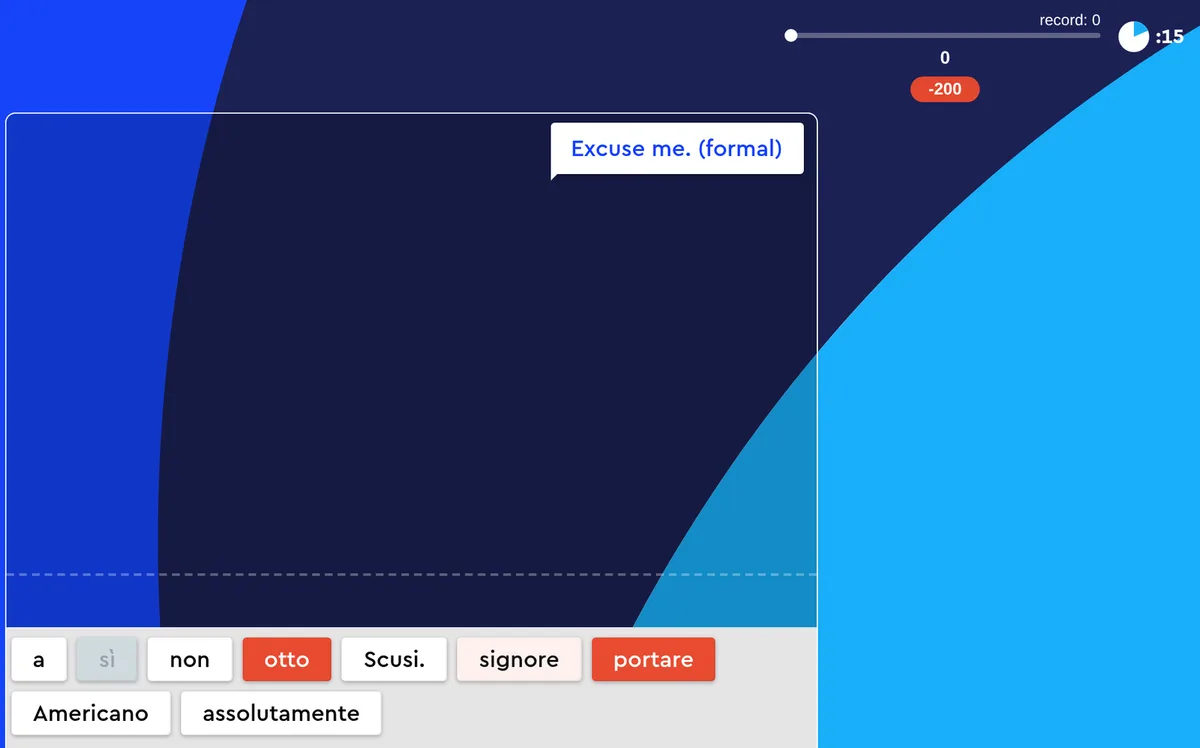
The rest of the practice area is lighter still. Flash Cards (14 for Lesson 1) leave the grading to you: you tap "Got it" or "Skip". The Skills lists showed every phrase as learned ("9 Items Learned / 9 Items In total") while the course page said we had completed 0 of 30 lessons, so they don't tell you what you actually know. The Cultural Highlight for Lesson 1 is a single text card about Italy becoming a republic by referendum on June 2, 1946, which has nothing to do with the lesson. We saw the same unexplained red marks in the French and Latin American Spanish courses; our Pimsleur Spanish review shows the Spanish version.
Does Pimsleur Italian teach reading?
A little, in separate reading lessons that don't follow the audio lessons. Reading Lesson 1 is five words with play buttons: "io", "mi", "mio", "tipo" and "presto". A display switch adds English glosses (I, me, mine, type, soon). Its 87-second audio was about 80% English in our listening check. The narrator explains the sounds, a native Italian voice says each word, and you repeat it aloud. Nothing checks you, and there is nothing to type.
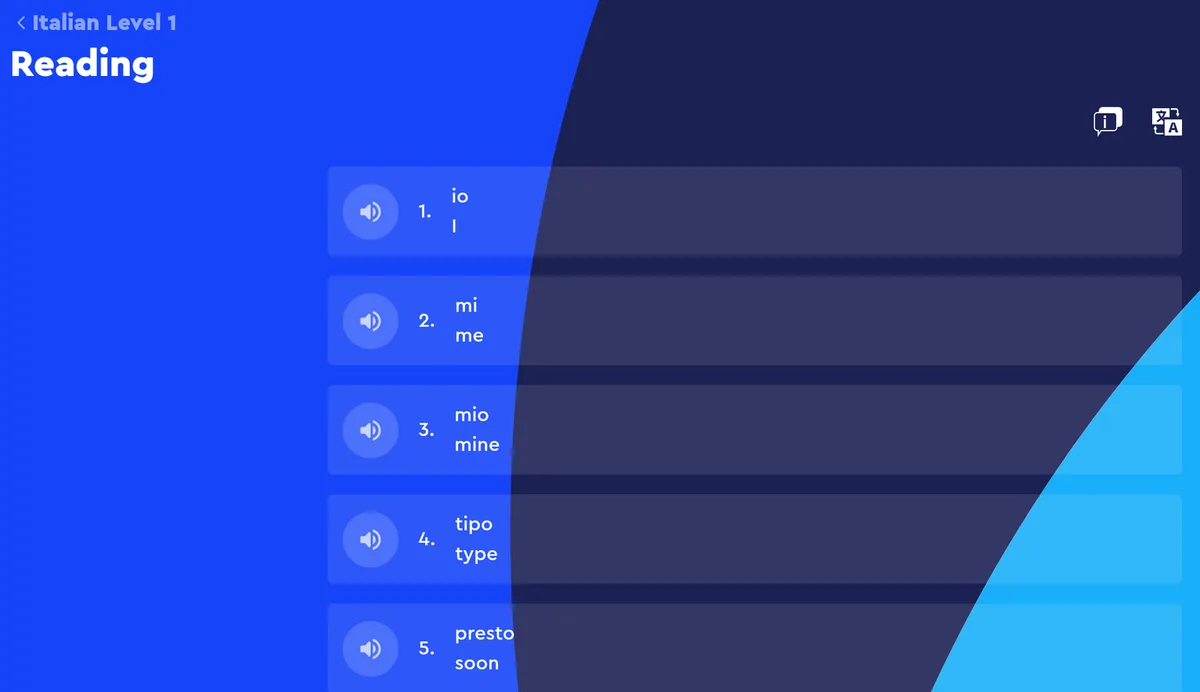
Pimsleur's Level 1 booklet says so directly: "the words taught in the Reading Lessons don't match up with the vocabulary in the corresponding audio lesson." So the written form of what you say in the audio lessons appears only in the practice activities, such as Speak Easy and the Skills lists. Alysa found the same gap in French: the Audio-Only plan gave her no written French at all, and the Premium review exercises felt harder than they needed to be because she had only heard the words.
Does Pimsleur Italian check your pronunciation?
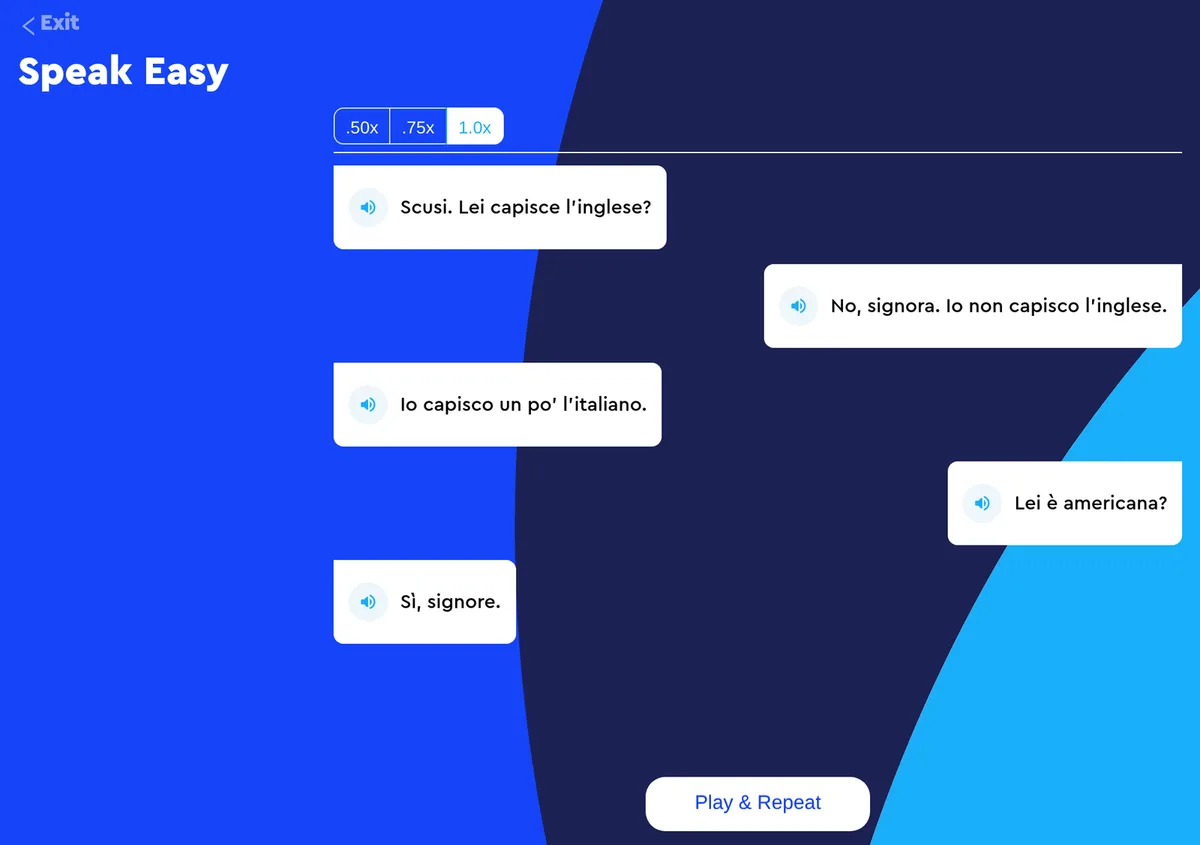
Not in the lesson. The audio plays the right answer after each pause, and you compare yourself by ear. Speak Easy shows the Lesson 1 conversation in Italian at three speeds (.50x, .75x and 1.0x) with a Play & Repeat button, but it has no microphone and no score.
Pronunciation feedback lives in Voice Coach, a separate tool. When we opened it in the Italian course, it first asked for "Consent to Use Speech Data with AI", saying our "speech data may be securely sent to Pimsleur trusted partners for AI processing and analysis." Pimsleur's Voice Coach FAQ says to use it after the daily audio lesson. According to the FAQ, its Challenge mode shows you a phrase in English, you say it in the new language, and you get a 1 to 100 score for the phrase that combines whether you remembered it with how you said it, plus words colored white, grey or red. Alysa had a different problem in French: neither the web app nor the mobile app could access her microphone.
For pronunciation, Copycat Cafe does it better. In every lesson, you play the conversation at normal or slow speed with the written lines, say each line aloud, and get a 0–100 score on every word, with a tip on what to change. You get that feedback inside the lesson, on the line you just said.
How much does Pimsleur Italian cost in 2026?
From $14.95 a month for audio only to $478.80 for lifetime access to every language. Pimsleur sells Italian three ways: a monthly plan for Italian alone, All Access to every language, or a one-time lifetime purchase. These are the US prices on Pimsleur's Italian page, Audio-Only page and lifetime page on November 13, 2026:
| Plan | Price | What you get |
|---|---|---|
| Audio Monthly | $14.95 a month | Italian audio lessons only |
| Premium Monthly | $19.95 a month | Italian, with the practice activities |
| All Access Monthly | $20.95 a month | 50+ languages, with the practice activities |
| All Access Annual | $164.95 a year | Same as All Access Monthly, billed yearly |
| Italian Level 1, lifetime | $112.50 (listed at $150) | Level 1 for good, one payment |
| Italian Levels 1–5, lifetime | $431.25 (listed at $575) | The whole Italian course for good |
| All Access Lifetime | $478.80 (listed at $798) | All levels of 50+ languages for good |
For most learners, All Access Annual is the plan to look at: $164.95 works out to about $13.75 a month, less than Italian alone at $19.95, and you get every language. Each subscription starts with a 7-day free trial, and each lifetime purchase comes with a 30-day money-back guarantee. If you only want Level 1, its $112.50 lifetime price costs less than six months of Premium.
The lifetime page showed the list prices crossed out, with no reason for the discount, and we found no Black Friday banner on November 13. Our Pimsleur Black Friday guide tracks whether lifetime drops further, and our Pimsleur cost guide explains every plan and discount.
With a free account, you get Lesson 1 and its practice activities, and Lessons 2 to 30 show a padlock. Opening Lesson 2 shows "Continue Your Learning", which promises "Subscribe monthly to 51 languages or purchase Level 1 lifetime access for one language." Its three offers are all All Access, though: monthly and annual plans with a 7-day free trial, and lifetime at "$478.8". The Italian-only lifetime course appeared only on the website's lifetime page. The monthly offer's small print reads: "If you do not cancel within the free trial, you will be billed $20.95 (plus applicable taxes if any) per month until you cancel." Note the date when you start a trial.
Pimsleur Italian pros and cons
Here is what stood out in our test, good and bad:
Pros
- 57% of Lesson 1 is silent pauses, most of them left for your answers
- Italian voices that sounded like recorded native speakers to us
- Long words are built up syllable by syllable, from the end
- Works hands-free, on a walk or in the car
- Five levels, with a lifetime option for Italian alone
Cons
- In our tests, the practice games never explained a mistake
- English sets up almost every Italian line, even at the end of Lesson 1
- Pronunciation feedback only in Voice Coach, behind an AI speech-data consent
- Reading lessons don't match the audio lessons
- The "you" in Lesson 1's phrases is the formal "Lei"
The pros are about the core audio, and the cons are mostly about everything around it.
Who should use Pimsleur Italian, and who should skip it?
Pimsleur Italian suits you if you learn well by ear, have 30 minutes a day away from a screen, and want to get used to answering in Italian without freezing. Start with the free Lesson 1: if the pauses feel useful rather than tedious, the course will suit you.
Look elsewhere if you want your mistakes explained, a free course or shorter lessons. For grammar explained in short lessons, Babbel is the usual pick, and our Pimsleur vs Babbel comparison sets the two side by side. For a free start, Duolingo is the obvious choice; see Pimsleur vs Duolingo and our Duolingo review, which covers its French course in depth. For every option side by side, see the best apps to learn Italian, and if you want a teacher or a set syllabus, our guide to online Italian courses.
What's the best alternative for speaking Italian?
If your goal is to speak Italian and you want to know how you sound, Copycat Cafe is built for that: you hear an everyday conversation, say each line aloud with a 0–100 score on every word, then use it with Copy, your AI conversation partner. It costs $14.50 a month billed as $174 a year, or $29 a month, with a 7-day free trial and a 30-day money-back guarantee on your first payment.
Frequently asked questions
Is Pimsleur good for learning Italian?
Yes, if you learn well by ear and want to say Italian out loud from the first lesson. Each lesson is about 30 minutes of audio, and 57% of Lesson 1 is silent pauses, most of them left for your answers. It is weaker on reading, on explaining mistakes and on pronunciation feedback, which sits in a separate Voice Coach tool.
How much does Pimsleur Italian cost?
US web prices checked November 13, 2026: Premium for Italian alone costs $19.95 a month and Audio Monthly $14.95. All Access, with 50+ languages, costs $20.95 a month or $164.95 a year. Lifetime Italian Level 1 costs $112.50 (listed at $150), Levels 1–5 cost $431.25 (listed at $575), and All Access Lifetime costs $478.80 (listed at $798). Subscriptions start with a 7-day free trial.
Is Pimsleur Italian free?
Only Lesson 1. With a free Pimsleur account, you get Italian Level 1 Lesson 1 and its practice activities; Lessons 2 to 30 are locked. Subscriptions start with a 7-day free trial, and Pimsleur's small print says you will be billed when the trial ends unless you cancel.
How long is the Pimsleur Italian course?
Pimsleur Italian has five levels. Level 1 has 30 audio lessons of about 30 minutes each; Lesson 1 runs 31 minutes 52 seconds. Pimsleur also lists 100 reading lessons across the course, and the Level 1 booklet says there is one reading lesson for each audio lesson.
Does Pimsleur Italian correct your pronunciation?
Not inside the audio lessons, which only play the right answer after your pause. Pronunciation feedback comes from Voice Coach, a separate tool that asks for consent to process your speech with AI. Pimsleur's FAQ says its Challenge mode gives each phrase a 1 to 100 score that combines recall and pronunciation.