

Disclosure: This article contains affiliate links. If you sign up through them, we may earn a commission at no extra cost to you. This doesn't influence our review.
Pricing note: Prices below are U.S. prices observed in July 2026. App prices, promotions, trials, and feature availability can vary by platform, course, account, and region, so check the final offer shown at checkout.
How we reviewed this comparison
Our earlier Pimsleur review documents several days of hands-on use of Pimsleur French Audio-Only and Premium, and our Duolingo review documents several days of Duolingo French lessons across different levels. For this July 2026 update, we did not retest every feature. We checked current official product pages, help documents, app-store listings, and feature announcements, then qualified anything that varies by course, platform, or account.
Pimsleur is our pick if you want a structured, audio-led course that repeatedly prompts you to answer aloud. Duolingo is our pick if you want free, short, varied lessons with strong habit-building features. Pimsleur Premium now includes written, visual, grammar, culture, game, and pronunciation tools, while Duolingo now includes more speaking practice than its tap-and-match reputation suggests.
Neither product is simply “audio versus vocabulary” anymore. Pimsleur has Voice Coach and a limited AI Conversation Coach beta, while Duolingo Max offers AI Roleplay and Video Calls. The better choice depends on whether you value a speaking-led audio sequence, a free and varied daily routine, or sustained conversation practice.
The short version
- Pimsleur: 30-minute core audio lessons, repeated spoken responses, and optional Premium tools. All Access covers 51 languages and costs $20.95/month or $164.95/year on the current U.S. site.
- Duolingo: Free, bite-sized lessons across 40+ languages, with speaking, listening, reading, writing, grammar support, and extensive game mechanics. Paid prices and trials vary by platform and account.
- Copycat Cafe: The Copycat Method™ — Watch. Copy. Chat. — with 0–100% pronunciation feedback, slow and normal audio, structured conversation lessons, and Chat with Copy. It costs $174/year or $29/month for French, Latin American Spanish, Castilian Spanish, Italian, and German.
If your priority is sustained conversation, you may still want a tutor, a language partner, or a conversation-focused product alongside either app. Read on for the detailed tradeoffs.
Is Pimsleur better than Duolingo?
Pimsleur is better suited to learners who want an audio-led sequence and frequent spoken responses; Duolingo is better suited to learners who want free, short, varied practice. That is a difference in emphasis, not proof that one app is universally better.
Dr. Paul Pimsleur recorded the first Pimsleur course in 1963, and the courses were first marketed directly to consumers in 1980. The company later moved through tapes, CDs, downloads, and apps. According to Pimsleur’s history, its method grew from research into memory and self-instruction. Today, the core lessons use listening, anticipation, spoken responses, and Graduated Interval Recall. Core conversational lessons are about 30 minutes.
Pimsleur’s current plans matter. Audio-Only includes the core lessons for one language but omits the interactive visual practice tools. Premium adds reading, written review, Speak Easy conversation transcripts, Quick Match, Speed Round, grammar and culture Minis, and Voice Coach. All Access provides those Premium features across all 51 languages where the features are supported.
Duolingo launched in 2012 with a different model: short, visual lessons supported by XP, streaks, leaderboards, achievements, and recurring characters. Many exercises involve translation, matching, listening, writing, or selecting an answer, but the current product also includes speaking exercises from the first lesson and free speaking-only practice on mobile. Lily is still the sarcastic teenager; she is now also one of Duolingo Max’s AI conversation partners.
Both products work on mobile and the web, although individual features can differ by platform. Pimsleur’s core method is still audio-led. Duolingo’s standard course is still more visual and varied.
Where do Pimsleur and Duolingo fall short?
Both products now include more speaking support than older comparisons suggest, but neither offers the same experience in every course or plan.
Pimsleur’s standard speaking practice is structured. Core lessons prompt you to recall and produce specific phrases, which gives you substantial imitation and retrieval practice. Voice Coach can add a 1–100 score in Challenge mode for supported languages. Open-ended AI conversation is much narrower: Pimsleur’s current AI Conversation Coach beta is for All Access Latin American Spanish learners. It was not available for French when we checked.
In our earlier French test, some of Pimsleur’s vocabulary and phrasing felt more formal than everyday conversation. Audio-Only also omits written practice. We did not retest the July 2026 core lesson player’s speed controls, so we are not claiming that the core player universally has only one speed. Pimsleur does document .75x and .5x playback inside Speak Easy.
Duolingo’s standard lessons include genuine speaking practice, but most speaking turns are short. Duolingo says speaking exercises appear from the first lesson, and its Practice tab now offers free speaking-only sessions on iOS and Android. What standard exercises do not show is a detailed 1–100 diagnostic comparable with Pimsleur Voice Coach or Copycat Cafe’s word-level scoring.
Duolingo Max goes further with Roleplay and free-flowing Video Calls. That means “Duolingo has no conversation practice” is no longer accurate. Availability still varies by course, platform, and account, and the free standard course does not center sustained open-ended AI conversation.
The practical gaps to consider
- Pimsleur’s open-ended AI coach is currently limited to one Spanish beta rather than all 51 languages.
- Duolingo’s most sustained AI conversation features require Max and are not available in every course or on every surface.
- Standard Duolingo speaking exercises do not expose the same detailed numeric pronunciation breakdown as Voice Coach or Copycat Cafe.
- Neither product replaces real interaction, extensive native input, writing practice, or a complete grammar and culture curriculum for every learner.
If sustained conversation is your main goal, supplementing either app with a tutor, language partner, or conversation-focused product can make sense. That is a narrower and more accurate conclusion than saying either app “barely makes you speak.”
Pimsleur vs Duolingo: detailed comparison
Here is how the two apps compare on the criteria that matter most for an adult choosing a language-learning routine.
How does each app teach you?
Pimsleur’s core method is an audio sequence built around anticipation, spoken responses, and Graduated Interval Recall. A narrator introduces a dialogue, breaks it into phrases, asks you to respond, and brings earlier material back at expanding intervals. Premium keeps that audio core and adds written, visual, game, grammar, culture, and pronunciation tools.
Duolingo uses varied, bite-sized exercises: translation, matching, listening, writing, selection, short dialogues, and speaking. Grammar appears implicitly in every lesson and explicitly through Guidebooks, focused Grammar Lessons in larger courses, and Explain My Answer in supported courses. XP, streaks, leagues, and achievements support the routine.
Bottom line: Pimsleur is more consistently audio-led; Duolingo offers more exercise variety.
What does each app cover?
Pimsleur French has five levels with 30 core lessons each, for 150 half-hour lessons. Premium adds reading lessons, digital flashcards, Quick Match, Speed Round, Speak Easy transcripts, Voice Coach, and grammar and culture Minis. Pimsleur does not publish an official CEFR mapping for the French course, so we are not assigning it an A2 or B1 outcome.
Duolingo covers listening, speaking, reading, writing, vocabulary, and grammar across 40+ languages. In April 2026, Duolingo said course content for nine popular languages, including French, had expanded through B2-aligned material. That describes curriculum coverage; it does not guarantee that completing a course makes every learner B2.
Duolingo Max adds AI Roleplay and Video Calls in supported courses. Current availability changes quickly, so check the course and device you plan to use.
Bottom line: Duolingo covers a broader mix of skills and Pimsleur keeps the core sequence more focused on listening and spoken recall.
How many languages does each app offer?
Pimsleur All Access currently includes 51 languages, from Spanish, French, German, Japanese, and Mandarin to Dari and Ojibwe.
Duolingo advertises 40+ languages and more than 100 courses, including Scottish Gaelic, Hawaiian, and Navajo. Every language course and lesson remains available in the free product, although course depth varies.
Bottom line: Both offer broad coverage. Pimsleur has the higher language count in its paid All Access plan; Duolingo keeps every course free.
How long are lessons?
Pimsleur core lessons run about 30 minutes. Optional Premium review can extend a session, but 45–60 minutes is not a required daily commitment.
Duolingo lessons usually take a few minutes; Duolingo describes the average lesson as about five minutes. You can set a daily goal and do several lessons if you want a longer session.
Bottom line: Pimsleur suits a focused half-hour block. Duolingo is easier to fit into short gaps.
Which has better pronunciation feedback?
Pimsleur’s core lessons repeatedly model phrases and prompt you to imitate them. In supported languages, Voice Coach adds AI feedback. Pimsleur’s Voice Coach guide says Practice mode uses Fair, Good, or Excellent ratings, while Challenge mode assigns a 1–100 score and records phrase, lesson, and level results.
Duolingo’s standard speaking exercises use speech recognition and provide immediate acceptance or correction, but they do not expose the same detailed numeric diagnostic. Duolingo Max Video Calls can provide feedback after calls, with availability varying by course and platform.
Bottom line: Pimsleur offers the clearer built-in numeric pronunciation metric. Duolingo offers more speaking than before, but its standard feedback remains less granular.
Which has more authentic audio?
Pimsleur’s course audio uses native-speaker models. In our earlier French testing, the speech sounded clear and deliberate—closer to careful instructional speech than a fast chat between friends—and some phrasing felt formal.
Duolingo uses custom character voices with distinct personalities. We liked the variety, although some voices sounded more synthetic in our earlier test. Duolingo also now offers Stories, DuoRadio, and Video Calls in supported courses, so the audio experience is broader than isolated sentence drills.
Bottom line: Pimsleur offers a consistent audio-led course; Duolingo offers greater voice and activity variety. For speed controls, Pimsleur Speak Easy offers .75x and .5x, while Duolingo offers slow replay on some listening exercises.
How does each app teach grammar?
Pimsleur teaches grammar mainly through examples and repetition in the core lessons. Premium also includes bite-sized grammar and culture Minis, so “Pimsleur teaches no grammar” is inaccurate. It is still not organized like a conventional grammar textbook.
Duolingo combines implicit exposure with explicit support. According to Duolingo’s grammar overview, every lesson presents grammar in context, while Guidebooks and focused Grammar Lessons explain patterns more directly. Explain My Answer has also been free for most learners in seven major courses since January 2026.
Bottom line: Both teach grammar, but neither is a conventional grammar-first curriculum.
Which is more motivating?
Pimsleur is less game-heavy than Duolingo, but it is not free of gamification. Premium includes Daily Challenges and streaks, Speed Round games, Voice Coach scores, badges, and certificates. The core 30-minute audio sequence still feels more like a course than a mobile game.
Duolingo makes game mechanics central: XP, streaks, leagues, achievements, characters, and frequent rewards are woven through the product.
Bottom line: Choose Duolingo if game mechanics help you return daily. Choose Pimsleur if you prefer a more course-like routine with lighter progress mechanics.
Which has better cultural content?
Pimsleur Premium includes culture and grammar Minis, Light Bulb moments, travel photos, and contextual situations such as dining, introductions, and travel. Culture supports the course rather than replacing the speaking-led core.
Duolingo also includes cultural material. Its culture overview points to formal and informal address, politeness patterns, conversation lessons, and curriculum examples; Stories and DuoRadio add more contextual material in supported courses. Depth still varies considerably by language.
Bottom line: Neither product has “virtually no culture.” Both include it unevenly, and learners who care deeply about customs and social nuance should still add native media and real interaction.
How much does Pimsleur cost vs Duolingo?
Duolingo has the cheapest entry point because every course is free. Pimsleur publishes clearer standard U.S. subscription prices, while Duolingo’s paid prices and trials can vary by platform, account, and offer.
Pimsleur pricing
On the current U.S. Pimsleur French page:
- All Access Monthly: $20.95/month for all 51 languages
- All Access Annual: $164.95/year for all 51 languages
- Premium Monthly: $19.95/month for one language
- Premium Annual: $149.95/year where that annual offer is available
- Free trial: 7 days for eligible new customers
Lifetime purchases are also available, but course depth and pricing vary by language. French has five levels; not every Pimsleur language does. Subscriptions can be shared with up to three additional household members.
Pimsleur’s 30-day guarantee has important limits: it applies to qualifying initial purchases made directly from Pimsleur without a free trial of seven days or longer. Apple and Google purchases, renewals, and trial offers are not covered by that guarantee.
Duolingo pricing
Duolingo’s language courses remain free with ads and free-tier limits. Super removes ads and paid-plan limits and adds more personalized practice. Max adds AI features such as Roleplay and Video Calls in supported courses.
Energy has not universally replaced Hearts. Duolingo’s official Energy announcement says the system is currently available to a small number of users. Current official surfaces are inconsistent: the U.S. App Store advertises Unlimited Energy, while Duolingo’s current learner guides still refer to Hearts and unlimited Hearts. The limit you see therefore depends on your account and platform.
For U.S. pricing, the current App Store listing shows multiple Super Duolingo in-app purchases, including $12.99 and $95.99 options, but the public list does not label every billing period and plan. The live Duolingo web page currently advertises a one-week Super trial, while the U.S. App Store description advertises 14 days. Use the exact price and trial shown to your account at checkout.
Family plans can include up to six accounts. Max pricing and feature availability also vary, so we are not presenting one checkout price as universal.
Copycat Cafe pricing
Copycat Cafe costs $29/month or $174/year ($14.50/month when billed annually). It includes French, Latin American Spanish, Castilian Spanish, Italian, and German. Paid plans start with a 7-day trial. and carry a 30-day money-back guarantee on the first payment.
Bottom line: Choose Duolingo if free access matters most. Choose Pimsleur if its audio-led course is worth the subscription to you. Compare paid Duolingo plans using the exact offer shown on your device rather than relying on a universal price.
→ Read our complete Pimsleur review
→ Read our complete Duolingo review
Quick comparison
On smaller screens, each product appears as its own card so the details stay easy to scan.
Pimsleur
U.S. price checked
All Access: $20.95/month or $164.95/year
Languages
51 with All Access
Pronunciation feedback
Voice Coach: Fair/Good/Excellent in Practice; 1–100 in Challenge
Learning method
Audio-led recall and spoken responses
Grammar
Implicit core teaching plus Premium grammar Minis
Audio speeds
Speak Easy offers .75x and .5x; core-player controls not retested
Conversation practice
Structured prompts; AI coach beta for All Access Latin American Spanish
Typical lesson length
About 30 minutes for a core lesson
Game mechanics
Light: streaks, challenges, scores, badges
Free access
7-day trial for eligible new customers
Best fit
A structured, speaking-led audio routine
Duolingo (Free)
U.S. price checked
Free with ads and free-tier limits
Languages
40+
Pronunciation feedback
Immediate recognition feedback, without a numeric diagnostic
Learning method
Short, varied, gamified exercises
Grammar
In context, with Guidebooks and focused support in larger courses
Audio speeds
Slow replay on some listening exercises
Conversation practice
Short speaking exercises and free speaking-only mobile practice
Typical lesson length
About 5 minutes per lesson
Game mechanics
Central: streaks, XP, leagues, achievements
Free access
Yes
Best fit
Free, flexible, varied daily practice
Duolingo Max
U.S. price checked
Varies by checkout
Languages
AI features in supported courses
Pronunciation feedback
Post-call feedback where Video Calls are supported
Learning method
Standard course plus AI Roleplay and Video Calls
Grammar
The same course grammar support as the free tier
Audio speeds
Slow replay on some listening exercises
Conversation practice
AI Roleplay and Video Calls in supported courses
Typical lesson length
Short course lessons, plus optional AI sessions
Game mechanics
Same core game mechanics
Free access
Paid trial varies by account and platform
Best fit
AI conversation inside Duolingo
Copycat Cafe
U.S. price checked
$29/month or $174/year
Languages
French, Latin American Spanish, Castilian Spanish, Italian, and German
Pronunciation feedback
0–100% word- and phrase-level scoring
Learning method
Watch → Copy → Chat
Grammar
Grammar explained in context
Audio speeds
Slow and normal audio in structured conversations
Conversation practice
Guided roleplay and Chat with Copy
Typical lesson length
About 15 minutes
Game mechanics
Light streak tracking; no XP or leaderboards
Free access
7-day trial
Best fit
Integrated imitation, feedback, and conversation
Should you choose Pimsleur or Duolingo?
Start with the routine you can realistically maintain and the skill you most want to improve.
Choose Pimsleur if you
- Learn well through audio, repetition, and spoken recall
- Want a structured 30-minute core lesson
- Prefer lighter game mechanics
- Value Voice Coach and the written and visual tools in Premium
- Are comfortable paying for a speaking-led course
Choose Duolingo if you
- Want a useful free option
- Prefer short, varied lessons
- Like streaks, XP, leagues, and characters
- Want to study one or several languages
- Prefer a broader mix of reading, writing, listening, and speaking tasks
Consider Copycat Cafe if you
- Want structured Watch, Copy, and Chat practice in one lesson flow
- Want 0–100% word- and phrase-level pronunciation feedback
- Want slow and normal audio in the structured conversations
- Want guided roleplay and open-ended Chat with Copy
- Are learning French, Latin American Spanish, Castilian Spanish, Italian, or German
Pimsleur and Duolingo can both support a strong routine. Neither can guarantee that you will handle every real-life conversation: that also takes broader native input, less scripted interaction, and consistent practice over time.
Choosing based on your goals
“I want to start from scratch”
Duolingo may feel easier if you want free, visual, bite-sized lessons. Pimsleur starts asking you to answer aloud immediately; Audio-Only can be demanding if you need written support, while Premium adds reading and other visual tools. Try the format that makes you want to return.
“I want to improve my pronunciation”
Pimsleur gives you repeated native-speaker models and, in supported languages, Voice Coach feedback. Copycat Cafe integrates 0–100% word- and phrase-level scoring into its Copy step. Whichever tool you use, occasional feedback from a skilled teacher or native speaker can catch issues automated recognition misses.
“I want more conversation practice”
Pimsleur’s core prompts are structured. Free Duolingo speaking turns are usually short, while Max adds Roleplay and Video Calls in supported courses. For longer, less scripted practice, add an online tutor, language exchange, or a conversation-focused app such as Copycat Cafe.
“I’m on a tight budget”
Start with Duolingo’s free course and native content you already have access to. Our guide to learning French for free collects more options. Pimsleur’s seven-day trial can tell you whether its longer audio routine is worth paying for.
“I want to combine tools”
That can work if each product has a clear job: Duolingo for short, varied practice; Pimsleur for a focused audio session; and an optional tutor, language partner, or conversation product for less scripted interaction. Avoid stacking so many apps that you spend more time managing a routine than using the language. See our guide to the best language learning apps for other options.
What if conversation practice is what you really need?
If your main goal is sustained speaking, neither app’s standard experience may be your complete solution. Pimsleur emphasizes structured spoken recall. Duolingo’s free course includes speaking, but its turns are generally short; Max adds more open-ended AI conversation in supported courses.
That is also the problem we built Copycat Cafe to address. Full disclosure: we make it.
Copycat Cafe uses The Copycat Method™ — Watch. Copy. Chat. You watch a conversation, copy each line with 0–100% pronunciation feedback, and then use the language in guided roleplay or Chat with Copy. It currently offers French, Latin American Spanish, Castilian Spanish, Italian, and German.
There is real overlap between these products. Pimsleur has Voice Coach and a Latin American Spanish AI Conversation Coach beta; Duolingo Max has Roleplay and Video Calls. Copycat Cafe’s distinction is the way native-speaker modeling, detailed pronunciation feedback, and conversation practice are joined in one lesson flow.
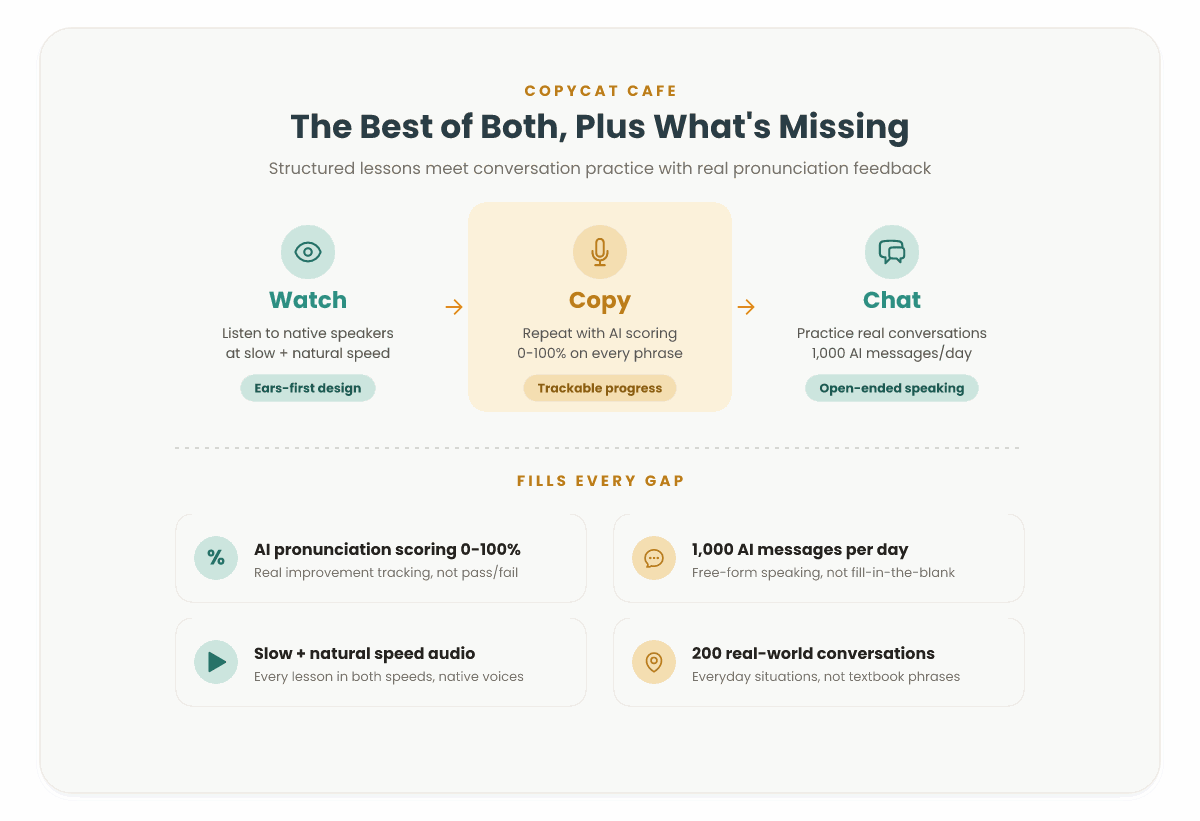
Copycat Cafe combines structured imitation, pronunciation feedback, and guided conversation in one lesson flow.
- 0–100% pronunciation feedback at word and phrase level during the Copy step.
- Slow and normal audio in every structured conversation, so you can hear the line clearly before matching a more natural pace.
- Guided roleplay and Chat with Copy for practicing beyond the model dialogue, with up to 1,000 messages per day.
- 200 structured lessons based on everyday situations such as ordering, making plans, and getting around.
- Speech transcription that lets you compare what the system heard with what you intended to say.
One Copycat Cafe learner told us:
“Passed B1 oral A1 written with 92 and 95 percent pass rates. No way would have achieved that without this course.”
Chris H., Switzerland
Where Copycat Cafe may not fit: It is paid, currently supports French, Latin American Spanish, Castilian Spanish, Italian, and German, and uses light streak tracking rather than XP or leaderboards. It teaches grammar in context but is not a conventional grammar-first curriculum. If you want a free course, much broader language coverage, or game-heavy practice, Duolingo or Pimsleur may fit better.
Copycat Cafe costs $174/year ($14.50/month when billed annually) or $29/month. Paid plans start with a 7-day trial. Paid plans start with a seven-day trial and carry a 30-day money-back guarantee on the first payment.
Want to try a conversation-led lesson flow in French, Latin American Spanish, Castilian Spanish, Italian, or German?
Can you use Pimsleur and Duolingo together?
Yes. They can complement each other if each has a clear role and the combined routine still feels manageable.
One possible daily routine:
- 5–10 minutes: a Duolingo lesson for varied practice and habit building
- About 30 minutes: a Pimsleur core lesson for listening and spoken recall
- Optional 15 minutes: less scripted conversation with a tutor, language partner, or an app such as Copycat Cafe
Duolingo’s game mechanics can make short daily practice easier to sustain. Pimsleur gives you a longer audio sequence with frequent prompts to answer aloud. A conversation-focused session can add more improvisation and detailed feedback. You do not need all three; use only the pieces that serve a clear goal.
Related guides:
- Pimsleur review
- Duolingo review
- Duolingo Max review
- Best Duolingo alternatives
- Best apps to learn French
- Best language learning apps
- Best AI language learning apps
- Babbel vs Duolingo
- Rosetta Stone vs Duolingo
- Babbel review
- French conversation practice
- Online French tutors
- Best French podcasts
- Learn French for free
- CEFR levels explained
FAQ
Is Pimsleur worth it compared to Duolingo?
Pimsleur may be worth paying for if you prefer a 30-minute audio-led course with frequent spoken responses and Voice Coach. Duolingo is the better budget choice because every language course is free and its lessons are shorter and more varied.
Which is better for beginners, Pimsleur or Duolingo?
Duolingo may feel easier for beginners who want free, visual, bite-sized lessons. Pimsleur starts speaking practice immediately through audio prompts; Premium adds written and visual tools for learners who do not want an audio-only experience.
Can you become fluent with Pimsleur or Duolingo?
Neither app covers every skill associated with fluency on its own. Pimsleur centers listening and spoken recall, while Duolingo covers a broader mix of skills and offers AI conversation through Max in supported courses. Most learners also need native input and real interaction.
How much does Pimsleur cost vs Duolingo in 2026?
As of July 2026, Pimsleur All Access costs $20.95/month or $164.95/year in the U.S. Duolingo courses are free; paid prices and trials vary by checkout. Copycat Cafe costs $29/month or $174/year.
Can you use Pimsleur and Duolingo together?
Yes. Duolingo can provide short, varied daily practice, while Pimsleur adds a structured 30-minute audio routine. A tutor, language partner, or conversation-focused app can add longer, less scripted speaking practice.
The best routine is one you can maintain. Choose a primary product, give every additional tool a clear job, and spend as much time as possible actually listening, reading, writing, and speaking.
This comparison combines earlier hands-on testing, documented in our full Pimsleur review and Duolingo review, with a July 23, 2026 review of official product pages, help documents, app-store listings, and feature announcements. We did not retest every current feature.