

Thinking about Mango Languages and wondering whether it's worth paying for, or whether your library card already gets you in? Mango is a conversation-based course in more than 70 languages, and many US public libraries give it to their members for free.
We used Mango's French course for this review. Below you'll find what a lesson is actually like, how its speaking practice works, how far the course goes, what it costs without a library card and what other learners say about it.
Go straight to Mango Languages' website to try its free lessons, or check whether your library offers Mango free. If speaking is your main goal, try our own app, Copycat Cafe. When we used Mango's Voice Comparison, it drew our test recording as a waveform next to the native speaker's and left the judging to us, with no score. In Copycat Cafe, you say each line of an everyday conversation and get a 0–100 pronunciation score on every word.
Prices checked November 11, 2026.
How we reviewed Mango Languages
In November 2026 we used Mango's French course on the web with a free account. We completed Lesson 1 of Unit 1 from the first slide to the last, opened Lesson 2, tried Voice Comparison, worked through the chapter vocabulary list and the lesson settings, and checked exactly where the free lessons stop. We judged Mango on its audio, how much it makes you speak, how clearly it teaches and what it costs. Prices come from Mango's website, its in-app plans page and its US App Store listing.
What is Mango Languages?
Mango Languages is a self-paced language course that runs on the web and in apps for iPhone, iPad and Android. It's made by Creative Empire, LLC, a US company that has supplied language courses to libraries for nearly 20 years. Mango calls its method Intuitive Language Construction: each lesson takes one real conversation and works on its vocabulary, grammar, pronunciation and culture at the same time.
The range is unusually wide. The course picker in our account listed 73 courses for English speakers, from French, Canadian French and two kinds of Spanish to Cherokee, Hawaiian, Yiddish, Ancient Greek and, for fun, Pirate. Only the biggest courses go deep, though. Mango says nine of them, including French, Latin American Spanish, Italian and German, run the full five units.
What is a Mango lesson like?
Every chapter starts with one short conversation, and the lessons take it apart. French Unit 1 opens with two people greeting each other: Tiens, bonjour ! Ça va ?
Ça va bien, merci. Et vous ?
Seven lines later they've agreed it's cold today and said à tout à l'heure
.
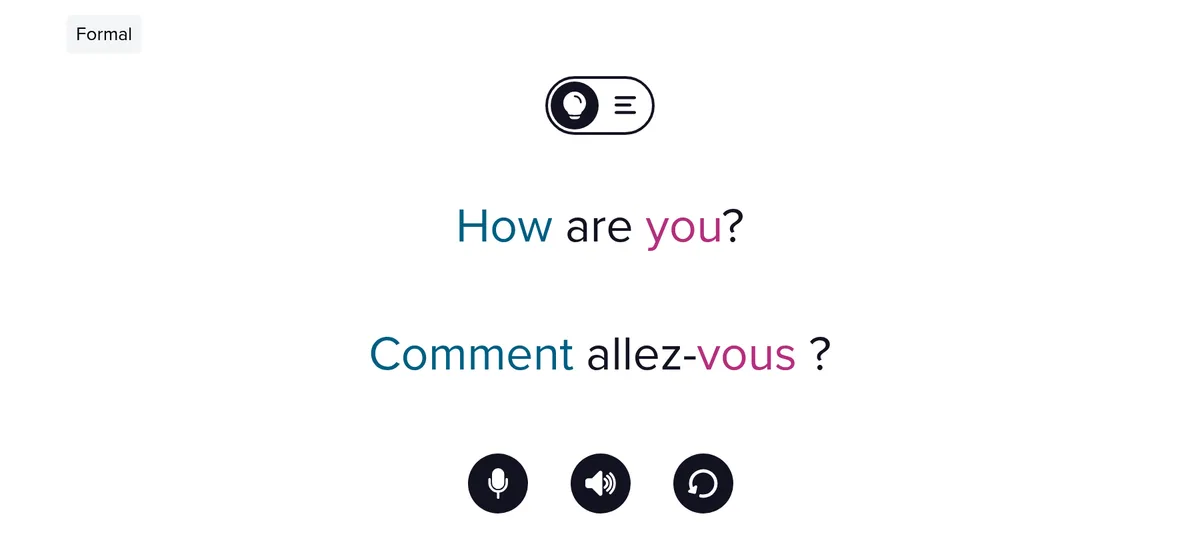
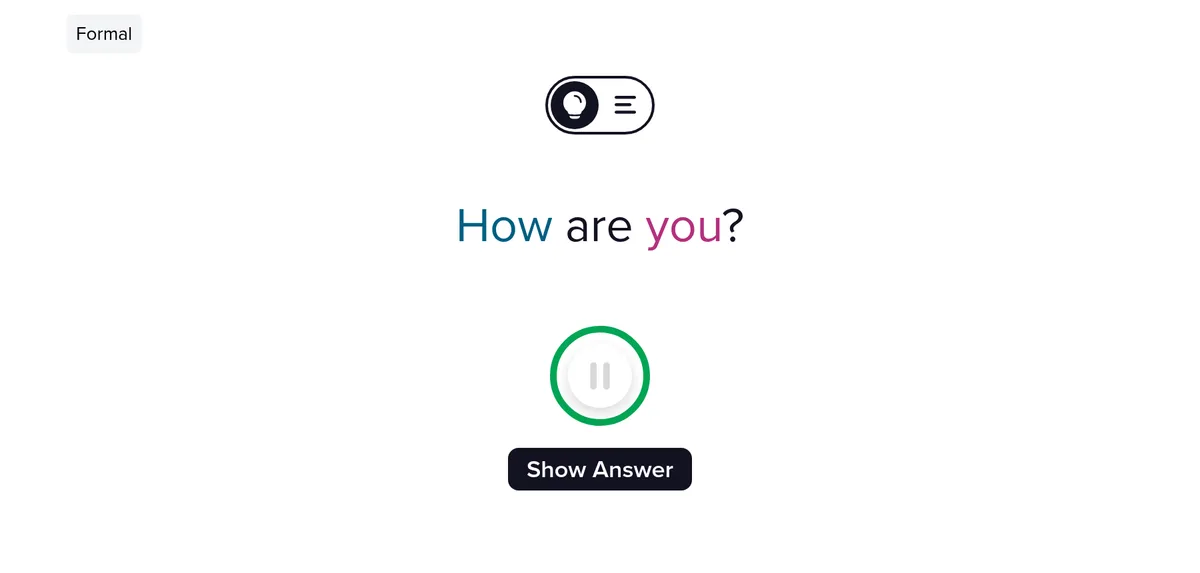
Lesson 1 then spends 56 slides on the greetings in that exchange. New phrases appear in English and French with matching words in the same color, so you see at a glance that comment is "how" and vous is "you" in Comment allez-vous ? Most slides are quizzes. You see the English, a timer counts down while you say the French out loud, then you tap Show Answer to hear it. In Lesson 1, 31 of the 56 slides were speaking quizzes. Six Critical Thinking slides ask you to build something you haven't been taught as a whole, such as "Good evening, madam. How are you?", from pieces you already have.
Short culture and grammar notes sit between the drills. One explains that tiens comes from tenir, "to hold", and signals mild surprise. Others cover when to switch from ça va ? to comment allez-vous ?, why you always use vous with strangers in France, and how many kisses to give when you greet someone. They're brief and practical, the kind of thing a good teacher mentions in passing. Our guide to saying "how are you" in French goes further if you want the full picture.
The audio is Mango's biggest strength. The dialogue is voiced by a man and a woman with standard French accents, recorded cleanly and spoken a little slower than everyday speech. You can replay any line. Mango says its core lessons are recorded by native-speaking actors, and that's how they sounded to us. In the lesson settings you can also turn off the quiz timer, the English narrator or the captions.
Repetition is the trade-off. "Hi, how are you?" came up five times in Lesson 1, and the formal version four times. That's good for memory and a little slow if you already know some French. One Reddit user who said they were well into B1 French on Duolingo wrote that Mango "started out by slowly explaining Bonjour, ça va"; Mango's placement test exists for exactly that learner.
Does Mango help you speak?
Mango gets you saying French from the first slide, but it leaves the judging to you. Nothing in the lesson checks whether you said the phrase, or said it well. On every speaking quiz we could tap Next without answering, and the lesson moved on.
Mango's one speaking tool is Voice Comparison. You tap the microphone on a phrase and record yourself, and Mango draws your recording as a waveform under the native speaker's. You can play either one, or both, and drag your waveform to line it up. There's no score and no note on which sound was off: you listen and decide for yourself.
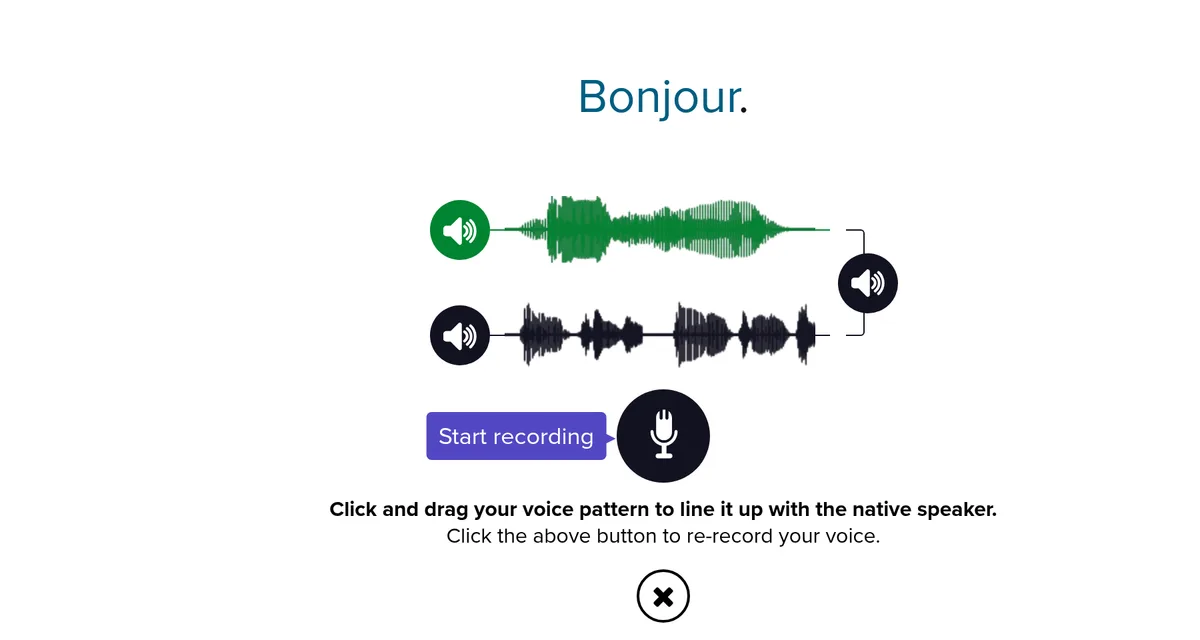
That works if you're disciplined and have a good ear. It's harder when you can't yet hear your own mistake, and French has plenty of sounds, like the vowel in tu, that English speakers miss. Mango's conversations are also scripted, so in the app you never answer a question you haven't rehearsed. For live speaking, Mango sells Mango Live: 30-minute one-on-one video lessons with a native-speaking coach in eight languages, French included, paid per lesson, separately from any plan.
How does Mango help you remember words?
Every chapter has a vocabulary list, and it's open on the free account. French Chapter 1 has 52 cards, each with the English, the French, audio and a respelling for English speakers: bonjour is "bo(n)joor" and monsieur is "meusyeuh". Tap Hide All and the list becomes a self-test. The respellings help on day one, though a few are rough: de rien becomes "deuh ryu(n)".
Slides marked with a lightbulb go into Daily Review, Mango's spaced-repetition queue, which brings phrases back over the following days. The Vocabulary tab also lets you build your own card lists.
How far does Mango's French course go?
Much further than most beginner apps. On our French course page, the five main units held 41 chapters and 585 lessons, from greetings and small talk in Unit 1 to airports, house hunting, emergencies and hair appointments in Unit 5. Three short specialty units sit beside them: Argot (French slang), Romance, and Wine and Cheese.
Mango compares the end of Unit 5 to CEFR level B1, and is careful to present that as a comparison, not an official rating. B1 is roughly where you can get through most everyday situations and talk about familiar topics. Our guide to the CEFR levels explains what each level means in practice.
Is Mango Languages free?
Often, yes, through a library. Mango says thousands of libraries, schools and organizations give their members full access, and large systems such as the Brooklyn, Chicago and Austin public libraries list it. Search for your library on Mango's Find Mango page, then link your library card in the app or on the web. According to Mango's page for libraries, a library profile can be shared with up to five family members. Library access includes the placement test but not the end-of-chapter quizzes.
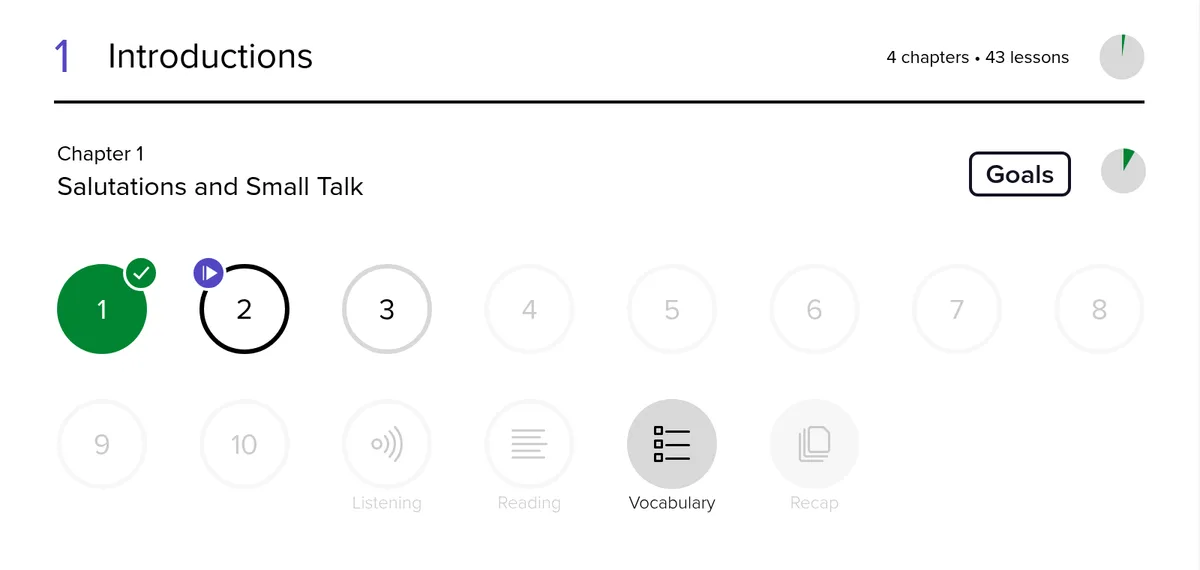
Without a library, the free account is small. Ours showed "Three free lessons per language". In French that meant Lessons 1 to 3 of the first chapter plus its vocabulary list, while Lessons 4 to 10, the chapter's listening and reading activities and its recap all led to the plans page. That matches Mango's help center, which says anyone can try the first three lessons of each course for free. Thirteen courses marked Free, such as Irish, Hawaiian and Cherokee, were also included with our free account.
How much does Mango Languages cost?
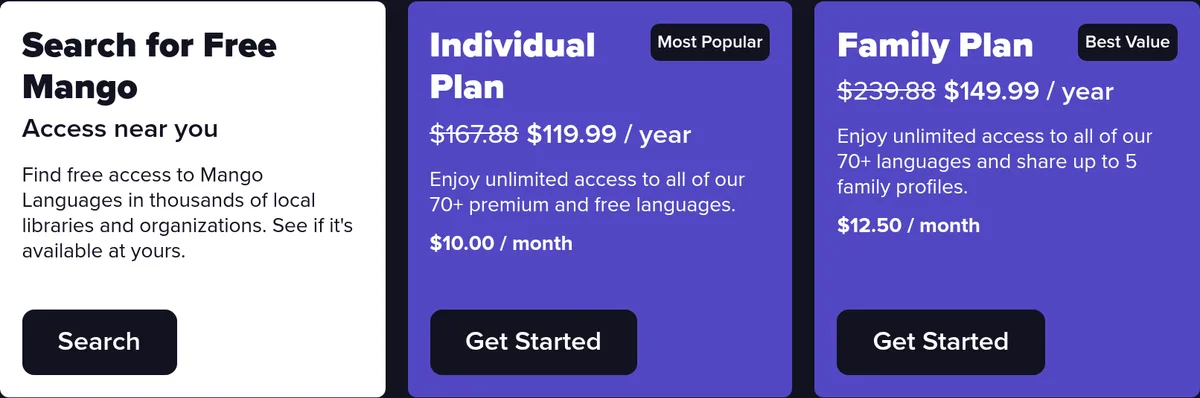
Without a library card, Mango has two personal plans, and both include every language.
| Plan | Monthly | Yearly | What you get |
|---|---|---|---|
| Individual | $13.99 | $119.99 ($10 a month) | Every language, one learner |
| Family | $19.99 | $149.99 ($12.50 a month) | Every language, up to 5 profiles, parental controls |
| Library card | Free | Free | Full course access where your library offers Mango |
Both personal plans start with a free trial, 14 days according to the US App Store listing, which shows the same prices as Mango's pricing page. If you'll stick with it, pay yearly: on the Individual plan that saves about $48 compared with 12 monthly payments. With two or more learners at home, the yearly Family plan costs only $30 more than the Individual one. Mango notes that prices can vary by country, and Mango Live lessons cost extra.
Pros
- Free with a library card at many US public libraries
- Clean recordings by native speakers, with replay on every line
- Color-coded breakdowns with short grammar and culture notes
- A long French course: 585 lessons across five units
- One plan covers more than 70 languages
Cons
- Nothing checks your speaking; Voice Comparison gives no score
- Lots of repetition, which feels slow if you know some French
- Scripted conversations only, with no free conversation practice in the app
- A small free tier if your library doesn't offer it
What do other learners say about Mango?
Ratings are high. On November 11, 2026, Mango had 4.8 out of 5 from about 44,000 ratings on Apple's US App Store and 4.8 from about 24,800 reviews on Google Play.
Many of its fans found it through the library. One App Store reviewer who found it through the library called it "WAYYYYY better than Duolingo" because it "explains things in much detail and doesn't distract you with annoying cartoon characters and constant sales pitches." The criticism matches what we found. In a Reddit thread titled "Is Mango just slideshow lectures?", one learner wrote that "even the speaking 'exercises' appear to just be for my own benefit and not actually graded." Another library user, in a different thread, saw that as a plus: "They don't grade you on your practice or punish you for minor things- you just learn."
Mango Languages vs Duolingo and Rosetta Stone
Mango feels more like a class than a game. Compared with Duolingo, it explains far more and uses longer real conversations, but Duolingo's main course is free and its exercises check typed, tapped and spoken answers. If you're choosing between them, our Duolingo review covers what Duolingo does well.
Rosetta Stone teaches by immersion, with pictures and almost no English, and its TruAccent speech recognition checks your pronunciation. Mango explains everything in English instead. Some libraries are switching from one to the other: the Okanagan Regional Library in Canada announced in November 2026 that Mango will replace Rosetta Stone for its members. Our Rosetta Stone review explains who its method suits.
Is Mango Languages worth it?
Yes, if your library offers it. For free, Mango is one of the best-structured beginner courses you can get, with clean native audio, clear explanations and a long path toward B1 in its biggest languages. Paying $10 a month also makes sense if you want several languages, or a less common one that Mango teaches well.
It's a weaker buy if your main goal is to speak with confidence. Mango gets you saying phrases from day one, but it never tells you how you sounded, and its conversations stay scripted. Pair it with something that listens back.
What if you mainly want to speak French?
If your main goal is to speak French, Spanish, Italian or German, our pick is Copycat Cafe. Mango's native recordings and culture notes are excellent, and we liked starting each chapter from a real conversation. But in our test, its speaking quizzes moved on whether we said anything or not, and the conversations never left the script. Copycat Cafe also starts from an everyday conversation, at normal or slow speed. Then you say each line aloud and get a 0–100 pronunciation score on every word, and use the same language in an open conversation with Copy, your AI conversation partner. It costs $29 a month or $174 a year in the US, with a 7-day free trial and a 30-day money-back guarantee on your first payment. Choose Mango if your library gives it to you free, or if you want a language we don't teach.
Related guides: