

You know that pensar becomes pienso. Then you're halfway through a sentence and out comes penso. Fixing that takes reps: see a verb and a person, produce the form, find out straight away if it's wrong, and go again.
Plenty of free websites will drill you. They differ in how they check you, though: whether a missing accent counts, whether you see the right form at once or at the end, and whether anything tells you why. So we tried three popular free trainers the way a learner would, made the same kinds of mistakes on purpose in each, and wrote down exactly what came back.
Here's what we found, which tool fits which goal, and what to use on your phone.
How we tested the conjugation tools
Our team used three free trainers on the web on November 13, 2026, without an account: Conjuguemos (its Graded Practice mode in five sets of present and preterite verbs), StudySpanish.com (its verb quizzes for regular present, e:ie stem-changing present and regular preterite verbs) and Spaleon (its trainer with one verb set in the present and preterite). In short sessions in each, we typed wrong answers on purpose: missing accents, the wrong person, verbs without their stem change and irregular verbs made regular. We also used SpanishDict's free conjugation tables, and read the pricing pages where they have one. For the phone apps, ConjuGato and Ella Verbs, we read their websites, Ella Verbs' pricing page and ConjuGato's App Store listing.
Which free tool should you use?
It depends on what you want to practise. Here are our picks by goal:
- Typing verb forms until they stick: Conjuguemos. Each mistake stays on screen until you type the right form.
- Verbs inside real sentences: StudySpanish.com. Every question is a sentence with a gap, and each topic has a written lesson.
- A quick drill with no sign-up and your own verb list: Spaleon. Pick up to ten verbs and a tense and start.
- Looking up one verb: SpanishDict's conjugation tables, with irregular forms in red.
- Practice on your phone: ConjuGato, whose free version and one-time Pro price suit a daily habit. Ella Verbs is the alternative if you want a level-by-level path.
All three web trainers were strict in the same way. This table shows how each one checked the mistakes we made on purpose:
| Tool | Account | When you see the answer | Missing accent | Explains the mistake |
|---|---|---|---|---|
| Conjuguemos | None needed; guest scores not saved | Right away, and you retype it | Marked wrong | No; the hint shows the verb's table |
| StudySpanish.com | None needed; scores not saved | At the end, as full sentences | Marked wrong | No |
| Spaleon | None needed | Right away, beside a crossed circle | Marked wrong | No |
So the choice comes down to the format you like and how soon you want the correction. The sections below show what each one did with our mistakes.
How does Conjuguemos check your Spanish verbs?
Strictly, and on the spot. Conjuguemos has free activity sets for many Spanish tenses, each with flashcards, multiple choice, 17 game modes and a Graded Practice mode. As a guest, "Use without account" took us straight to the list. Before each Graded Practice round you choose verbs, pronouns, tenses and a timer (five minutes by default). Then a prompt like yo/comer appears and you type the form.
Every mistake got the same red panel: "Should be:" and the right form. We typed come for yo/comer and it said "Should be: como". Stem changes were checked both ways: penso came back as pienso and pedo as pido, and when we added a stem change that doesn't belong, vueláis for vosotros/volar, it corrected us to voláis. In the preterite, the regularised podió came back as pudo.
Accents count. Recibis, cocine and asistio were all marked wrong, and so was the extra accent in vió ("Should be: vio"). After a mistake, a button for the accented letter you need appears under the answer box. A capitalised "Estuvimos" was still accepted.
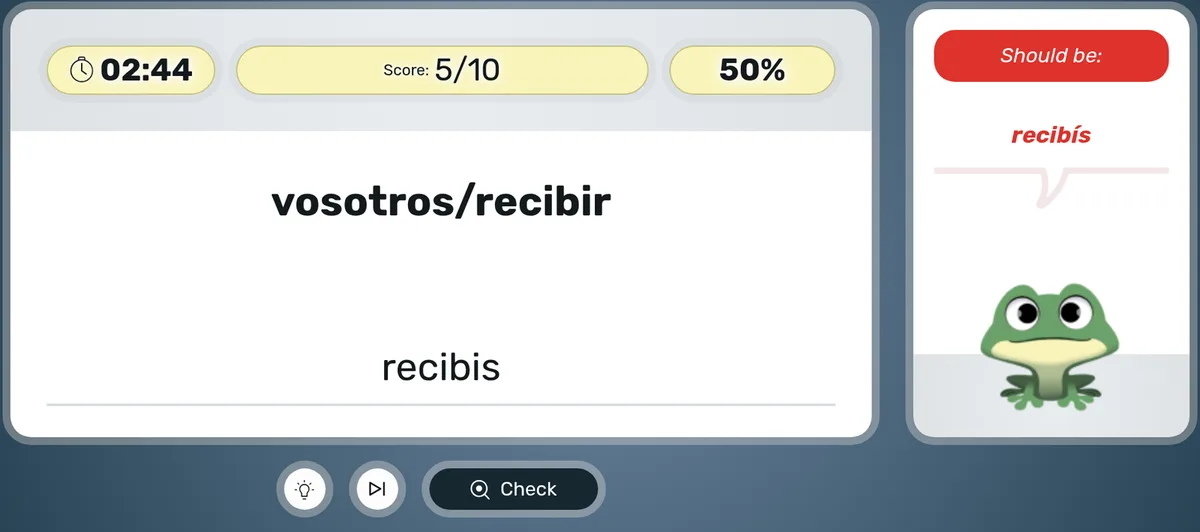
What makes it a good drill is that the prompt doesn't move on. You have to type the right form before you get the next verb, and that corrected attempt counts in your score. Typing como after come took our score from 0/1 to 1/2.
What it never did was say why. In our present-tense round, the Hint button opened the verb's full present-tense table, which is useful for spotting the pattern yourself.
Two things to know before you start. As a guest, your results vanish: our round ended at 7/12 (58%) with "You must be logged in as student to record your score". Conjuguemos's pricing page says a free student account gives unlimited recording of grades. And the page is busy with ads, including an auto-playing video player beside the exercise. No audio played during our Graded Practice rounds.
How does StudySpanish.com's verb quiz work?
It drills verbs in sentences and marks everything at the end. StudySpanish.com's verb drills page lists topics from present regular verbs to the subjunctive, commands and perfect tenses. Each topic opens with a written lesson and a button to generate a quiz. You choose 5 to 25 questions and whether to include vosotros.
Each question gives you the infinitive and a sentence with a gap, such as "invitar -- to invite: Emilio y yo ___ al amigo de Hilda." Accent buttons sit under every blank. You answer them all, then submit.
The results page gives your score and a table of the questions you got wrong, each as the full correct sentence with the verb in bold. Our missing accent in rompi came back as "Yo rompí el juguete.", and the stem-change slip temblo as "Yo tiemblo de frío." When we gave the wrong person, comió for María y Juan, it showed "María y Juan comieron con las manos."
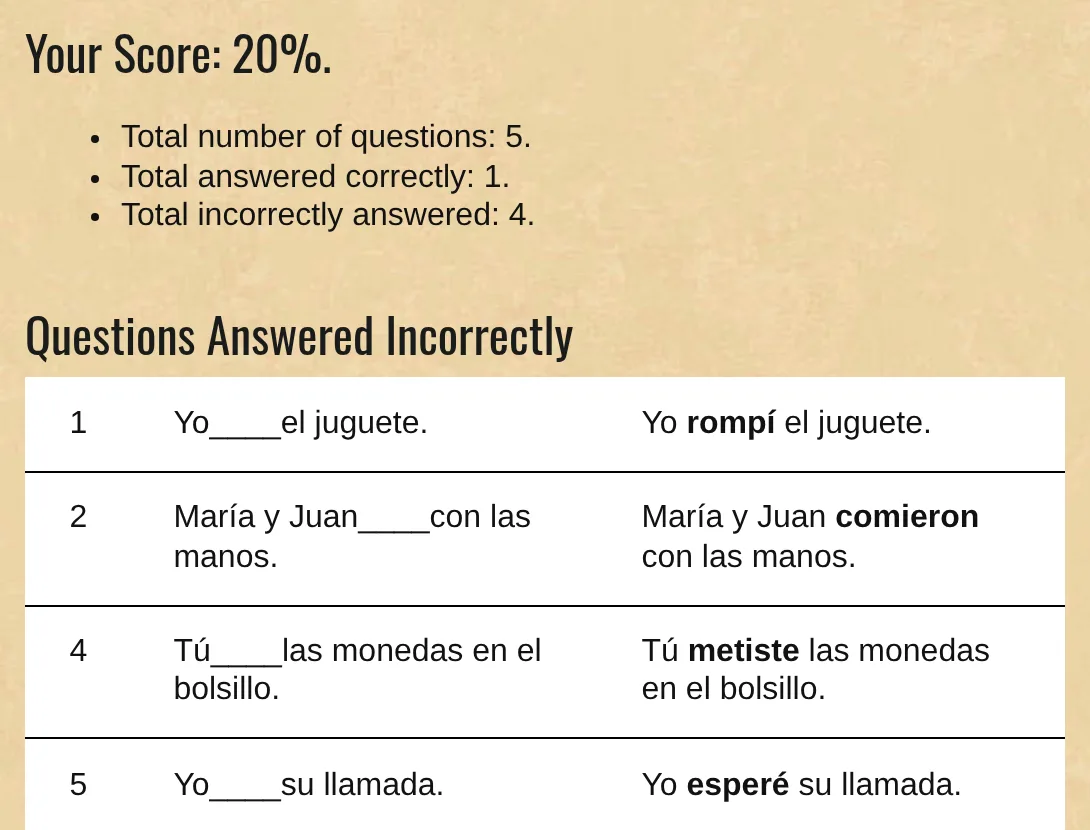
The weak spot is the feedback. The table doesn't show what you typed and doesn't explain the error, so with ten questions you have to remember which answer was yours. In several rows the corrected sentence also differed from the one we'd been given: the quiz asked "Yo ___ a la familia." for visitar, and the results showed "Yo visito muchos museos." Missing accents were marked wrong, and so was typing the pronoun with the verb ("yo sugiero"), so type the verb alone.
The quizzes worked without an account. Scores weren't saved, and the drills have no audio of the verb forms.
What is Spaleon good for?
Fast, no-fuss drilling. Spaleon's trainer needs no account. You pick a tense (present, preterite, imperfect, future, conditional and two subjunctives) and a verb set, such as regular verbs, irregular verbs, a topic like "Learning" or up to ten verbs you choose from about fifty.
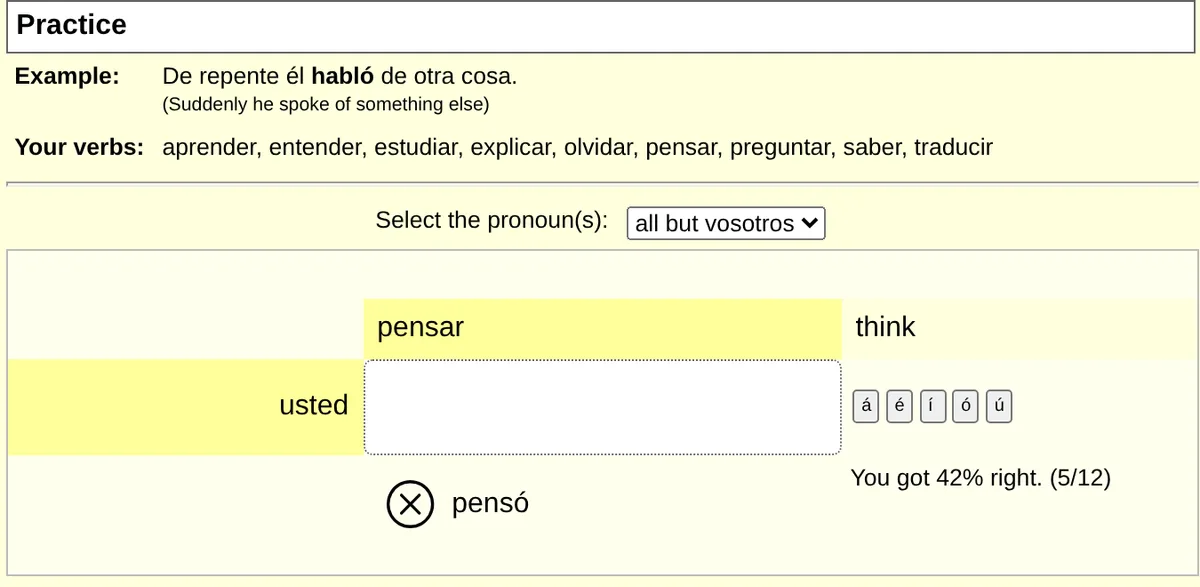
Each item shows the infinitive, its English meaning and a pronoun. When you're wrong, the box clears and the right form appears beside a crossed circle. Traduco came back as traduzco, olvidan for nosotros as olvidamos, and in the preterite, the regularised traducí as traduje. A running score sits beside the answer box.
It's as strict about accents as the others. Our penso for usted/pensar in the preterite was marked wrong and corrected to pensó, and the extra accent in explicán was corrected to explican. The accent buttons cover á, é, í, ó and ú, with no ñ.
One trap for learners of Latin American Spanish: the tú option is labelled "tú (vos)", but when we typed the vos form olvidás, Spaleon counted it wrong and showed no correction. Its "Solution" button then filled in olvidas. Like the other two trainers, Spaleon never explained a mistake, and the page carries a couple of ad blocks.
Where can you look up a Spanish conjugation for free?
SpanishDict's conjugation tables are free without an account. The table for pensar shows the indicative, subjunctive, imperative and progressive forms, with the note "Irregularities are in red". Switches let you include or hide vos and vosotros. After one click in the table, a sign-up box covered the page for us.
SpanishDict's conjugation hub also offers Conjugation Drills, which it describes as "personalized, interactive drills" to "master any verb in any tense", and interactive video lessons on Spanish verb tenses. The drills ask you to sign in first, so you'll need a free account to use them.
What should you do when a tool only gives you the right form?
Look up the pattern before your next round. None of the three trainers told us why an answer was wrong, so the explanation has to come from somewhere else. Here's where to find it:
- In Conjuguemos, press Hint when you're stuck and read the whole table, not only the form you missed.
- In StudySpanish.com, read the topic's written lesson before you generate its quiz.
- For a single verb, open its SpanishDict table and check which forms are in red.
If your mistakes cluster on one kind of verb, such as e:ie stem changes or irregular preterites, drill only that set. Conjuguemos has separate sets for stem-changing and irregular verbs, StudySpanish.com splits its topics by verb type, and Spaleon lets you pick the verbs yourself.
Can you skip vosotros or practise vos?
You can skip vosotros almost everywhere. StudySpanish.com asks whether to include it in each quiz, Spaleon leaves it out by default ("all but vosotros"), Conjuguemos lets you filter pronouns before a round, and SpanishDict's tables have a switch for it. If you're unsure whether you need it, our guide to Latin American vs Spain Spanish explains who uses vosotros and who uses vos.
Vos is harder to drill. Spaleon marked our olvidás wrong, and SpanishDict shows vos forms in its tables when you switch them on. Among the phone apps, ConjuGato's App Store listing says it includes Argentinian and Chilean voseo forms.
What's the best app for Spanish verbs on your phone?
ConjuGato and Ella Verbs are both built for verb practice on a phone, and both have a free version.
ConjuGato is a one-time purchase. Its website lists "No ads", "No subscriptions" and "Works offline", and links only to the App Store and Google Play. According to its App Store listing, you don't have to type: you think or say the form and tap to check yourself, with typing available as an option, and the free version covers 250 common verbs in the present and preterite. Its website says forms you rate as difficult come back more often. The US App Store lists the Pro version at $14.99.
Ella Verbs sells Pro as a subscription or a lifetime purchase, and takes you through the tenses in levels. Its website says "the full present tense and the top 100 verbs are free forever", that new users get a 5-day free trial of Pro without a card, and that it runs on iPhone, Android, Mac and the web at app.ellaverbs.com. Pro unlocks 18 tenses and 2,500 verbs, according to its pricing page.
Of the two, ConjuGato's one-time price is the cheaper one over time. If you'd rather follow a set path through every tense and practise on the web too, Ella Verbs fits better.
How much do these tools cost?
The web trainers we used are free to drill on. Paid plans add saved scores, an ad-free page or more verbs and tenses. Prices checked November 13, 2026:
| Tool | Free | Paid |
|---|---|---|
| Conjuguemos | Public activities free (per its pricing page), playable without an account; a free student account saves grades | Teacher Premium $45 a year; ad-free add $25 |
| StudySpanish.com | Verb drill quizzes without an account | Premium $9.99 a month or $119 lifetime |
| Spaleon | The whole trainer; signing in is optional | None listed |
| SpanishDict | Conjugation tables; drills with a free account | Premium, with a 7-day free trial |
| ConjuGato | 250 verbs, present and preterite | Pro $14.99 one-time (US App Store) |
| Ella Verbs | Present tense and top 100 verbs | Pro $8.99 a month, $54.99 a year or $164.99 lifetime on the web |
For most learners the free tiers are enough. StudySpanish.com's Premium adds what it calls "an integrated digital report card that saves your scores", and Ella Verbs notes that its app-store prices are higher than its web prices, so check its web pricing page before you upgrade in the app. Conjuguemos's ad-free option is listed as an add-on to its teacher and school plans.
How do you go from conjugation drills to speaking?
Drills get the forms into your fingers. Saying them in a conversation, while someone waits for your answer, takes practice of its own.
For that, our own app, Copycat Cafe, is built around speaking. Each lesson is an everyday Spanish dialogue, in Latin American or Spain Spanish: you say each line aloud and get a 0–100 pronunciation score on every word, then use the same language in conversation with Copy, your AI conversation partner. It costs $14.50 a month billed as $174 a year, or $29 a month, with a 7-day free trial and a 30-day money-back guarantee on your first payment.
If you're still choosing a main app or course, our guide to the best apps to learn Spanish compares the main options, and our list of the best Spanish courses online covers structured courses with teachers. Using Duolingo already? Our Duolingo for Spanish review covers how it teaches Spanish and which apps to add for speaking. And for a plan that puts drills, listening and speaking together, see the best way to learn Spanish as an adult.
Frequently asked questions
What is the best free way to practice Spanish verb conjugation?
For typed drills on the web, Conjuguemos: you type each form, missing accents are marked wrong and you retype every mistake before moving on. StudySpanish.com is better if you want verbs in full sentences, and Spaleon is the quickest to start with no account.
Is Conjuguemos free?
Yes. Conjuguemos's pricing page says students get free, unlimited access to all public activities, and we played without an account; guest scores are not saved. A free student account records your grades. The site shows ads, and paid plans are for teachers and schools.
Do Spanish conjugation tools accept answers without accents?
Not the ones we used. Conjuguemos, StudySpanish.com and Spaleon all marked missing accents wrong, for example recibis for recibís and penso for pensó. Conjuguemos and Spaleon also marked an extra accent wrong.
What is the best app for Spanish verbs on a phone?
ConjuGato suits a daily habit on a one-time price: its free version covers 250 common verbs in the present and preterite, and Pro is $14.99 on the US App Store. Ella Verbs suits learners who want a level-by-level path, with the present tense free and Pro from $54.99 a year on the web.
Can I practice vos conjugations?
SpanishDict's free tables show vos forms when you switch them on, and ConjuGato's App Store listing says it includes Argentinian and Chilean voseo forms. Spaleon marked our vos form olvidás wrong.