

Disclosure: This article contains affiliate links. If you sign up through them, we may earn a commission at no extra cost to you. This doesn't influence our review.
Here is what Duolingo's Spanish course does well in 2026, where it stops short, and three apps that pick up where it ends.
Updated September 30, 2026: We checked current features, pricing and access terms against official sources. The firsthand impressions below come from the author’s original tests.
Full disclosure: I'm Nur, co-founder of Copycat Cafe. One of the apps on this list is ours. The other two are not, and you'll see honest reasons to pick any of them over Copycat Cafe in the right situation. Reader value first, always.
Who this is for
You're reading this if you fit one of three profiles:
- You've used Duolingo for Spanish for months (or years), your streak looks impressive, and you still freeze when someone actually asks you a question in Spanish.
- You're about to start learning Spanish and you keep hearing "just use Duolingo." You want a second opinion before you spend the next year tapping owls.
- You like Duolingo, you don't want to leave it, and you want to know what to add to fix the speaking gap.
If any of those is you, keep reading. Everything below is based on time inside the app, the official Duolingo blog, and the company's own published research.
What Duolingo's Spanish course actually does in 2026
Three things worth knowing before you decide.
The course now reaches B2 (upper intermediate)
Duolingo now teaches Spanish content through B2, or upper intermediate, according to its course update. That describes the curriculum. Completing it does not automatically mean you have reached B2 in speaking, listening, reading and writing.
The expansion covers nine teaching languages, including Spanish, for most learners regardless of their starting language. It is a meaningful reason to keep going beyond the beginner lessons if Duolingo suits you.
Spanish is one of Duolingo's flagship courses
Spanish is a strong choice on Duolingo. Its advanced content includes Stories, DuoRadio listening exercises and grammar explanations. I would pay more attention to the skills and course level you are working on than to a fixed unit count: use the path shown in your own app to check how much is left.
For dialect, Duolingo’s explanation of ustedes and vosotros describes the Latin American focus of its Spanish course for English speakers. If you specifically want Spain Spanish, the separate courses below are worth comparing.
The AI features have improved meaningfully
A few AI features in particular are worth mentioning honestly.
Roleplay lets you have a typed or spoken conversation with a Duolingo character in a guided scenario. It is included in Duolingo Max for English speakers learning Spanish on iOS and Android. The scenarios are a real step up from tap-the-tile exercises.
Video Call with Lily lets you speak with an AI character in real time. Duolingo describes level-adjusted conversations and memory of earlier calls. I find this one of its more interesting features. Video Call is included in Max, and Duolingo has begun expanding it to Super subscribers, so check what your account includes before upgrading.
Video Call with Falstaff offers more guided support, with prompts, suggested phrases and tips in your own language. Duolingo’s current announcement lists it for iOS Max subscribers learning Spanish, among other languages. It is a gentler option for beginners than an open-ended call.
Explain My Answer, previously a Max feature, is now free for most Spanish learners. It can explain vocabulary and grammar after correct or incorrect answers. You do not need to buy Max just for those explanations.
Credit where credit is due. Advanced content, guided speaking calls and free explanations make Duolingo a more useful option than the old tap-and-translate stereotype suggests.
Where Duolingo's Spanish course breaks down
Now the honest part. These are the four things I would watch if your main goal is speaking.
1. Recognizing words is not the same as saying them
Tapping the right word, dragging tiles into order and typing a translation are different tasks from answering someone out loud. If you recognize Spanish but freeze when asked a question, make speaking a deliberate part of your routine. Our guide to Spanish conversation practice gives you questions and scripts to rehearse.
Duolingo does offer speaking practice. Its Practice tab includes free speaking lessons on iOS and Android, and its AI calls go beyond reading a prompt aloud. Duolingo’s own study of beginner Spanish and French learners found higher spoken-translation scores among Falstaff users than learners who did no calls. That is evidence about a particular task and group, rather than proof of fluency for everyone.
2. You still need to rehearse your own situations
My concern is whether the phrases you practice match what you actually need. Before a trip, rehearse asking for the bill, explaining a problem with your room or answering a follow-up question. Duolingo’s Roleplay can help with scenarios, but I would still make a short list of situations from your own life and practice them out loud.
3. I still want more focused pronunciation feedback
This remains the biggest gap for me: I want feedback I can use to repeat a phrase more carefully. Duolingo’s newer Video Call tools include post-call feedback, but its current Spanish feature descriptions do not advertise the same 0 to 100, word-level pronunciation feedback offered in Copycat Cafe. That score evaluates a recording attempt; it is not a measure of your overall Spanish level.
4. The gamification rewards the wrong behavior
Streaks, points, leaderboards, gems. I like them as a reason to show up, but I worry that they can make finishing the lesson feel more important than learning it. My practical check: close the app and say a few sentences from the lesson without looking. If you struggle, repeat the material before chasing more points.
If your trip is coming up, make time to speak out loud. Copycat Cafe gives you a structured way to do that: listen to a dialogue, copy the lines with pronunciation feedback, then practice using them with an AI partner.
Three apps that pick up where Duolingo stops
If you want more focused speaking practice, here are three alternatives to Duolingo. I’m putting Copycat Cafe first because the Copycat Method™ builds listening, repetition and conversation into a structured routine. That does not make it right for everyone. Langua and Pimsleur suit different preferences.
1. Copycat Cafe: best for structured speaking practice with pronunciation scoring
Spanish variants: Latin American Spanish and Spanish from Spain
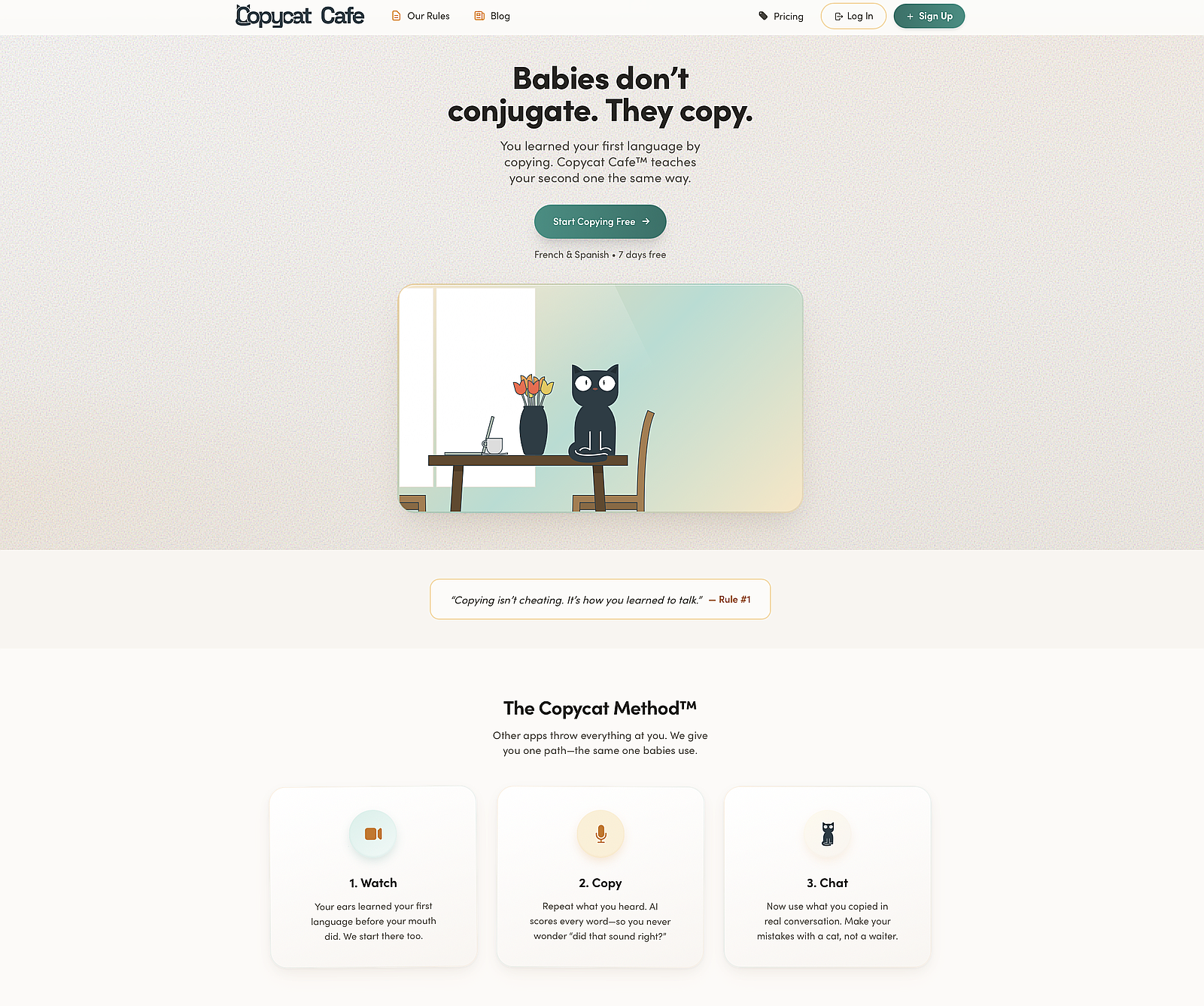
Verdict: Copycat Cafe is the speaking-first app built around the Copycat Method™ (Watch. Copy. Chat.), with authored dialogues, native-sounding audio, pronunciation feedback and an AI conversation partner.
Editorial note: We make Copycat Cafe, so we are biased. We still hold Duolingo to a fair standard and tell you plainly who it is right for.
The Copycat Method™ has three steps. Watch: listen to an authored dialogue and rebuild what you hear, using normal or slower audio. Copy: repeat the lines in chunks and get a 0 to 100 pronunciation score with word-level feedback when your recording can be assessed. Chat: practice with Copy, the AI partner. You can follow the lesson’s situation or open Chat directly; the sequence is a recommendation, not a lock.
- Structured lessons per course
- 200
- Spanish courses
- 2
- Pronunciation score
- 0 to 100
Each Spanish course has 200 structured lessons covering A1 to B2 material. Paid access includes all five courses: Latin American Spanish, Spanish from Spain, French, German and Italian. Personal costs $174 a year ($14.50 a month billed yearly) or $29 month-to-month. The 7-day trial requires a card and renews into your chosen plan unless you cancel. The 30-day money-back guarantee covers your first paid charge.
“…passed B1 oral A1 written with 92 and 95 percent pass rates. No way would have achieved that without this course.”
Chris Horler, Copycat Cafe user in Switzerland (original testimonial). This is his individual experience, not a promised result.
Try Copycat Cafe if
Your specific frustration is that you understand Spanish more than you can speak it, and you want structured A1 to B2 material plus repeated speaking practice and pronunciation feedback.
2. Langua: best for flexible AI conversation practice
Spanish variants: Spanish conversation practice with dialect options; more than 20 languages overall.
Verdict: Langua is a solid AI-powered conversation tool with a structured A1 to A2 course for beginners and flexible, low-pressure AI practice for intermediate and advanced learners across 20+ languages.
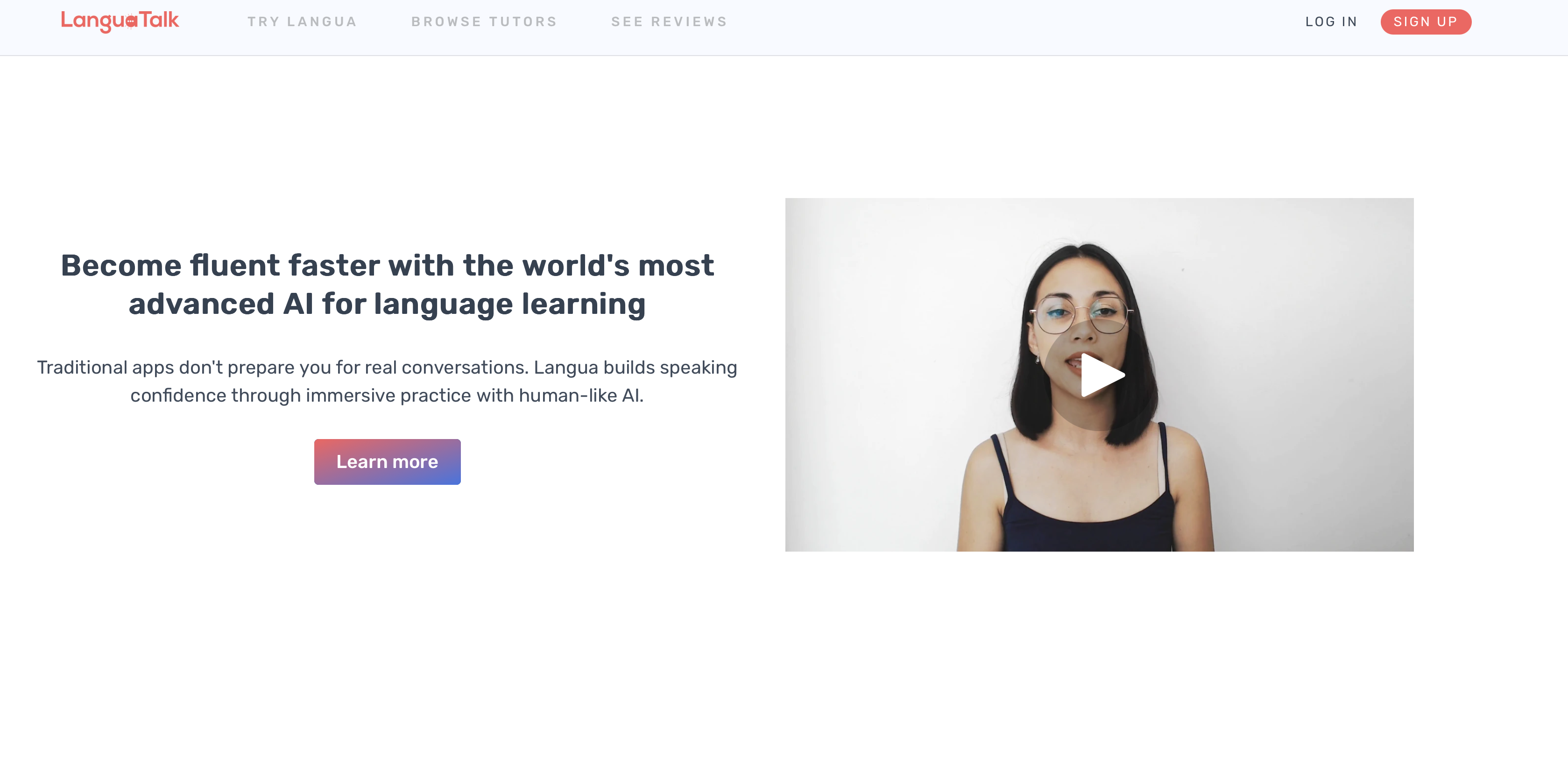
Langua is a web and mobile app focused on AI conversation. The voices are cloned from real native speakers, so calls feel less like talking to a generic chatbot. You can choose to listen only, listen first then read, or stay in text mode if you want quiet practice in public.
The standout feature for me is Call Mode: hands-free conversations for a walk or chores. Langua’s plan guide lists 30 Call Mode minutes and 75 standard-chat messages daily for Standard; Unlimited removes those advertised limits. It also offers limited free practice. Corrections depend on your mode and settings. Conversation reports require at least six replies, and audio summaries are mobile-only, according to its conversation guide.
Two honest caveats. I would not rely on open-ended AI chat as my entire beginner course, and Langua now has a structured A1 to A2 path alongside its conversation tools. I still think its strongest fit is someone with a foundation who wants flexible speaking practice without booking a tutor. Its current feature page explains the beginner path and voice options.
The US Apple listing shows Communicate at $19.99 monthly or $149.99 annually, and Unlimited at $29.99 monthly or $199.99 annually. The Communicate store label differs from “Standard” in the web help, so check the plan details when subscribing. Langua’s web trial terms specify 5 days on monthly plans or 7 days on annual plans, with a card required. Its 30-day guarantee covers web and Android purchases; Apple handles App Store refunds.
Try Langua if
You already have some Spanish foundation and want flexible, open-ended AI conversation, with hands-free Call Mode for a walk or household tasks.
3. Pimsleur: best for hands-free audio practice
Spanish variant: Two separate courses, one for Latin American Spanish and one for Castilian Spanish
Verdict: Pimsleur is my audio-first pick for structured listening and spoken recall, with separate Latin American and Castilian Spanish courses.
Pimsleur’s core format is simple: listen, respond during the pause, then compare your response with the audio. It asks you to recall and build answers, not only repeat the last phrase. If you enjoy learning by ear, that is the appeal.
What makes it relevant for Spanish: Pimsleur offers separate Latin American and Castilian Spanish courses. Its current course overview lists five levels with 30 core lessons each for both. At about 30 minutes a lesson, that is roughly 75 hours of core audio per course. Both give you the same number of core lessons.
The core lessons are audio-led, though reading lessons and visual practice tools are also available. Premium features include Voice Coach pronunciation practice. The US website advertises All Access at $20.95 a month with a 7-day trial for new customers, renewing unless canceled. I would choose it for the listen-and-respond routine, rather than assume that completing five levels certifies a particular CEFR level.
Pimsleur’s iOS release notes also list an AI Conversation Coach beta for All Access learners of Latin American Spanish. That gives this course a conversation option alongside the core audio lessons.
Try Pimsleur if
You spend time driving, walking, or doing things that leave your hands and eyes busy, and you wish that time was teaching you to speak.
For the wider comparison, including Babbel, Busuu and Rosetta Stone, see Best Apps to Learn Spanish in 2026. For options beyond Spanish, see our Duolingo alternatives review.
Duolingo vs the three alternatives at a glance
| Feature | Duolingo (Free) | Duolingo Max | Copycat Cafe | Langua | Pimsleur |
|---|---|---|---|---|---|
| Price (USD) | Free core course | Check your account’s current offer | $174/year or $29/month (web Personal) | $149.99/year Communicate; $199.99/year Unlimited (US Apple) | $20.95/month All Access (US web) |
| Spanish variants | Latin American focus | Same course as free | Separate Latin American and Spain courses | Dialect options | Separate Latin American and Castilian courses |
| Pronunciation and feedback | Speaking exercises | Speaking exercises and AI conversation feedback | 0 to 100 score with word-level feedback on assessed recordings | Written/verbal corrections; reports after 6 replies | Voice Coach in Premium features |
| Speaking practice | Read-aloud exercises; free Practice speaking lessons | Roleplay; Lily calls; guided Falstaff calls on supported iOS accounts | Listen, copy chunks, then chat with AI | Open AI chat and hands-free Call Mode | Audio recall; AI Conversation Coach beta for iOS All Access Latin American Spanish |
| Course coverage | Content through B2 | Same Spanish curriculum as free | 200 lessons per course; A1 to B2 material | A1 to A2 path plus flexible conversation | 5 levels; 150 core lessons per Spanish course |
| Free access / trial | Free core course | Check trial eligibility and renewal terms in your offer | 7-day card-backed trial; renews unless canceled | Limited free practice; web paid trials 5 days monthly / 7 days annual | 7-day trial for new customers; renews unless canceled |
| Best for | Building a daily habit | AI conversation inside Duolingo | Structured speaking with feedback | Flexible AI conversation | Hands-free audio practice |
Prices shown may vary by country, platform, and offer. Course levels describe material, not guaranteed proficiency. Copycat Cafe’s refund guarantee applies to the first paid charge; Langua’s guarantee applies to web and Android purchases. Video Call is also expanding to Super, so check your account before paying for Max.
→ Copy your first conversation (the speaking-first pick on this list).
Compare the practice you are paying for
Choose the routine you will actually use.
Copycat Cafe Personal is $174 a year. Compare that with the Super or Max offer shown in your own account, including the billing period. If you already love Duolingo and will use its AI calls, upgrading may be convenient. My preference for someone seeking a dedicated speaking routine is still Copycat Cafe: listening, copying and conversation are the center of the product.
→ Copy your first conversation. 7-day card-backed trial; renews unless canceled. The 30-day guarantee covers your first paid charge.
For a tighter budget, start with Duolingo’s free course and free Practice lessons. Super removes ads and includes unlimited Energy; the Family Plan covers six accounts. The US Apple listing advertises a 14-day Super trial. That is not a promise of the same trial for Max. Check eligibility, billing period, renewal price and cancellation terms before subscribing.
When Duolingo IS the right call
To be fair, here are the situations where Duolingo Spanish is actively the right choice:
- ✓ You're a true beginner and the cost matters. Free is free. Start there. You can always add a paid tool later.
- ✓ You’ve never built a daily language habit. I find Duolingo’s streak system a strong reason to show up. Use that momentum and include some speaking from the start.
- ✓ You only need to understand Spanish, not speak it. If your goal is reading or passive listening, Duolingo's exercises are well-suited.
- ✓ You like the gamification. Some people genuinely enjoy it. If you do, that's not a flaw, that's a fit.
The honest verdict
Duolingo Spanish in 2026 is one of my favorite free starting points for vocabulary and a daily habit. The advanced course and newer speaking tools deserve credit. My reservation is still about how I want to practice: fewer points to chase, more time repeating useful phrases and using them in conversation.
If “I want to speak Spanish” is your priority and your current routine leaves a gap, add more deliberate speaking. My picks remain Copycat Cafe for structured practice with pronunciation feedback, Langua for flexible AI conversation, and Pimsleur for learning by ear. You can use them alongside Duolingo or instead of it.
The good news: these tools can complement Duolingo. Pick the one that addresses your specific gap, rather than collecting subscriptions. If you’re still deciding between apps, tutors, classes and immersion, our guide to the best way to learn Spanish compares them.
If your gap is speaking, try the Copycat Method™ for a week. Judge it by whether the routine suits you and helps you practice the phrases you want to use.
Related guides: Latin American vs Spain Spanish, AI apps for Spanish and our full Duolingo Max review.
Frequently asked questions
Is Duolingo good for learning Spanish?
Yes, especially for vocabulary, a daily habit and a free structured starting point. Its Spanish content extends through B2, and it includes speaking exercises. If you still struggle to answer out loud, add more conversation and focused pronunciation practice.
Can you become fluent in Spanish using only Duolingo?
Completing Duolingo’s Spanish course does not guarantee fluency or a B2 speaking level. Its exercises and AI calls can support speaking, but I recommend varied listening, reading, real conversations and feedback beyond a single app.
Does Duolingo teach Latin American Spanish or Castilian (Spain) Spanish?
Duolingo’s Spanish course for English speakers has a Latin American focus. Its own explanation says it teaches ustedes rather than vosotros. If you want a separate Spain-focused course, Copycat Cafe and Pimsleur both offer one.
How much does Duolingo cost in 2026?
The core Spanish course is free. Super and Max are paid subscriptions, and the Family Plan covers six accounts. Check the price, billing period, included features and trial eligibility in your own account. Video Call is expanding to Super, so Max is not necessarily the only paid option for calls. Prices vary by country, platform and offer.
How many units are in the Duolingo Spanish course?
Check the course path in your own app for its current section and unit count. Duolingo’s official update confirms Spanish content through B2, which is more useful for comparing curriculum coverage.
What's the best Duolingo alternative for Spanish in 2026?
My first pick for structured speaking practice with pronunciation feedback is Copycat Cafe. Choose Langua for flexible AI conversation, or Pimsleur for audio-led listening and spoken recall. The best fit depends on the gap you want to address.
Is Duolingo Max worth it for Spanish learners?
It can be worth it if you enjoy Duolingo and will regularly use Roleplay and Video Call. I would not upgrade just for Explain My Answer, which is free for most Spanish learners. Check whether your Super offer already includes Video Call, then compare the remaining Max features with a dedicated speaking app.
How long should I spend on Duolingo each day for Spanish?
Start with a manageable routine, such as 10 to 15 minutes a day, and make room for speaking out loud. Fifteen minutes daily for a year adds up to about 91 hours. Treat that as a practice schedule, not a promise of a particular level, and adjust it to your goals.