

We typed "Una cornetto, per favore." into Duolingo's Italian course on purpose. Cornetto is masculine, so the right article is un. Duolingo turned the answer green, said "You have a typo." and let us keep our heart.
That moment sums up a lot about learning Italian with Duolingo. It is free, friendly and easy to come back to every day. It is also gentle enough to let some mistakes slide, and it asks you to speak later than you might expect.
This review covers what the Italian course teaches, what the lessons are like, how it corrects you, whether Super is worth paying for, and what to add if your goal is to speak.
Prices checked November 13, 2026.
How we tested: On November 13, 2026, our team took Duolingo's Italian course on the web as a guest, in two sessions. In the first we took the opening lesson; in the second we went through the first unit's opening lessons, the level recap, the Story "Coffee or Tea" and the first lesson of the next part of the path. We got answers wrong on purpose to see how Duolingo corrects you, listened closely to the Italian lesson and Story audio, and read the US Super page. I also used Duolingo's German course on my iPhone with a Super account on November 12, including a lesson, Explain My Answer and the Speak practice. Duolingo's lessons work the same way in every course, and I label that test as German wherever I use it.
What does Duolingo's Italian course cover?
It now runs from your first Salve! to B2 content on the CEFR scale, the level at which you can follow some complex texts and give your views on a wide range of topics. Duolingo announced the expansion on April 22, 2026: almost anyone learning Italian can now study through a Duolingo Score of 129, the end of B2. Before that, most learners could only complete content up to A2.
B2 is the level of the material. Whether you can hold a B2 conversation at the end depends on how much you speak, which is where the rest of this review comes in.
If you start from scratch, the path opens with Section 1, Unit 1, "Order at a café". In our lessons it taught Salve, per favore, grazie, un tè, un caffè, un cornetto, un cappuccino, gelato, perfetto, arrivederci and the small words e ("and") and o ("or"). The next units on the path were "Greet and say goodbye" and "Talk about where you're from", each with a "JUMP HERE?" test if you already know some Italian. Along the way the path adds Stories, a Radio node and a Guidebook, whose tooltip says "Learn grammar tips and see key phrases for this unit".
What is a Duolingo Italian lesson like?
Short, varied and very game-like. Our first lesson took about four minutes. It mixed "Write this in English" with a word bank, "Select the correct meaning", "Fill in the blank" and "Tap what you hear", which has a slow-audio button. Later lessons added "Type the missing word", short "Complete the chat" dialogues, matching pairs and typed English-to-Italian translations labelled "HARD EXERCISE".
Every wrong answer costs a heart. When we answered "tea" for Salve! on purpose, a red bar showed "Correct solution: Hello!", our hearts dropped from 5 to 4, and a message warned: "Each mistake costs 1 heart!" The missed item came back at the end of the lesson as a "PREVIOUS MISTAKE".
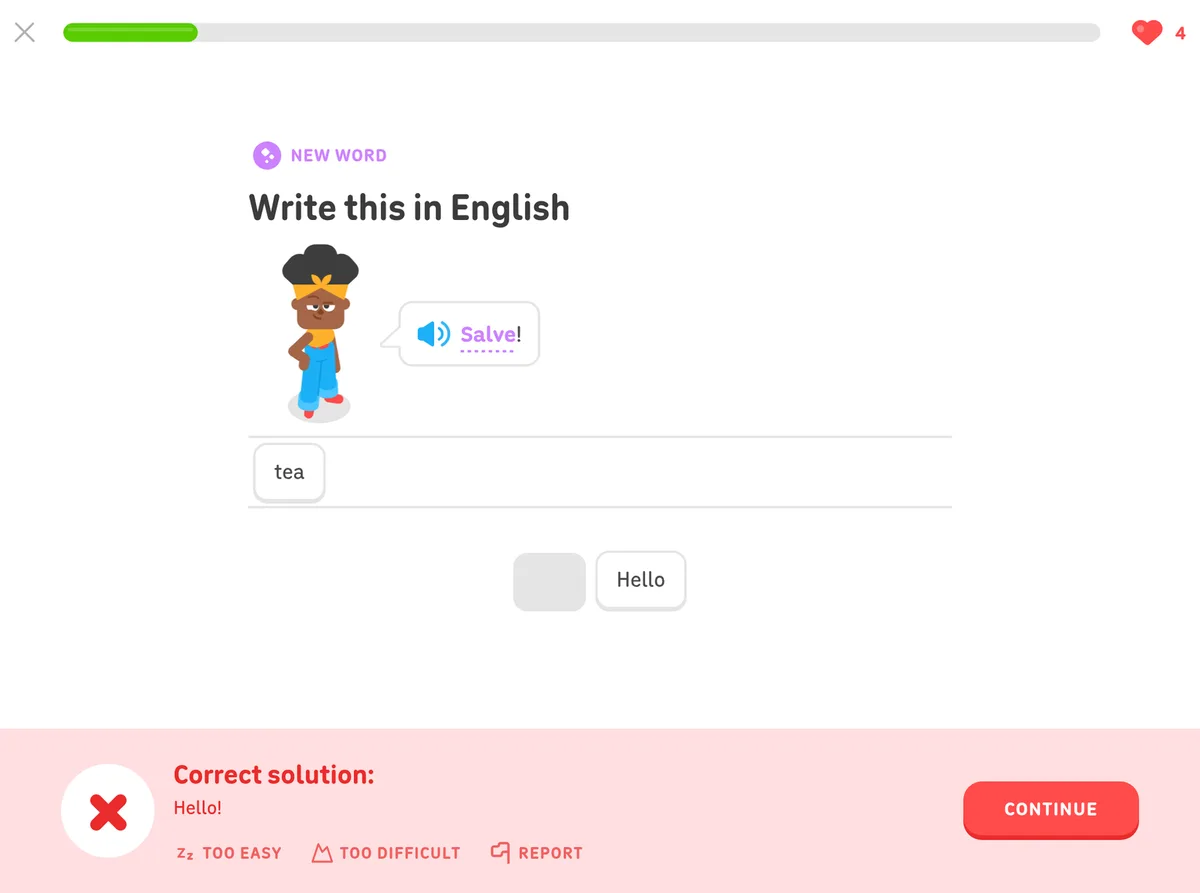
Mistakes in Stories cost hearts too. On the free plan, hearts come back one at a time ("Next heart in 5 hours"), or you can refill them for 350 gems or earn them back in practice. When we ran out in the middle of a lesson, Duolingo said "You ran out of hearts. Have a free refill on us to keep going!" and gave us back all five hearts.
After our first lesson came the reward screens: "Lesson Complete!", your Duolingo Italian Score, the streak, a streak goal, daily quests, gems and, for a guest, "Time to create a profile!". In Duolingo's German course on my iPhone, I spent about 54 seconds tapping through screens like these after one lesson. It felt very gamified, and I was craving more actual learning. If streaks and gems get you to open the app every day, they're doing their job. If they don't, they're the part you'll tap past.
How does Duolingo correct your Italian mistakes?
It shows you the correct sentence, but in our lessons it never said why an answer was wrong, and it let some grammar mistakes through as typos.
The article mistake from the introduction wasn't a one-off. Duolingo also accepted "Una tè o una cappuccino?", with two wrong articles, as "You have a typo.", and it did the same when we typed una in a fill-in-the-blank for "Salve, ___ tè." None of these cost a heart. When we typed Il instead of Un, Duolingo marked it wrong and showed "Correct solution: Un caffè, per favore.", with no note on which article to use or why.
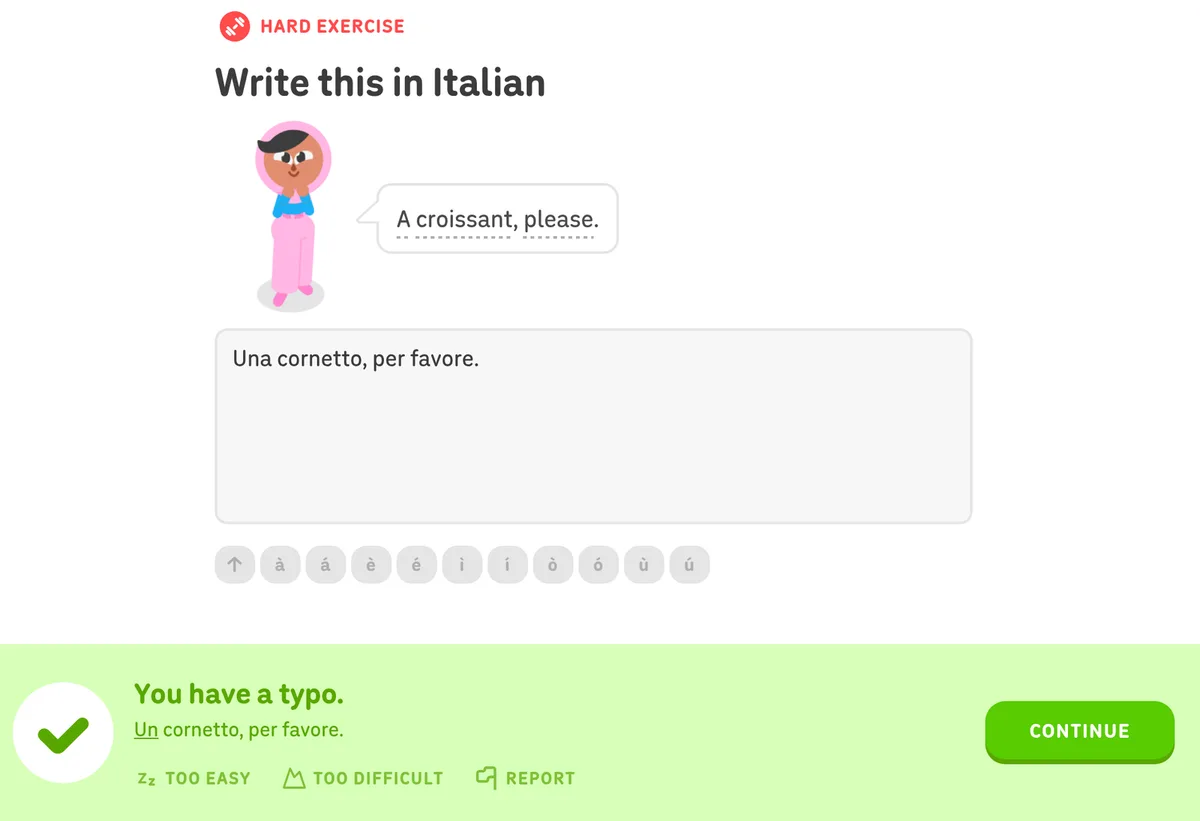
The pattern looked like a spelling check. One wrong letter in a word passed as a typo (Salvee, Arivederci), and two in the same word did not (Arivederchi). Una is one letter away from un, so a gender mistake can pass as a typo.
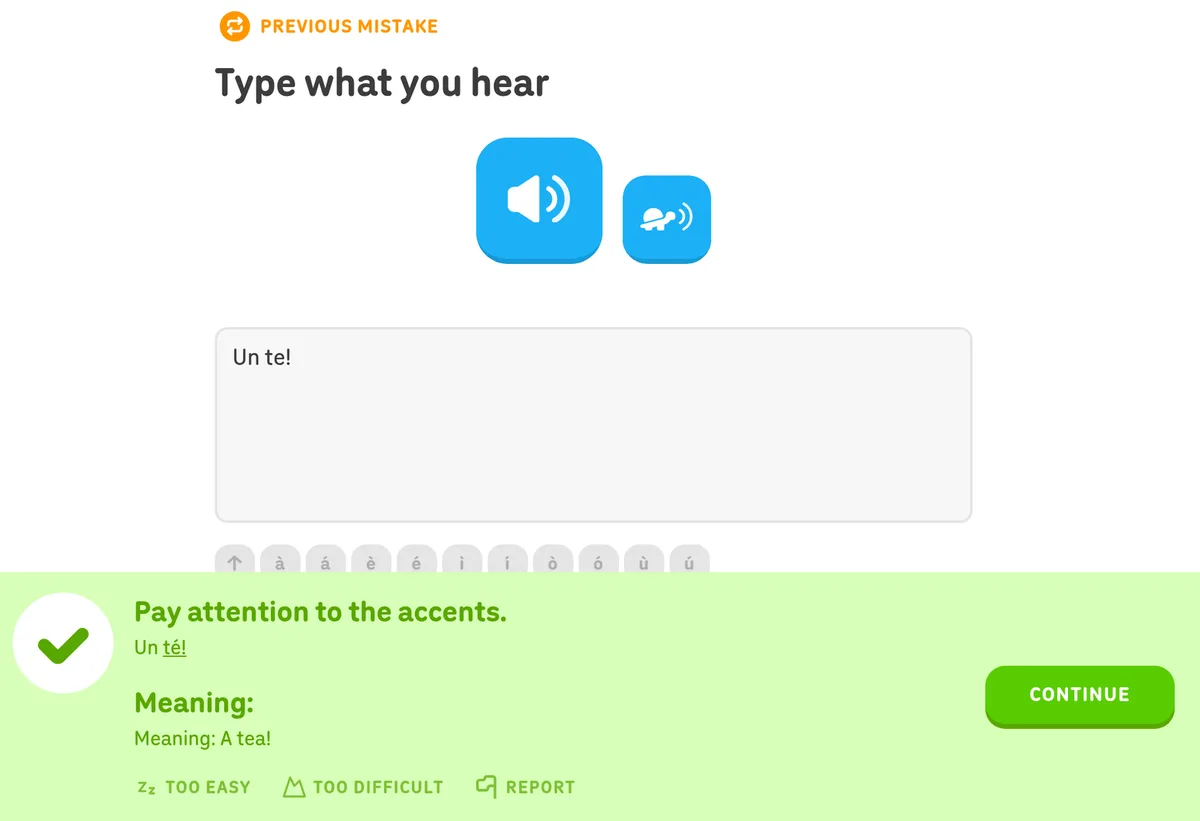
Accents get the same soft treatment. We typed "Un te!" without the accent, and Duolingo marked it right with "Pay attention to the accents." Its own correction spelled the word té, with an acute accent, while the rest of the lesson spelled it tè. Take the warning seriously anyway: in Italian, an accent can change the word, as with e ("and") and è ("is").
Duolingo does have a tool for the why. Explain My Answer became free in January 2026, and Duolingo says it is available for most learners in its Italian course. It explains the grammar or vocabulary behind an answer. None of the corrections in our Italian guest lessons on the web came with an explanation, though.
When I opened Explain My Answer in Duolingo's German course on my iPhone, on Kaffee in Kaffee mit Milch, bitte, it told me that Kaffee means "coffee" and is "a common drink made from roasted coffee beans." It felt like AI blindly explaining something obvious.
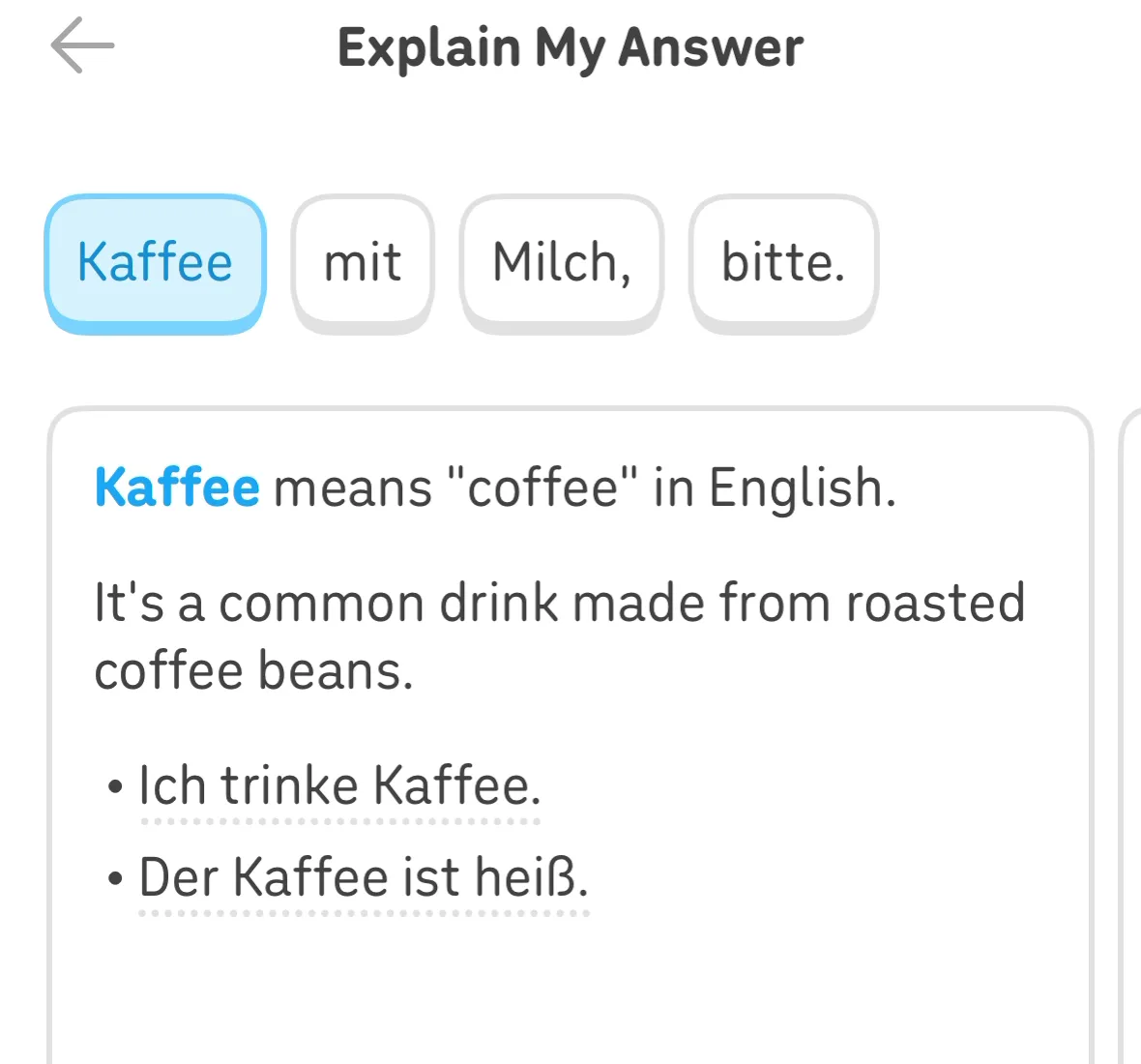
So treat a green "You have a typo." as a prompt to compare your answer with Duolingo's word by word. In our lessons, that's where the gender mistakes hid. If you want the rule, check the unit's Guidebook, which Duolingo says has grammar tips for the unit.
Does Duolingo teach you to speak Italian?
A little, and later than its onboarding suggests. When we started the course, Duolingo's "Here's what you can achieve!" screen promised "Converse with confidence: Stress-free speaking and listening exercises". Yet our first session's lesson had no speaking exercise, and in the second session there was none in the first three lessons, the level recap or the Story either. The first "Speak this sentence" exercise, Salve, un tè., came in the first lesson of the next part of the path, with a "CLICK TO SPEAK" button.
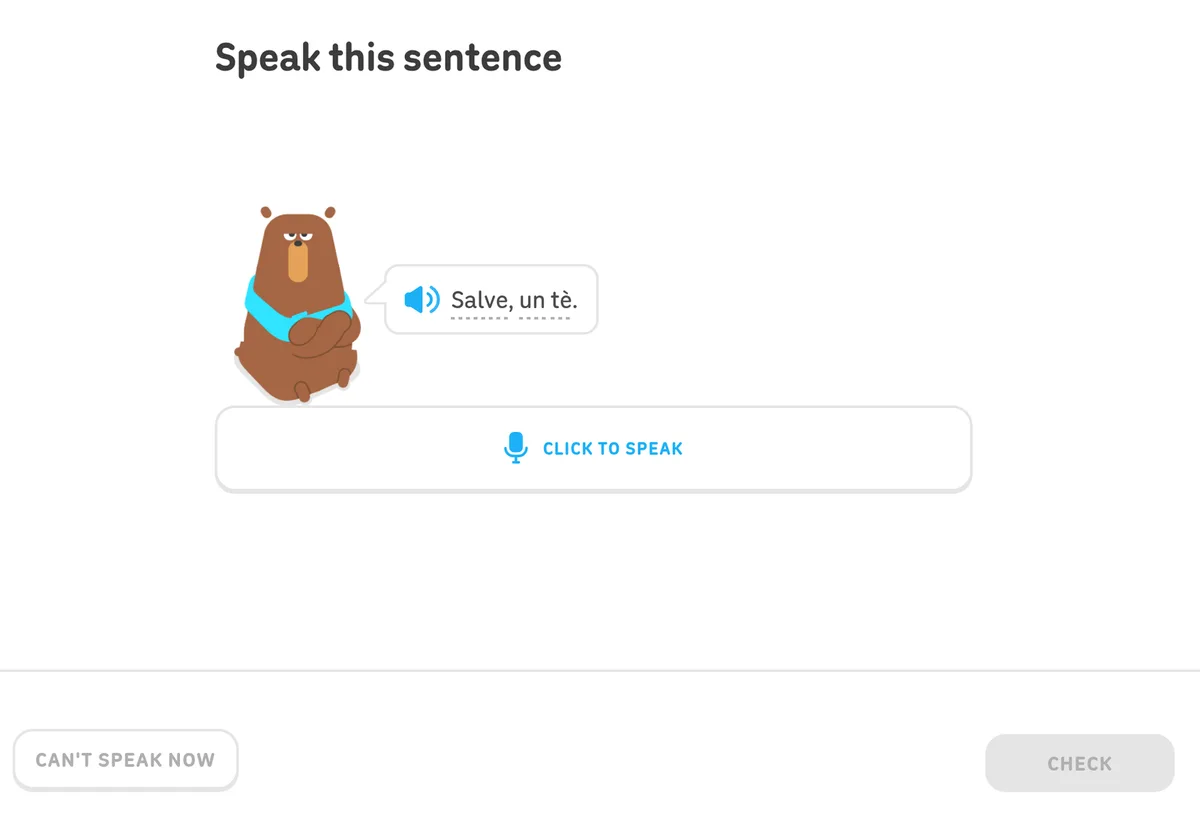
It is also easy to skip. We pressed "CAN'T SPEAK NOW", and Duolingo said "Microphone is off. They will be back in 15 minutes." It swapped the next two speaking items in that lesson for "Write this in English", and no heart was lost.
When you do speak, the feedback is simple. In Duolingo's German course on my iPhone, I did a Speak session in the Practice tab: ten short lines to repeat after Duolingo's characters. After each line, a green banner said "You said it in German!" with the English translation, with no score and nothing about which sound to work on. It made me listen and repeat, which for me is not a conversation. Our Duolingo for German review has a screenshot.
For pronunciation feedback, Copycat Cafe goes further: you say each line aloud and get a 0–100 pronunciation score on every word, with a tip on what to change in the words that need work.
Copycat Cafe also does more to get you from hearing a line to saying it. Our Italian lesson "At the bar" opens with the café order Duolingo's first unit builds toward: "Buongiorno, vorrei un cappuccino e un cornetto." You play the conversation at normal or slow speed, slow that line down and rebuild it by ear, then say it yourself. Duolingo first asked us to say a three-word phrase after four lessons; in Copycat Cafe, saying whole lines aloud is the main step of every lesson.
Super adds more open speaking. Video Call lets you talk in real time with Lily, an AI character, in the iOS and Android apps, and Italian is one of its courses. It isn't on the website. Duolingo says new Super subscribers already get unlimited Video Call and every Super subscriber will have it by the end of 2026.
How does Duolingo's Italian audio sound?
Clear and correct, but the voices sounded synthesized. We heard a dozen stylized character voices speaking standard Italian. The double consonants in cappuccino, cornetto and arrivederci and the open è in tè and caffè sounded right to us. Phrases said in one go sounded fairly natural. Slow beginner lines, said almost word by word, sounded less so, and in the first lesson a couple of clips had an odd gap between words ("Un … caffè").
The Story "Coffee or Tea" works the same way: an American English narrator and two Italian voices that also sounded synthesized to us, with about a quarter of the audio in English narration. It's a gentle first step into a longer exchange, with yes-or-no questions to check you followed it.
Is Super Duolingo worth it for Italian?
Only if the free plan's limits get in your way or you want Video Call. You get the same Italian course either way.
On Duolingo's US Super page, Super showed "4 weeks free. Then from $9.99 USD/mo." Our French-course test the same day recorded $119.99 a year or $16.99 month to month. Super Family started at $11.99 a month for up to six accounts. The trial was called four weeks, but the page's timeline charges you on Day 30, and you can cancel up to 24 hours before.
What you mainly get is unlimited hearts, no ads and, as it rolls out, Video Call. Duolingo Max, the higher tier, is ending: Duolingo's Q3 2026 shareholder letter says it stops selling new Max subscriptions in November 2026, so Super is the plan to compare. Our Duolingo Max guide explains the change, and our Duolingo Black Friday guide tracks discounts.
Pay for Super if you hit zero hearts often or want to practise talking on your phone. Don't pay for it to get pronunciation feedback: I tested Duolingo's German course with a Super account, and its Speak practice still gave no score.
What should you add to Duolingo to speak Italian?
Practice that makes you say whole sentences and tells you how they sounded. Keep Duolingo for vocabulary and the daily habit, and add these three:
- Say every answer aloud, including in exercises that don't ask you to.
- Check articles and accents yourself. When Duolingo says "You have a typo.", compare word by word and check the Guidebook's grammar tips. Our Italian IPA guide shows how the open è, double consonants and other Italian sounds are written.
- Get speaking practice with feedback, from a speaking app, a tutor or a class. Our guide to online Italian courses compares live classes and self-paced courses.
For a full routine, see our practical plan for learning Italian. To compare apps, see our guide to the best apps to learn Italian and our Duolingo alternatives.
If speaking is your gap, Copycat Cafe is built for it: you hear an everyday Italian conversation, copy each line with a 0–100 score on every word, then use it with Copy, your AI conversation partner. It costs $14.50 a month billed as $174 a year, or $29 a month, with a 7-day free trial and a 30-day money-back guarantee on your first payment.
The verdict
Duolingo is a good free way to start Italian and keep at it every day, and its course now goes as far as B2. Just read its green screens carefully: "You have a typo." can hide a wrong article, and finishing a lesson isn't the same as saying a sentence out loud. Use it for the habit, check its corrections yourself, and add speaking practice early rather than at the end of the path.
For more on the app itself, see our Duolingo review of the French course and Does Duolingo Work?
Frequently asked questions
Is Duolingo good for learning Italian?
Yes, for starting. The core Italian course is free, teaches content through B2 and makes a daily habit easy. In our lessons it explained no mistakes, let some wrong articles pass as typos and asked for speaking only after several lessons, so add grammar help and speaking practice beside it.
What level does Duolingo Italian reach?
Duolingo announced in April 2026 that most Italian learners can now study content through B2 on the CEFR scale, a Duolingo Score of 129. Before that, most learners could only complete content up to A2. B2 describes the material; speaking at that level takes practice beyond the app.
Does Duolingo Italian have speaking exercises?
Yes. "Speak this sentence" exercises appear on the web and in the apps, but in our test the first one came after four lessons, and you can switch them off for 15 minutes. In my test of the German course, Speak practice confirmed each line without a pronunciation score. Super adds Video Call on iOS and Android as it rolls out.
Is Duolingo Italian free?
The core course is free. The free plan uses hearts: each mistake costs one, and they come back over time or with gems. Super adds unlimited hearts, no ads and, as it rolls out, Video Call. On November 13, 2026, Super was advertised from $9.99 a month; US web prices were $119.99 a year or $16.99 a month.
Is Super Duolingo worth it for Italian?
It's worth it if you often run out of hearts or want to practise talking with Video Call on your phone. It is not worth it for pronunciation feedback, because in my German-course test its Speak practice gave no score. Duolingo stops selling its higher Max tier in November 2026, so Super is the plan to compare.
Can you become fluent in Italian with Duolingo?
Duolingo can build vocabulary, listening and a daily habit, and its course reaches B2 material. Fluency also takes forming your own sentences and speaking with less support, so most learners need conversation practice, pronunciation feedback and a grammar resource beside the app.