
Disclosure: This post contains affiliate links. If you buy through them, we may earn a commission at no extra cost to you.
Partway through the free Foundation Spanish lesson, Michel Thomas asks his male student how to say "it is for me". The student answers "Es para me", using me where Spanish needs mí. Michel Thomas gives him "Para mí", the student tries again, and the teacher adds: "Mí, spelled M-I." Seconds later the student gets the whole sentence right: "No es para usted, es para mí."
That is the Michel Thomas Method in one exchange. Every course has a free lesson, so you can hear it before you pay, and we listened to all five Spanish ones to find out how the lessons work, how much Spanish you actually hear, which accent it teaches and who it suits.
How we tested
On November 14, 2026, our team created a free account on the Michel Thomas Spanish site, with no payment details, and played all five free Spanish lessons in its web player: Foundation, Foundation Plus, Intermediate, Spanish Vocabulary and Fluent Spanish Conversation, 83 minutes of audio in all. We transcribed every track, estimated how much of it is English, timed the pauses, listened closely to the voices and accents, and noted how the teachers corrected the students. The day before, we played the short free excerpt on the Spanish page and the Apple Books previews of Foundation and Intermediate. We also checked prices, the refund rule, and the app's store listings and ratings.
What is a Michel Thomas Spanish lesson like?
It's a recorded class with two beginners, and you're the third student. The teacher asks "how do you say…", you press pause and answer out loud, then you hear one of the students answer and the teacher confirm it. In his opening, Michel Thomas calls the two students "a teaching device in order to create a learning situation for three", and the publisher says they "are not reading from scripts".
The free Foundation lesson opens with Michel Thomas's introduction and ground rules, about a third of the lesson with almost no Spanish. He tells you not to try to remember anything, because "the responsibility for your remembering is in the teaching and not with you". Then he starts with words you already know: English words ending in -ible and -able are nearly the same in Spanish, so possible becomes posible. From there the students build es posible, no es para usted, ¿por qué?, así and lo siento, pero. By the end of the 20-minute lesson, they're saying "Lo siento, pero no es aceptable para mí así" (I'm sorry, but it isn't acceptable for me that way).

The recordings don't wait for you. Unless you press pause, a student answers before you've worked it out, so keep a hand on the player, which is awkward in the car. In the Foundation lesson, the students usually answered within a second or two, and no silence we measured lasted as long as 4 seconds.
Michel Thomas was born Moniek Kroskof in Poland in 1914, according to the publisher's FAQ. He joined the French Resistance during the war, and in 1947 he moved to Los Angeles and set up the Michel Thomas Language Centers, teaching for more than fifty years in New York, Beverly Hills and London. He teaches the Foundation, Foundation Plus and Intermediate courses himself; Vocabulary and Fluent Spanish Conversation were made later by other teachers.
How much of Michel Thomas Spanish is in English?
Most of it, in the first three courses. Michel Thomas explains everything in English, and the Spanish comes in short phrases from the students, so you'll hear far more English than Spanish. In our rough estimate from the transcripts, English took about 66% to 86% of the speaking time in the teaching tracks of the Foundation, Foundation Plus and Intermediate lessons; the transcription spelled some Spanish as English, so the true share may be a little lower.
Spanish Vocabulary is much the same: a long introduction in English, then a teaching track that was about 82% English. Fluent Spanish Conversation is where the Spanish arrives. Its dialogue and the comprehension check after it are almost all Spanish; the dialogue sounded scripted to us but fluent, and we measured it at about 146 words a minute. The class tracks after it go back to mostly English, so across that free lesson, Spanish took roughly half the speaking time (here the transcription turned some English questions into Spanish, so if anything that share is a little high).
How does Michel Thomas correct mistakes?
Mostly by making the student say it again, shorter and better, and sometimes by explaining the rule. In the free lessons we heard, he corrected slips straight away and rarely explained for long, as with the "para mí" slip at the top of this review. A few more moments from the recordings:
- A weak ending. In Foundation, the male student said "Es posible" without a clear final syllable. "Yes, but I want to hear the ble," said Michel Thomas, and had him repeat it until it was clear.
- The wrong word. Later in Foundation, asked for "Why isn't it acceptable for you that way?", the female student started "¿Por qué no es posible…". Michel Thomas said just "Acceptable", then fed her the sentence piece by piece until she had built "¿Por qué no es aceptable para usted así?"
- A rule. In Intermediate, the female student said "Lo entendo". This time he explained: "Usually, if you push down on an E… the E will cave in and split into IE." She answered "Lo entiendo".
- A missing word. Soon after, she said "Prepara para mí" for "He is preparing it for me". "Say it again. He is preparing it," he said, and she got to "Lo prepara para mí".
Those are the students' mistakes, though. Michel Thomas can't hear yours. The course is audio only and nothing checks your answers, so your only check is comparing your answer with the student's. If you said "para me" like the student did, nothing would tell you. For feedback on your own speaking, Copycat Cafe goes further: you hear an everyday conversation in Latin American or Spain Spanish at normal or slow speed, say each line aloud and get a 0–100 pronunciation score on every word, with a tip on what to change.
Which Spanish accent does Michel Thomas teach?
It depends on the course. The publisher's Spanish page says the course is "a simple, universal form of Spanish" that "does stick to the Spanish usage of vosotros for the plural of 'you' and uses Peninsular Spanish pronunciation". What we heard in Michel Thomas's own lessons leaned the other way.
At the start of Foundation, he explains that in "parts of Spain" the c before e or i and the z sound like the English th, so Barcelona becomes "Barthelona", and that "everywhere else" they sound like an s. When he taught, pronunciación and diferencia sounded to us like the s version. In Intermediate, he taught "¿Por qué no me entienden?" for "why don't you all understand me", the ustedes form Latin America uses for any group, rather than the vosotros form people use among friends in Spain. Michel Thomas wasn't a native Spanish speaker: his English and Spanish sounded Central European to us, clear but not native, and both students sounded British to us.
The later courses bring in native voices. In Spanish Vocabulary, Rose Lee Hayden introduces two native speakers, "one with a Spanish accent", the other "with a Latin American one", and they say the model answers. In the free lesson, both said "Gracias a estas transformaciones, el español es más comprensible ahora", and the th and s versions were easy to hear side by side. Rose Lee Hayden says herself that she isn't a native speaker and learned her Spanish in Latin America; she sounded American to us. In Fluent Spanish Conversation, the narrator and the two people in the dialogue sounded like speakers from Spain to us, with the th sound and vosotros forms, and the free lesson ends with a track on "the vosotros verb forms". If you know which Spanish you want, our guide to Latin American vs Spain Spanish explains how much the difference matters.
What does each course cover, and how much does it cost?
There are five Spanish courses, meant to be taken in order, and you buy each one once rather than subscribing. These are the prices on the publisher's Spanish page; the lengths are the publisher's, and the last column is what we measured for each free lesson.
| Course | Teacher | Length and level | Price (UK / US) | Free lesson we played |
|---|---|---|---|---|
| Foundation | Michel Thomas, with two students | 9 hours, beginner | £80 / $100 | 20 min |
| Foundation Plus | Michel Thomas, one-to-one with you | 2 hours, advanced beginner | £40 / $50 | 21 min |
| Intermediate | Michel Thomas, with two students | 6 hours, intermediate | £70 / $90 | 9 min |
| Spanish Vocabulary | Rose Lee Hayden, with two native speakers | 6 hours, intermediate | £60 / $75 | 15 min |
| Fluent Spanish Conversation | Virginia Catmur and Jennifer Stanley-Smith | 6 hours, advanced intermediate | £60 / $75 | 18 min |
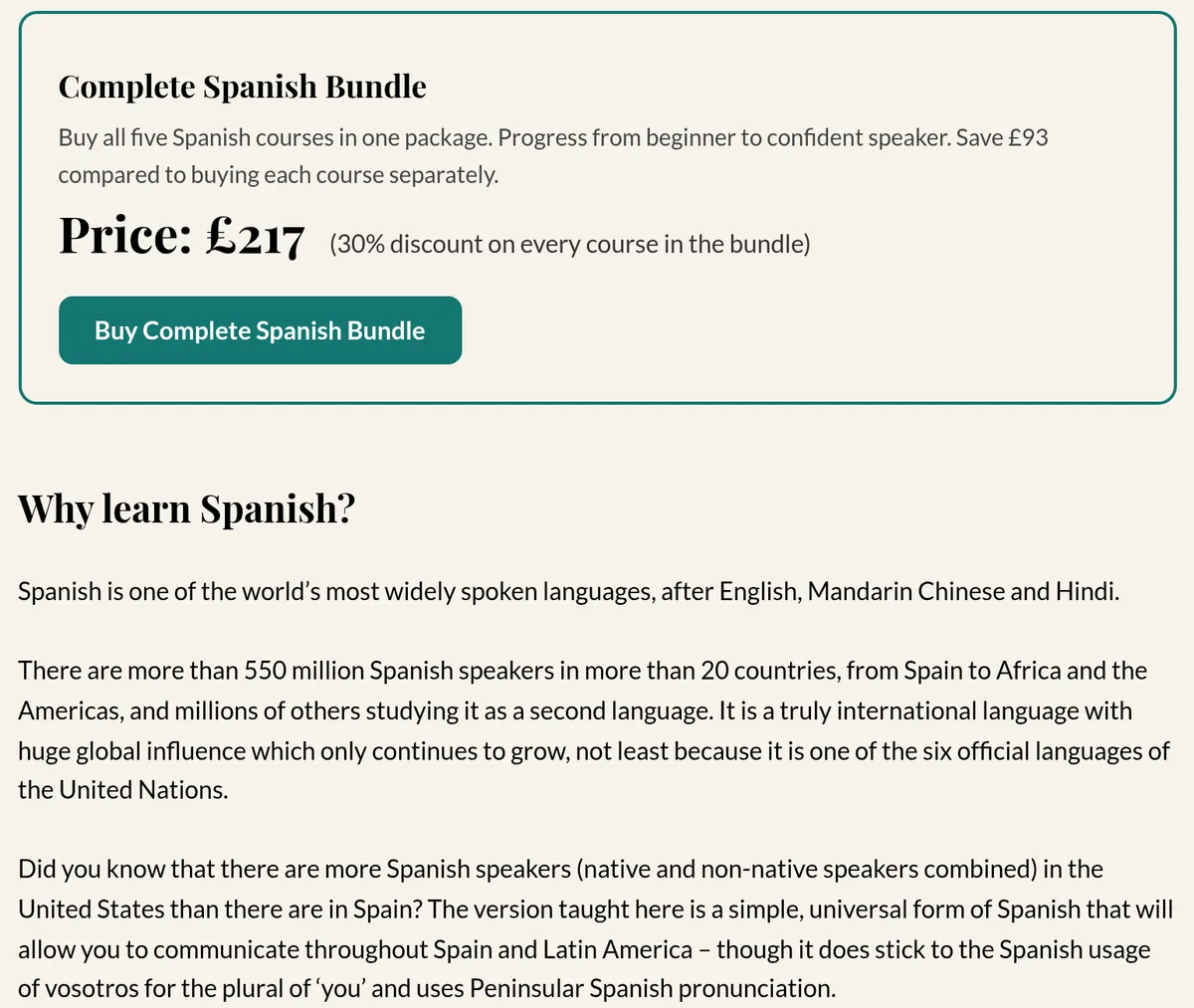
The Complete Spanish Bundle has all five courses for £217 or $273, which the page says saves £93 compared with buying them one by one. For most beginners, the real decision is Foundation, which works out at roughly £9 or $11 an hour of teaching. The same Foundation audio is also sold as an audiobook, for £60.99 or $79.99 on Apple Books when we checked, but it's a separate product that doesn't come with the web player or the publisher's app. The publisher's FAQ says Foundation also includes two hours of review audio with only the phrases.
Each free lesson is the start of its course, and the later ones assume you've done the earlier ones. Foundation Plus, after a short narrator introduction, has Michel Thomas greet "all of you who have been waiting for me to come back" and moves quickly to object pronouns (lo quiero), the future (no lo haré), tengo ganas de and me parece. Intermediate begins "You all wanted me to come and continue the course which I gave you" and reviews the present tense quickly before the -ando and -iendo forms. Spanish Vocabulary says it "builds directly upon what you've accomplished having completed Michel Thomas's Spanish courses", and its first examples are his. Fluent Spanish Conversation starts with a list of key words, then a conversation with two friends from work about reality TV, questions about it in Spanish, and a class with two students on everyday phrases such as "para mí" and "¿en serio?".
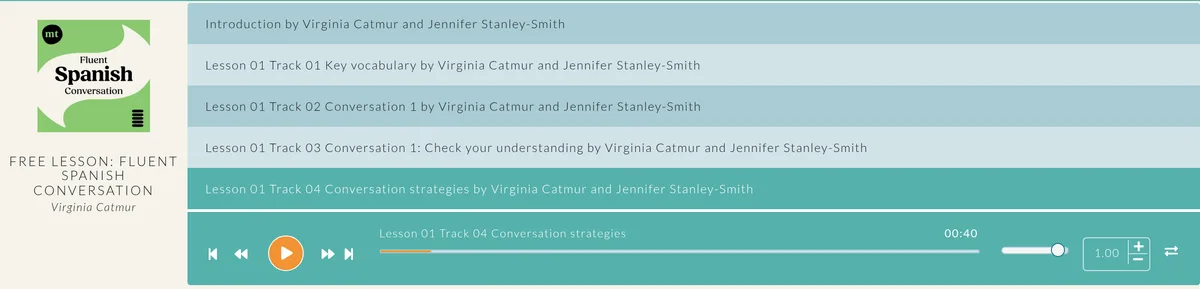
Two things to know before you pick a free lesson. On the day we tested, the "Free lesson" button for Fluent Spanish Conversation on the Spanish page added the French conversation lesson to our library instead; we reached the Spanish one through the library's own free-lesson link for that course. And the Spanish page credits that course to Rose Lee Hayden, while the library and the audio files credit Virginia Catmur and Jennifer Stanley-Smith.
The refund rule is strict. The pricing page offers a 14-day money-back guarantee, but only if you contact them "before you start downloading or streaming the course". Once you've pressed play, you can't get your money back, so the free lesson is your trial.
What's in the Michel Thomas app?
The free Michel Thomas Language Library app, on the App Store and Google Play, is a player for the courses you own. You buy on the website, sign in to the app with the same account and download your courses for offline listening; the pricing page says purchases sync between the app and the web player. The web player we used has play and pause, 30-second skips and a speed setting, but no exercises or transcripts.
When we checked on November 14, 2026, the app had 4.2 stars from 157 ratings on the US App Store, 4.1 from 162 in the UK, and 2.6 stars from 187 reviews on Google Play, where it lists more than 50,000 downloads.
What do learners say about Michel Thomas?
They like the teaching and complain about the app. We read all 85 written reviews in the US and UK App Store review feeds, from 2018 to November 2026. The praise is for the method: one reviewer called it the "best kept secret in language learning", a few said they had finished a course, and one went from no Spanish to holding "reasonable conversations" on holiday in Spain. The complaints are mostly about the app: a pause button that doesn't respond from the lock screen, crashes, downloads that won't play, and courses that disappeared after the app was replaced. "Great content, terrible app," one review title says. Price comes up too, in titles such as "Ridiculously expensive".
Recent reviews lean negative. Of the 15 written since January 2024, 11 gave one star, mostly about the app, signing up or lost purchases rather than the lessons. Our web player worked without trouble, but if you plan to listen on your phone, try the free lesson in the app before you buy.
Michel Thomas vs Language Transfer vs Pimsleur
If you're choosing an audio course for Spanish, Language Transfer and Pimsleur are the two we'd compare it with. They differ from Michel Thomas in price, in who you hear and in who controls the pauses.
| Feature | Michel Thomas | Language Transfer | Pimsleur |
|---|---|---|---|
| Price | £80 / $100 for Foundation; £217 / $273 for all five courses | Free | $20.95 a month or $164.95 a year for All Access |
| Who you hear | Michel Thomas and two learners; native speakers only in the later courses | A teacher and one learner, no native speaker in the tracks we played | An English narrator and Spanish voices that sounded native to us |
| How you answer | Press pause before the students answer | Press pause before the student answers | The lesson leaves a gap for you |
| Explanations | Short rules in English as you build sentences | Detailed explanations of why | Little; the narrator walks you through phrases to say back |
| Spanish variety | Michel Thomas's own Spanish sounded closer to Latin American to us; Fluent Conversation's speakers sounded like speakers from Spain | One Spanish course | Separate Latin American and Castilian courses |
| Checks your speaking | No | No | Voice Coach in Premium and All Access; AI Conversation Coach for Latin American Spanish in All Access |
Michel Thomas and Language Transfer feel alike: a teacher talks a learner through building sentences, and you pause to answer first. Language Transfer is free and explains more, and its Complete Spanish runs about 14½ hours. Michel Thomas corrects more briskly, usually by having the student say it again, and you hear two students instead of one. Pimsleur is the one to choose for native voices and a lesson that paces your answers for you. Our Language Transfer review and Pimsleur Spanish review cover each in detail.
Is Michel Thomas Spanish worth it?
Yes, if you want a teacher to walk you through how Spanish fits together and you're happy to pay once and pause often. The free lessons do what the publisher describes: within 20 minutes, two complete beginners are building real sentences, and the mistakes we heard were fixed on the spot. It suits you less if you want to hear a lot of native Spanish early on, listen hands-free, or know how your own Spanish sounds.
Pros
- A free lesson of 9 to 21 minutes for every course, with no payment details
- Real beginners whose mistakes are corrected as you listen
- You build full sentences from the first lesson
- Buy once, no subscription, and download for offline listening
Cons
- Mostly English in the first three courses
- Michel Thomas wasn't a native Spanish speaker, and his Spanish sounded closer to Latin American to us than the publisher's "Peninsular" description
- You have to pause the audio yourself
- No refund once you start streaming or downloading
- Nothing checks your answers or your pronunciation
- App reviews report bugs and lost purchases
Start with the free Foundation lesson. If the method clicks, Foundation is the one course to buy first; the others can wait until you've finished it. For where an audio course fits among apps, podcasts and conversation practice, see our guides to the best way to learn Spanish and the best Spanish learning apps.
If you want feedback on your own speaking, Copycat Cafe is the one we'd add. On top of the word-by-word scores, you use the same Spanish in a conversation with Copy, your AI conversation partner. It costs $14.50 a month billed as $174 a year, or $29 a month, with a 7-day free trial and a 30-day money-back guarantee on your first payment.
Frequently asked questions
Is Michel Thomas Spanish free?
No, but each course has a free lesson. You create a free account with no payment details and play the lesson in the web player. Foundation costs £80 or $100, and all five Spanish courses cost £217 or $273.
Is Michel Thomas good for learning Spanish?
Yes, for understanding how Spanish sentences are built: you learn alongside two beginners and hear their mistakes corrected. It's mostly English, Michel Thomas wasn't a native Spanish speaker, and nothing checks your own answers or pronunciation.
Does Michel Thomas teach Latin American or Spain Spanish?
The publisher says it uses vosotros and Peninsular pronunciation. In Michel Thomas's own lessons, his Spanish sounded closer to Latin American to us, with an s sound in words such as pronunciación and ustedes for "you all". The speakers in Fluent Spanish Conversation sounded like they were from Spain to us.
How long is Michel Thomas Foundation Spanish?
The publisher lists Foundation Spanish at 9 hours, and its FAQ adds two hours of review audio. The free first lesson is 20 minutes long.
Which Michel Thomas Spanish course should I start with?
Start with Foundation if you're a beginner. The courses are meant to be taken in order: Foundation, Foundation Plus, Intermediate, Vocabulary and Fluent Conversation, and each later free lesson assumes you know the courses before it.
Can I get a refund on a Michel Thomas course?
Only before you start. The publisher offers a 14-day money-back guarantee if you contact them before you start downloading or streaming the course, so use the free lesson to decide.
Is Michel Thomas better than Pimsleur?
It depends on what you want. Michel Thomas explains how Spanish works and lets you hear learners make mistakes, and you buy it once. Pimsleur uses native voices, leaves pauses for your answers and is mainly sold as a subscription.