

Disclosure: This article contains affiliate links. If you sign up through them, we may earn a commission at no extra cost to you.
If you studied French at school, you may remember learning the conjugations of “avoir” and “être” by heart. How can you turn that knowledge into French you can use?
Grammar explanations can help, but memorising rules is not the only route to accurate French. Research does not support a universal claim that explicit instruction is useless or counterproductive: a meta-analysis of 41 studies found larger effects for explicit than implicit instruction on the English grammar features it examined, including spontaneous use.
A practical approach is to combine short explanations when they clarify a pattern with plenty of meaningful listening, reading, retrieval and speaking practice.
Here is one way to combine them.
Why grammar rules alone are not enough
If rule memorisation puts you off
If you find long grammar exercises boring, try a short explanation followed by useful example sentences. The aim is to make the pattern something you can use, not simply something you can recite.
The Kwiziq lessons we opened work this way: a short explanation with audio examples, then a quick quiz on the pattern.
Practise exceptions alongside the pattern
When a rule has exceptions, collect examples of both rather than trying to work everything out during a conversation.
Knowing the rules doesn’t mean you’ll be able to apply them
I regularly speak with French learners who know grammar rules better than I do.
They proudly tell me that French adjectives have no secrets for them anymore and that they learned how to conjugate the present tense by heart.
And then they make mistakes as soon as they speak.
That’s because knowing the rules doesn’t mean you’ll know how to apply them.
Fluent speech usually cannot depend on consciously reciting a rule before every sentence. Learners still differ, though: some find a concise explanation useful before practising until the pattern becomes easier to use.
Learn rules in context, not in isolation
Copycat Cafe recommends meeting grammar inside useful language because context connects a form to meaning and use. Use a short explanation when it helps, then practise the form in sentences you understand.
When should you study grammar rules?
I spent most of my life hating German grammar. I hated that something as simple as knowing whether a word is feminine or masculine seemed so hard.
Then I learned that German nouns formed with the suffix -tät are feminine, as in die Qualität. Dartmouth’s grammar reference gives this pattern and examples.
That gave me a useful clue for that group of nouns, rather than a solution for every German noun.
Likewise, some French noun endings can help you predict gender. Learn examples and exceptions alongside the pattern.
Some rules are more useful than others. Prioritise high-frequency patterns that solve a problem you keep encountering, then practise them in sentences you understand and might actually say.
How to learn grammar naturally
Regularly hearing and reading French you can partly understand gives you repeated examples of how patterns connect to meaning. That exposure is useful, but adults do not have to copy first-language acquisition or avoid explanations.
Spaced review can help you retain example sentences. A meta-analysis of 48 second-language experiments found an overall benefit for spaced practice, with results varying by learning target, practice type and retention interval. An SRS app such as Anki can schedule reviews, but it does not by itself prove that memorised sentences will transfer to spontaneous conversation.
Learn more in The ultimate guide to learning vocabulary.
Step 1: find example sentences
Let’s say you want to practise the French present tense.
The first step is to find lots of example sentences using the present tense. These sentences should be:
- Useful (can you imagine saying that one day?)
- Not too long
- Correct (check a reliable teaching source, dictionary example, or qualified speaker)
Step 2: create flashcards with spaced-repetition software
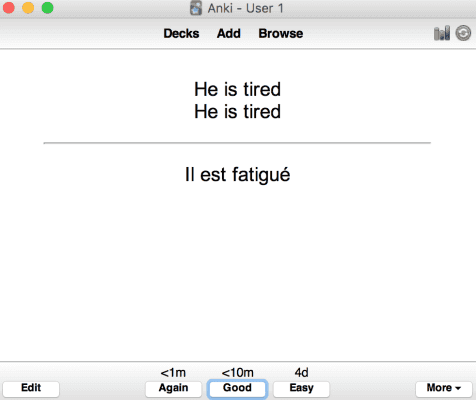
Once you have your sentences, open Anki and add them with their translation.
If you have audio to go with the sentence, include it for listening practice.
Step 3: review regularly, then use the pattern
Review your sentences on the schedule Anki suggests, and also try the pattern in speaking or writing. Spaced review supports retention; whether you can use the grammar spontaneously still depends on the material, practice and opportunities to produce it.
Oh and I strongly encourage you to use Anki to learn vocabulary too. Check out the Ultimate Guide to Learning Vocabulary to learn how to do that.
Over to you
Have you ever tried to learn French grammar in context? How did it go?