
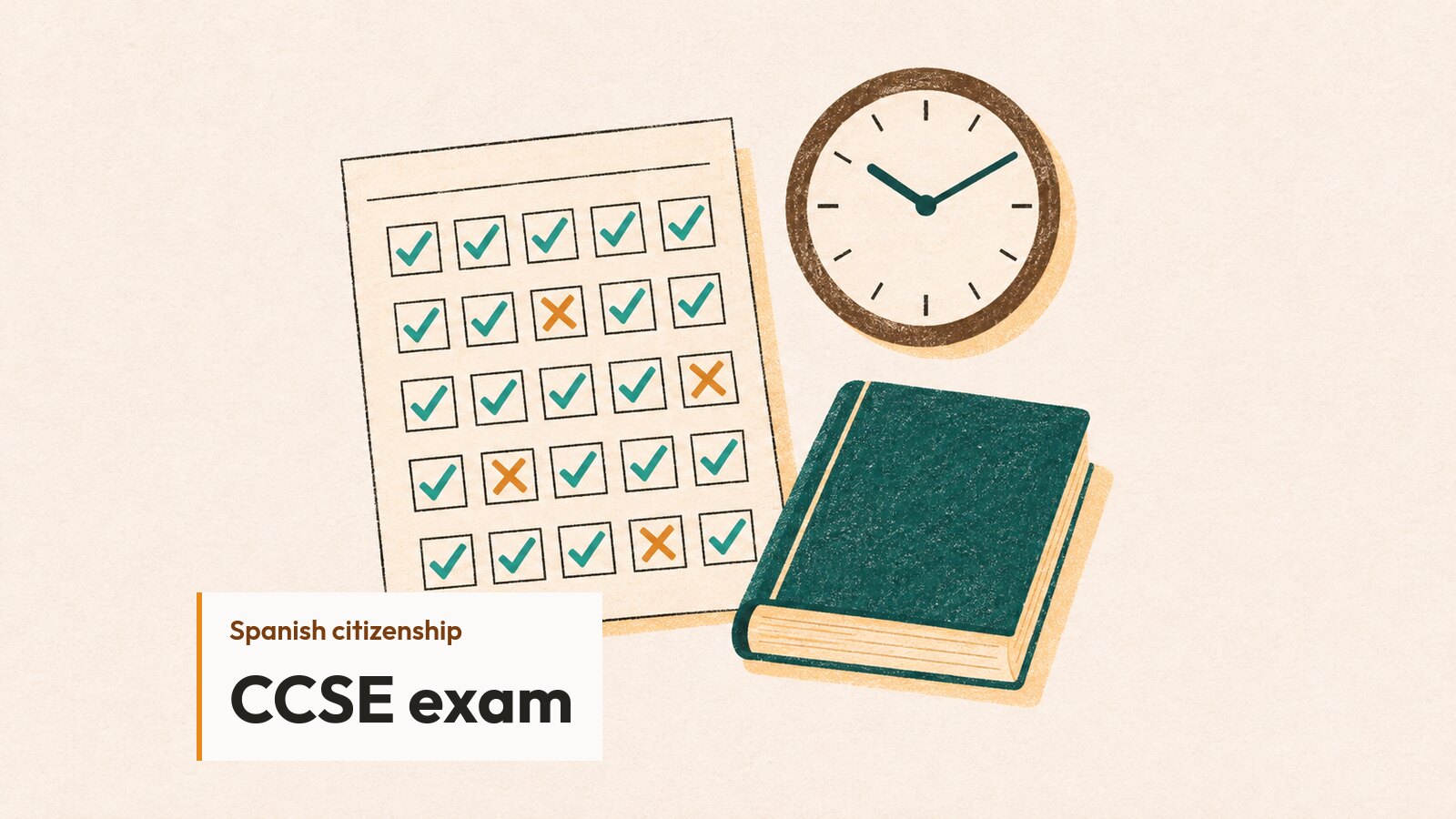
If you're applying for Spanish nationality by residence, the CCSE is the test almost nobody gets to skip. Even if you're from Mexico or Argentina and never have to prove your Spanish, you still have to show what you know about Spain's Constitution, institutions, geography and everyday life.
It's one of the more forgiving tests you'll take. Every question it can ask is published in advance, with the answers. Here's how it works, what it costs and how to study for it.
Who has to take the CCSE?
Every adult applying for Spanish nationality by residence, unless they're exempt. Under-18s and people whose legal capacity has been modified by a court are exempt. People who finished compulsory secondary school (ESO) in Spain can ask the Justice Ministry to excuse them. The CCSE also applies to nationals of Spanish-speaking countries, who are exempt only from the DELE language test.
Our guide to the Spanish citizenship language requirement explains every exemption and how the CCSE fits with the DELE A2. Anyone aged 16 or over can register, whatever their nationality.
What's on the CCSE?
According to the Instituto Cervantes, the test has 25 questions in five tasks. Each question has three answer choices or is true or false, and only one answer is right. The split follows Royal Decree 1004/2015, which puts 60% of the questions on the Constitution and how Spain is organised, and 40% on its culture, history and society:
| Task in the 2026 manual | Questions in the manual |
|---|---|
| 1. Government, legislation and civic participation | 120 |
| 2. Fundamental rights and duties | 36 |
| 3. Territorial organisation and geography | 24 |
| 4. Culture and history of Spain | 36 |
| 5. Spanish society | 84 |
Your test follows the same split: 15 questions come from tasks 1 to 3 and 10 from tasks 4 and 5. The questions are written in the Spanish of Spain. Expect things like which institution makes the laws, which rights the Constitution protects, which is Spain's most populous autonomous community, where you get the family book (libro de familia), or what you have to pass for a driving licence.
How is the CCSE marked?
Each correct answer scores one point, and wrong or blank answers score zero. You need 15 out of 25, or 60%, so you can afford ten mistakes. Never leave a question blank: a guess can only help.
Your result is APTO (pass), NO APTO (fail) or NO PRESENTADO (didn't sit it), with no score. It arrives about 20 days after the test, by email and in your personal area on the Instituto Cervantes website, as an electronically signed certificate with a verification code. The certificate is valid for nationality applications for four years from its issue date.
Dates, price and retakes
You register and pay online in your personal area on the Instituto Cervantes exam site, and an exam centre then sends you your appointment. The official CCSE date is usually the last Thursday of the month, such as 29 October and 26 November in 2026. Registration for the 2027 sessions opens on 23 November 2026. The exam centres are mostly in Spain, and some Instituto Cervantes centres abroad also run the test.
The fee is €85 everywhere. If you fail or miss your date, you can sit it once more for free at the same centre, within six months of your first date and once the first results are out.
How to prepare for the CCSE
Start with the free official material. The Instituto Cervantes publishes the 2026 preparation manual with all 300 possible questions and their answers, an audio version of every question, and a free app called CCSE Nacionalidad Española. Because every test question comes from that list, the most reliable plan is simple: work through the manual task by task until you get almost all of them right.
The harder part for many people is the Spanish itself. The questions are short, but they use the vocabulary of Spanish public life: ayuntamiento, comunidad autónoma, Cortes Generales, empadronamiento. If you understand the question, you'll often know the answer from living in Spain. Everyday conversations about Spain help with that. In one of our A2 lessons, two friends compare Madrid and Barcelona:
«Barcelona tiene más kilómetros de playa que Madrid.»
"Barcelona has more kilometers of beach than Madrid."
«Eso es fácil: Madrid no tiene mar.»
"That's easy: Madrid isn't on the coast."
Our app, Copycat Cafe, teaches through short scenes like this one. You hear each conversation at normal or slow speed and rebuild every line by ear, say the lines aloud and get a 0–100 pronunciation score on every word, then use the same Spanish with Copy, your AI conversation partner. Keep the official manual for the syllabus, and use Copycat Cafe for the Spanish behind it and for the DELE A2 if you need it. The Spanish from Spain course has 50 lessons at each level from A1 to B2. Copycat Cafe costs $174 a year ($14.50 a month) or $29 a month in the US, with a 7-day free trial and a 30-day money-back guarantee on your first payment.
Frequently asked questions
How many questions do you need to pass the CCSE?
15 out of 25. Wrong and blank answers don't take points away, so answer every question.
How much does the CCSE cost?
€85 worldwide. The fee includes a free second attempt if you fail or miss the test, at the same centre within six months.
Where do the CCSE questions come from?
From the Instituto Cervantes' official 2026 preparation manual, which publishes all 300 possible questions with their answers. It's free to download, and there's a free official app too.
How long is the CCSE certificate valid?
Four years from the date it's issued, for Spanish nationality applications.
Do Latin Americans have to take the CCSE?
Yes. Nationals of Spanish-speaking countries are exempt from the DELE language test, not from the CCSE.